
Introduction
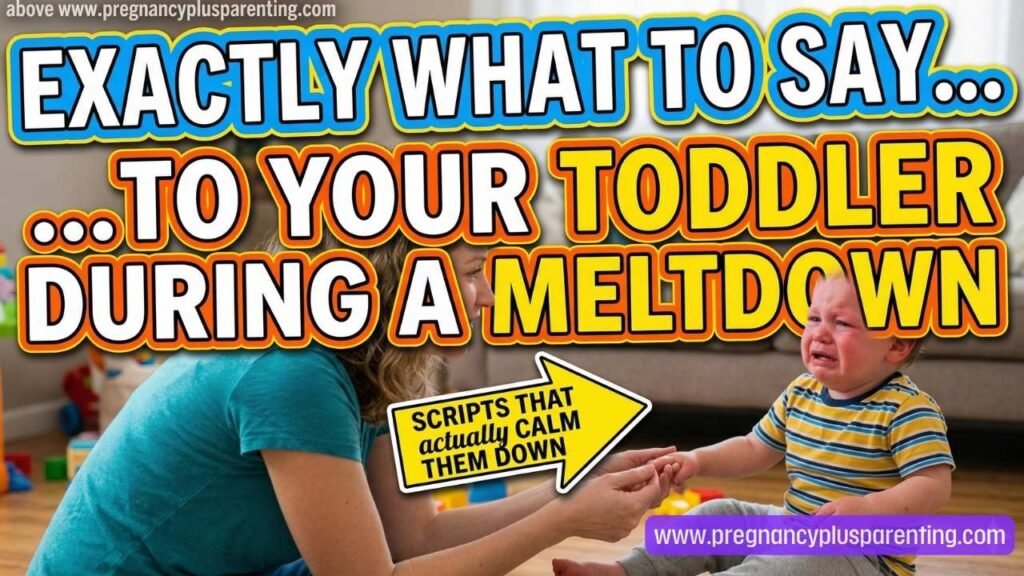
It was a Tuesday afternoon, the kind where everything feels like it’s going fine — and then it isn’t. My toddler wanted the blue cup. I handed her the blue cup. But apparently it was the wrong shade of blue. Within ten seconds, she was on the kitchen floor, her entire body rigid, screaming like I’d handed her a cup full of disappointment in physical form.
I stood there, sleep-deprived, half-eaten toast in hand, genuinely wondering: what am I supposed to say right now?
The early days of my parenting journey were full of instinctive responses I’m not proud of. I’d say things like “Stop it, there’s nothing to cry about” or “You’re fine!” — not out of cruelty, but out of sheer desperation and a complete lack of a script. Nobody gave me the actual words. Nobody sat me down before I became a mother and said, “Here — when your toddler loses their mind over a broken cracker, this is what you say.”
That’s exactly what this article is. Not theory. Not a lecture. The actual words. The scripts I now use, learned through years of reading child psychology, attending parenting workshops, and — more importantly — surviving hundreds of meltdowns in real life with my own kids.
Whether your toddler is 18 months or just turned 4, whether the meltdown is in your living room or a very public supermarket aisle, these phrases have the power to shift the energy of the entire moment. Not because they’re magic. Because they speak directly to what a toddler’s brain actually needs in those hard moments.
Let me show you exactly how.
1. Why the Words You Choose Actually Matter (Neuroscience Made Simple)
Before we get into the scripts, I want to spend a moment on the “why” — because once you understand what’s actually happening inside your toddler’s brain during a meltdown, the right words start to make so much more sense.
Toddlers have a beautifully developed emotional brain — the limbic system — that lights up intensely. What they don’t yet have is a fully developed prefrontal cortex. That’s the part of the brain responsible for logic, reasoning, impulse control, and emotional regulation. Here’s the part that changes everything once you truly hear it: the prefrontal cortex isn’t fully developed until the mid-twenties. Yes, you read that right. The mid-twenties.
This means that when your child is mid-meltdown, they are literally unable to “calm down” on command. Telling them to “stop crying” or “use your words” is asking their brain to do something it biologically cannot do in that moment. The brain is flooded with cortisol and adrenaline. The thinking brain has gone offline. The emotional brain is in full control.
What can actually penetrate that flood? Connection. Your voice, your calm, your specific words — they act as a co-regulating signal to your child’s nervous system. Dr. Dan Siegel, a clinical professor of psychiatry at UCLA, describes this beautifully in his concept of “name it to tame it.” When we accurately label a child’s emotion out loud, it actually helps activate the prefrontal cortex and begins to reduce the emotional flooding.
So when you say “You are SO angry right now” in a warm, matter-of-fact tone — you’re not just being empathetic. You are literally doing neurological work. You are helping your child’s brain do something it cannot yet do on its own.
Research from the University of California found that labeling emotions — what researchers call “affect labeling” — significantly reduces activity in the amygdala, the brain’s alarm center. When you name what your child is feeling, you’re helping their brain regulate from the outside in. That’s not gentle parenting fluff. That’s neuroscience.
And that’s why the words matter.
2. Before You Say a Single Word — The Most Important Step
Here’s something I had to learn the hard way: the most powerful thing you can do in the first ten seconds of a toddler meltdown has nothing to do with words at all.
It’s about getting regulated yourself first.
I remember the first time I consciously paused before responding to my daughter’s meltdown. She’d thrown her entire dinner on the floor and was screaming. My instinct — my whole body — wanted to raise my voice back. Instead, almost as an experiment, I took one long, slow exhale. The kind you do before you blow out birthday candles. Just one breath. Something in the room shifted. She actually looked up at me.
Children are extraordinarily sensitive to the emotional state of their caregivers. If you approach a meltdown tense, frustrated, and speaking in a clipped voice — even if your words are technically correct — your child’s nervous system will pick up on your stress and escalate further. They’re not reading your script. They’re reading your body.
The sequence that works for me every single time:
Step 1: One slow exhale. Don’t inhale dramatically — just let the breath go quietly. This activates your vagus nerve and signals safety to your own nervous system in seconds.
Step 2: Soften your face. Consciously drop your jaw and relax the tension in your forehead. Your child reads your face before they hear your words.
Step 3: Get low. Crouch down, sit on the floor, kneel beside them. Eye level or below is non-threatening and deeply connecting. Towering over a dysregulated toddler increases their fear response.
Step 4: Slow your voice. Lower the pitch, slow the pace. A calm voice is a co-regulating voice. It sends the signal: there is no emergency here.
Step 5: Now speak.
These five steps take maybe eight seconds. They require nothing except intention. But they completely change the interaction that follows — both for your child and for you.
See More : How to Help a Sensitive Child Calm Down Without Losing Your Own Mind
3. The 3 Phases of a Meltdown (and What to Say at Each One)
Not all meltdowns are the same moment. There is an arc to them — a beginning, a peak, and a coming-down. Using the right language at the wrong phase can actually backfire and escalate things further. Here’s how to understand the three phases:
Phase 1 — The Rising Wave: The meltdown is just starting. Your toddler is frustrated, whining, or beginning to cry. The window for connection is still open. This is your most powerful intervention point. The right words here can prevent the full meltdown entirely.
Phase 2 — The Full Storm: Full meltdown. Screaming, throwing, floor-diving, rigid body. The thinking brain is offline. Minimal words work best here — your presence and calm matter far more than anything you say. This is not the time for teaching, explaining, or problem-solving.
Phase 3 — The Clearing: The crying has slowed. Your child is looking for you, reaching for physical contact, their breathing is normalizing. This is reconnection time. This is where the real relationship-building happens.
The biggest mistake most parents make — I made it too, for years — is trying to have a whole conversation during Phase 2. That’s like trying to teach someone to swim while they’re actively drowning. Wait for Phase 3 for any teaching, problem-solving, or explanation. Everything before that is wasted breath and often makes things worse.
4. Phase-by-Phase Scripts That Actually Calm Them Down
Phase 1 Scripts: When the Wave Is Rising
This is your most powerful window. At this stage, the right words can prevent the full meltdown entirely. You’re looking to validate the emotion before the child escalates trying to feel understood.
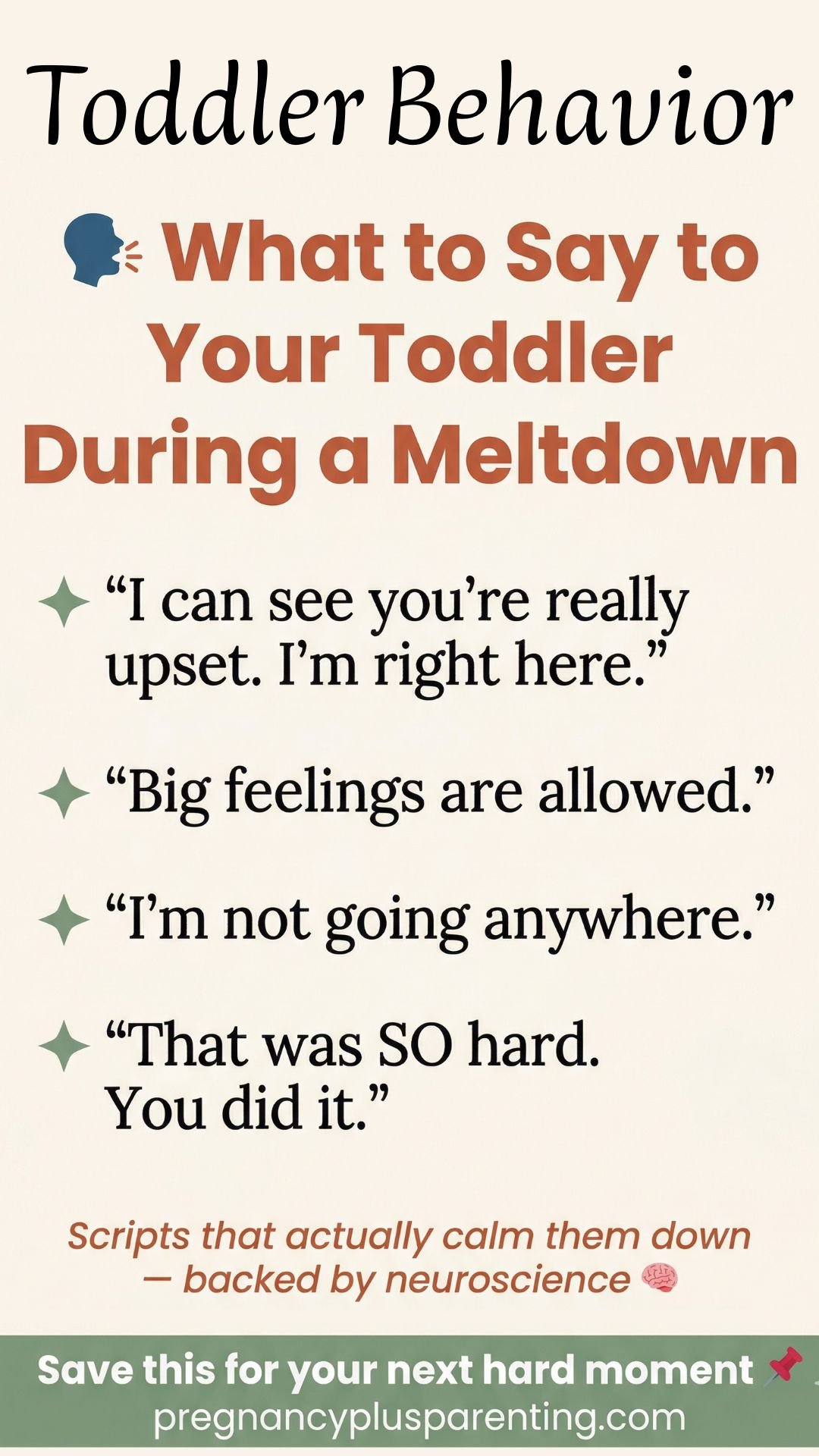
Script — Feeling Seen: “I can see something is really bothering you right now. I’m right here.” Why it works: Acknowledges the emotion without minimizing it. The phrase “I’m right here” is deeply regulating — it signals physical and emotional safety simultaneously.
Script — Name the Feeling: “You really wanted that, and now you can’t have it. That feels so unfair.” Why it works: This mirrors the child’s experience back to them accurately. When children feel genuinely understood, the need to escalate drops significantly. You don’t need to agree with the logic — just acknowledge the feeling.
Script — Simple and Warm: “Oh, sweetheart. You’re feeling really frustrated right now, aren’t you?” Why it works: The soft opening, the accurate emotion label, the question format — all of these invite the child into a co-regulatory loop with you rather than pushing them further into dysregulation.
Script — Physical Invitation: “Do you want to come sit with me for a minute? I’m just going to be right here.” Why it works: Offers physical proximity without forcing it. Toddlers regulate best through co-regulation — the warmth of your calm body is genuinely soothing to their nervous system.
Phase 2 Scripts: In the Full Storm
During peak meltdown, less is more. Your child cannot process complex language. Use short phrases, repeated calmly if needed. Your tone and presence are doing the heavy lifting here — words are just the scaffolding.
Script — The Anchor: “I’m right here. I’m not going anywhere.” Why it works: Short, safe, and reassuring. It answers the deepest toddler fear — “will you leave me alone in this feeling?” — with a clear, steady no.
Script — Naming Without Fixing: “You’re really upset. That’s okay. Big feelings are allowed.” Why it works: Removes the shame many toddlers have been inadvertently taught to attach to strong emotions. Permission to feel is often the thing that begins to end the storm.
Script — Breathe Together: “I’m going to take a slow breath. You can do it with me if you want. [Exhale audibly and slowly.]” Why it works: Co-regulation in action. You are regulating your own nervous system out loud, modeling the skill, and gently inviting — never forcing — your child to join.
Script — When They’re Physical: “I won’t let you hurt yourself or me. I’m going to hold you gently until the big feeling passes.” Why it works: Sets a clear, calm boundary around safety while maintaining warmth. The word “gently” does significant emotional work here. Avoid punitive language during physical expression — the behavior needs a boundary, but the emotion does not.
Important: During Phase 2, avoid asking questions that require reasoning (“Why are you doing this?”), giving ultimatums (“If you don’t stop, we’re leaving”), or lengthy explanations. All of these assume a capacity for rational processing that is simply not available right now. Save them for Phase 3.
Phase 3 Scripts: As the Storm Clears
This phase is golden. Your child is coming back to you — their nervous system is settling, they’re looking for reconnection. This is where you gently rebuild the bridge. Move in slowly, keep your voice soft and warm.
Script — The Reconnection: “Hey, you. You okay? I’m really glad that big feeling is passing. I’m right here.” Why it works: The casual “Hey, you” signals normalcy and warmth — no shame, no lecture. You’re essentially communicating: we both survived that, and I still love you completely.
Script — Offer Physical Comfort: “Would you like a hug? I’ve got lots of those.” Why it works: The question respects bodily autonomy — important even for toddlers. Many children need a moment before they want touch. The lightness of “I’ve got lots of those” signals that the emotional weather has fully cleared.
Script — Gentle Acknowledgment: “That was a really hard feeling, wasn’t it? You felt SO much just then.” Why it works: Validates the experience retroactively, which builds emotional vocabulary and creates the internal narrative: “I had a big feeling and I got through it.” This is the foundation of emotional resilience.
Script — Simple Problem-Solving (Only Now): “I wonder if we can think of something together. What do you think would help next time?” Why it works: Engages the thinking brain collaboratively. “I wonder” is a powerful phrase for toddlers — it’s curious and open rather than instructive. It positions you as partners, not authority figures handing down rules.
5. What NOT to Say During a Toddler Meltdown
I want to be careful here not to make you feel guilty — every parent has said these things. I’ve said every single one of them. But awareness is the first step to change, and understanding why these phrases don’t work makes it easier to reach for something different in the heat of the moment.
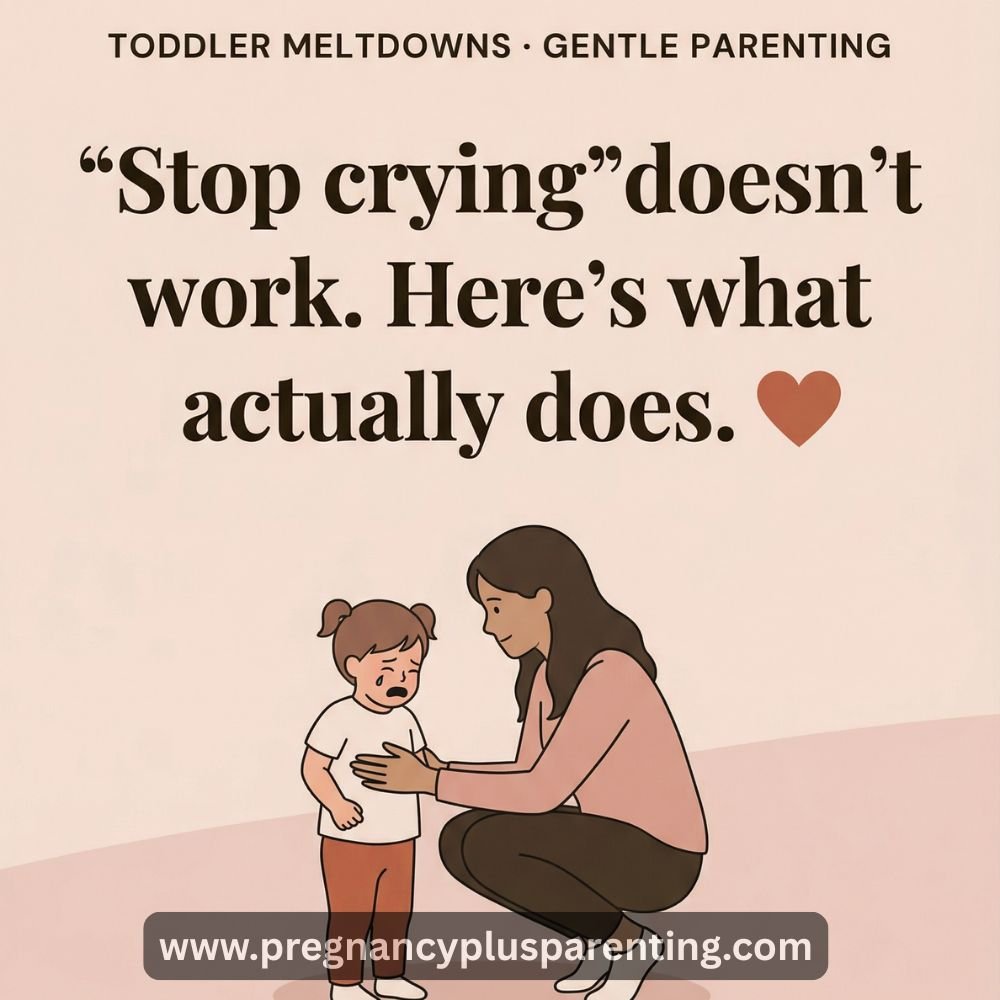
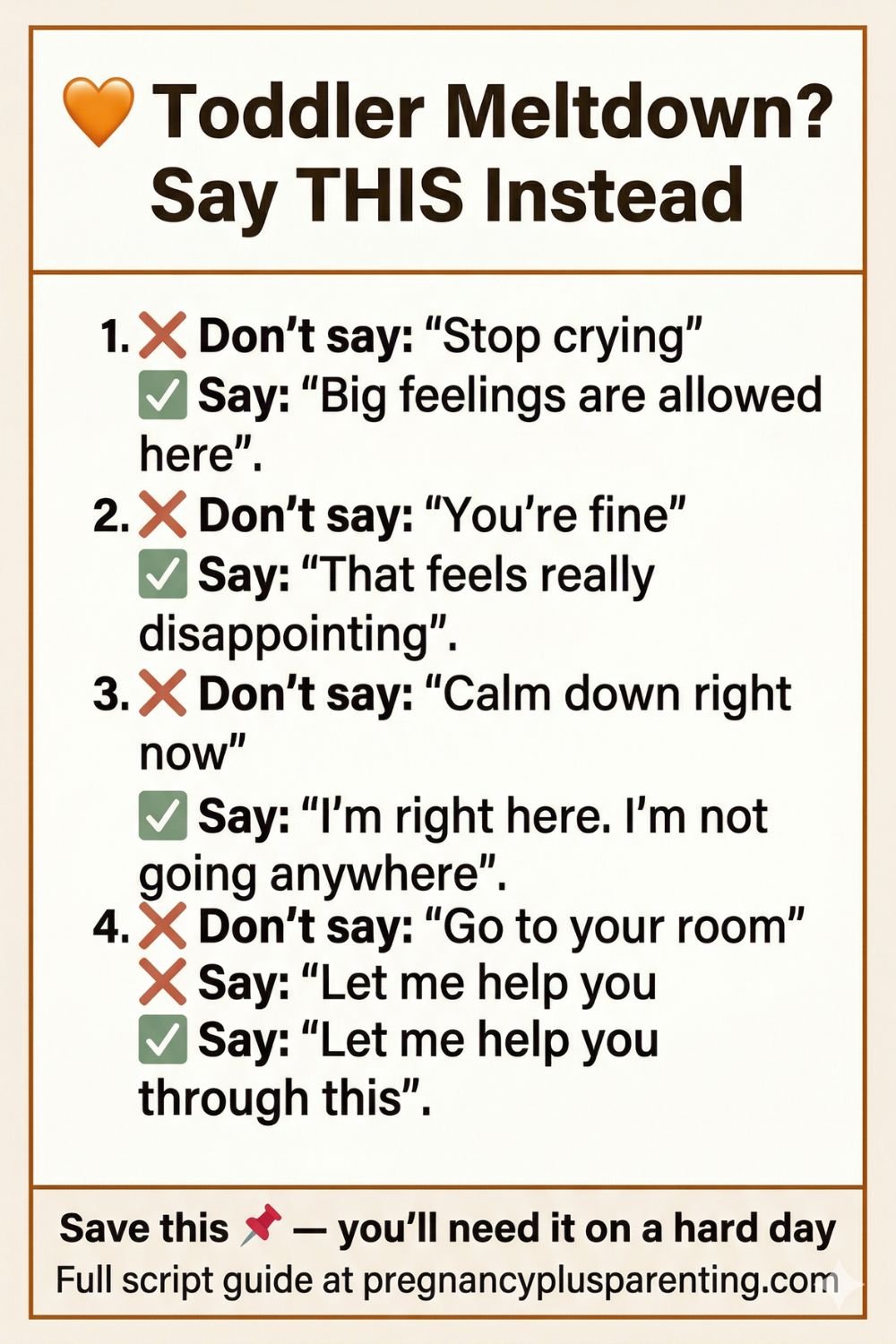
“Stop crying / You’re fine / There’s nothing to cry about” I used to say “You’re fine” approximately forty times a day. It felt reassuring to me. But what it communicates to a toddler is: “Your experience is wrong and invalid.” It doesn’t stop the crying — it just adds confusion and shame to the original feeling.
“If you don’t stop, I’m going to [consequence]” Consequences during a meltdown teach the child to suppress the feeling, not regulate it. We don’t want emotional suppression — that’s where anxiety and explosive behavior come from later. There’s absolutely a time for boundaries and consequences, but the middle of a neurological storm is not that time.
“You’re acting like a baby” Shame is not a regulating emotion. It activates the same threat response as physical danger. Adding shame to an already dysregulated nervous system is pouring fuel on a fire.
“Why are you doing this?” Even if your tone is gentle, this question requires self-awareness and verbal articulation in the exact moment your child is least capable of either. It often provokes more distress.
“Go to your room until you calm down” Isolation during distress teaches children that emotions are something to hide and be alone with. They may comply and appear calmer — but what’s actually happening is emotional shutdown, not regulation. Children co-regulate. They need connection to return to calm, not isolation.
The phrase I had to unlearn most was “You need to calm down right now.” I said it through gritted teeth more times than I can count. I finally understood: I was asking my daughter to do something she literally did not yet have the brain architecture to do independently. The shift to “Let me help you calm down” changed everything about our dynamic.
6. Scripts for Specific Meltdown Situations
Meltdown in Public
Public meltdowns come with an added layer — the social pressure, the stares, the internal panic that arrives alongside the need to stay calm. The key is to act as though there is nobody watching. Because the only person whose response matters in this moment is your child.
Script: “I know you wanted that. I hear you. We’re going to step outside for a moment and I’m going to stay right with you.” Why it works: Validates, acknowledges, and gives a clear calm action. Moving to a quieter space reduces sensory input, which helps the nervous system settle faster. You are guiding without dragging.
Meltdown Over Food (Wrong Plate / Wrong Colour Bowl)
Script: “You really wanted the red bowl. I hear you. That’s so disappointing.” Why it works: To us, the bowl colour is completely absurd. To a toddler, it’s a genuine loss of anticipated experience. Matching their emotional weight — rather than minimizing it — is what creates the felt sense of being understood. And being understood is what ends the storm.
Meltdown at Bedtime
Bedtime meltdowns are often overtiredness combined with separation anxiety. The child is overwhelmed and resisting the vulnerability of sleep.
Script: “Your body is SO tired, and sometimes tired feels really hard and frustrating. I’m going to lie here with you until you feel better. We’ll breathe slowly together.” Why it works: Normalizes the discomfort of overtiredness. Your physical presence at bedtime is itself deeply regulating. The breathing invitation is also a practical sleep-onset strategy.
Meltdown When a Sibling Has Something They Want
Script: “It’s hard to wait. You want a turn too and it feels like forever. I understand that. You will get your turn — I’ll make sure of it.” Why it works: Validates the emotion, acknowledges the distortion of toddler time (everything feels eternal to them), and provides a concrete promise that addresses the underlying fear of being forgotten or treated unfairly.
Meltdown When It’s Time to Leave the Park
Script: “You love it here so much. It’s really hard to go when you’re having so much fun. Five more minutes, and then we’ll say goodbye to the park together.” Why it works: Validates the love of the experience rather than dismissing it. Offering a concrete warning and a ritual of “saying goodbye” to the place gives the child a sense of agency in the transition rather than something being done to them without warning.
Meltdown Because Something Won’t Work (Toy, Puzzle, Game)
Script: “That is SO frustrating! You’ve been working so hard on that. It’s okay to feel frustrated. Do you want help, or do you want to try one more time on your own?” Why it works: Matches their emotional energy, acknowledges their effort, validates the frustration, and gives a choice — which restores the sense of autonomy and control that was lost when the task refused to cooperate.
Meltdown Over Screen Time Ending
Script: “I know. Stopping in the middle of something you love is really hard. That show was so good. I get it. It’s off now and I know that’s disappointing.” Why it works: Doesn’t negotiate (the boundary stays), but also doesn’t dismiss the real disappointment. Saying “I get it” — and meaning it — is often enough to take the edge off.
7. What to Say After the Storm Passes
The conversation you have after the meltdown is over is arguably more important than what you said during it — because now the thinking brain is fully online and your child is genuinely able to absorb and internalize what you share.
The golden rule: wait at least 20–30 minutes before any teaching conversation. The nervous system needs time to fully return to baseline. A reconnection hug or some quiet play together first is ideal.
Script — Building the Story Together: “Earlier you felt really angry. That was such a big feeling. Can you tell me what happened in your tummy when it came?” Why it works: Creates a narrative around the experience, which helps integrate the emotional memory. Asking about physical sensations builds what psychologists call interoceptive awareness — a core emotional intelligence skill that children can begin developing as young as two.
Script — Repair After You Lost Your Patience: “Earlier I got really loud and I don’t think that helped. I’m sorry I did that. I love you even when things are hard, and I’m still learning too.” Why it works: Repair is one of the most powerful things a parent can model. It teaches children that relationships survive rupture, and that apologizing is a sign of strength and love, not weakness. You don’t lose authority when you apologize to your child. You gain their trust.
Script — What Could Help Next Time: “When you feel that big angry feeling coming, what do you think might help? We could jump on the trampoline together, or squeeze something really hard, or you could come and get a hug from me.” Why it works: Builds a personalized emotion regulation toolkit — with the child as the architect. Children are far more likely to use a strategy they helped choose. This is the long-term work of raising emotionally literate human beings.
Over time — and I mean months and years, not days — these conversations become the foundation of your child’s internal voice during hard moments. They begin to hear you inside their own heads: “This is a big feeling. Big feelings are allowed. It will pass.”
That’s the goal. Not perfect behavior. An internal voice that knows how to weather a storm.
8. Quick-Reference Script Cheat Sheet
Save this, screenshot it, stick it on your fridge — wherever you need it most.
To validate:
- “I can see something is really bothering you. I’m right here.”
- “You really wanted that. That’s so disappointing.”
- “That was SO frustrating. I understand.”
To anchor during the storm:
- “I’m right here. I’m not going anywhere.”
- “You’re really upset. That’s okay.”
- “Big feelings are allowed in this house.”
To co-regulate:
- “Let’s breathe together. Watch me — like this. [Slow exhale]”
- “I’m going to stay calm and I’m going to stay with you.”
To reconnect after:
- “Hey, you. I’m so glad that big feeling is passing.”
- “Would you like a hug? I’ve got lots of those.”
- “That feeling came and you got through it. You did it.”
To repair:
- “I’m sorry I got loud. I love you even when things are hard.”
- “I’m still learning too. We can do this together.”
9. Frequently Asked Questions
My toddler doesn’t respond to any of these scripts. What am I doing wrong?
You’re probably not doing anything wrong — you’re just early in the process. These scripts work because they build a relational pattern over time, not because they’re magic words. If your child has been responding to dismissal or raised voices for months, it may take weeks of consistent practice before they start to trust the new approach. Keep going. Also check your body language — your tone and physical positioning matter as much as the words themselves.
What if I’m in public and can’t get down on the floor?
The floor is ideal but not mandatory. What matters most is matching eye level as closely as possible (crouch, bend, squat), using a soft low voice, and not pulling or rushing them. Even in a car park, you can kneel beside them. People watching you handle a meltdown with calm and warmth are honestly far more impressed than you imagine.
My toddler hits during meltdowns. What do I say then?
Set the limit clearly and calmly: “I won’t let you hit me. Hitting hurts.” Then offer an alternative physical outlet: “You can stomp your feet instead” or “You can squeeze this pillow really hard.” Don’t hold it against them afterwards — physical expression in toddlers is almost always impulsive, not intentional. Revisit it gently and briefly in a calm moment later.
Should I give in to what caused the meltdown to stop it?
Occasionally giving in — especially for minor things — is not the catastrophe many parenting voices make it out to be. But as a pattern, it teaches that intense emotion produces results, which makes meltdowns more frequent, not less. The goal is to hold your boundary when it matters while still validating the emotion. The two things can coexist: “I understand you’re upset. I still can’t give you more screen time. I love you and I’m here with you in this.”
How long will it take before meltdowns get less frequent?
With consistent gentle parenting responses, most families see meaningful improvement in meltdown frequency and duration within 6–12 weeks. The real reduction comes as language skills develop — 18 months to 3.5 years is the golden window for emotional vocabulary growth. By age 4–5, children who’ve been raised with emotional acknowledgment typically have significantly better self-regulation than their peers.
I lose my patience every single time. How do I stay calm when I’m exhausted?
You don’t need to be perfect — you need to be good enough, consistently. Most child psychologists agree that getting it right about 30% of the time and repairing the rest is enough to build secure attachment. Your own nervous system regulation is a practice, not a destination. Things that genuinely help: a simple pre-meltdown mantra (“I am safe, my child is safe, this will pass”), adequate sleep whenever possible, shared support from your partner or community, and genuine self-compassion after the hard moments.
A Final Word From One Parent to Another
Here’s what I want you to hold onto: the fact that you’re here, reading this, searching for better words — that already makes you a more attuned parent than you’re giving yourself credit for.
Parenting a toddler is some of the most emotionally demanding work human beings do. The meltdowns aren’t a sign that you’re failing. They’re a sign that your child trusts you enough to fall apart in front of you. They melt down with you because you are their safe place. When a child saves their most explosive feelings for their parent, that’s not a punishment — it’s the highest form of trust.
These scripts aren’t about producing a perfectly behaved child. They’re about building a relationship where your child knows — in their bones, before their language can articulate it — that their emotions are survivable, that you will stay, and that feeling big things is not something to be ashamed of.
That knowledge, built word by word, meltdown by meltdown, repair by repair, is the most powerful emotional inheritance you can give them.
You’ve got this. And on the days you don’t — you repair, and you try again tomorrow. That’s the whole job. And you’re already doing it.
Want more gentle parenting scripts and toddler behavior guides? Read more at pregnancyplusparenting.com