
Introduction: The 2am Google Search That Started This
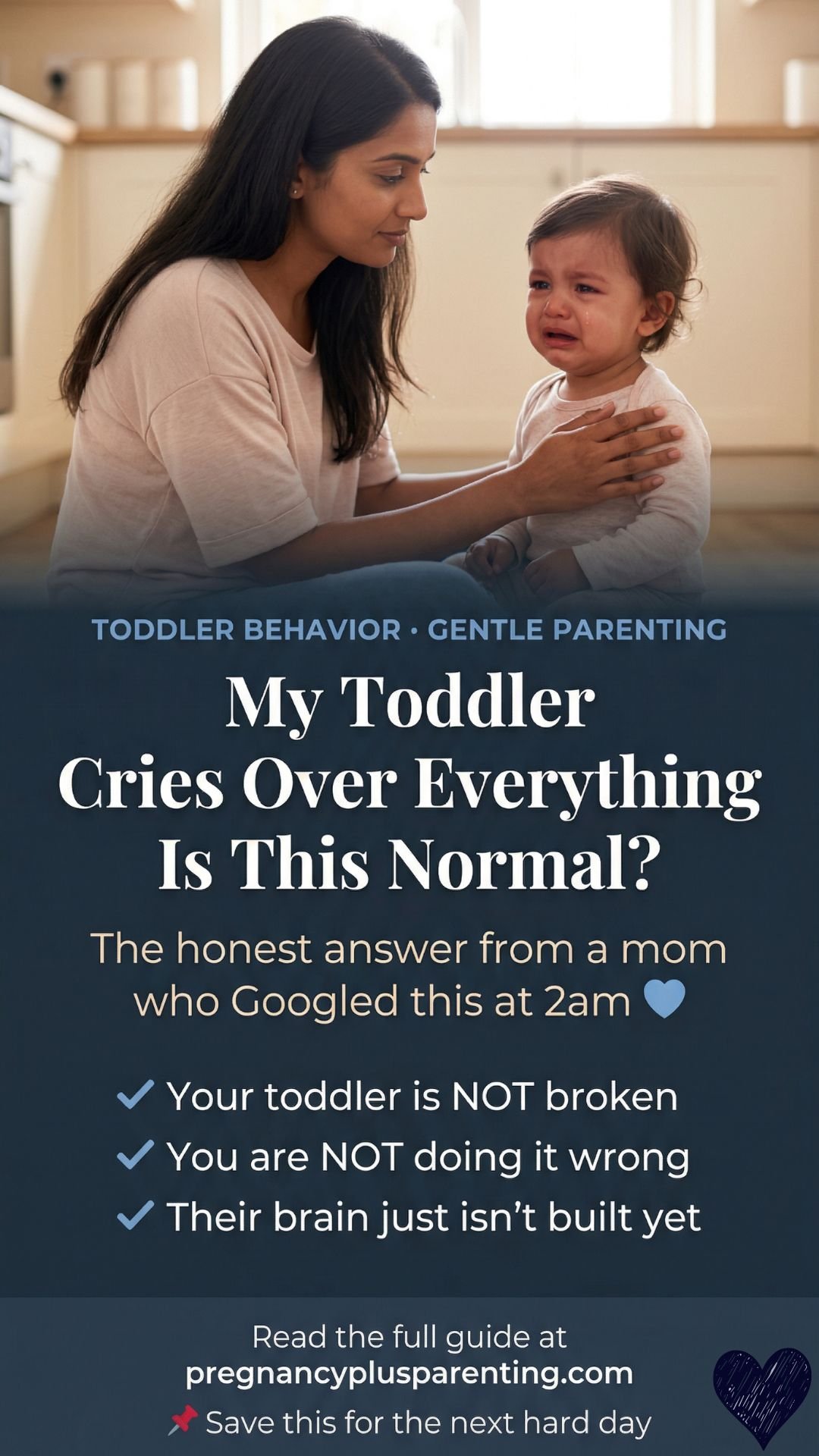
It was a Wednesday night — or more accurately, a Thursday morning. My daughter had cried that day because I cut her toast into triangles when she wanted squares. She cried because her sock felt “bumpy.” She cried because I said good morning to her in the wrong tone. She cried because I turned off the tap too fast. And then, at bath time, she cried because the water was getting cold — after she had refused to get out of it for twenty minutes.
I sat on the bathroom floor after she finally fell asleep, phone in hand, and typed the most tired, desperate search query I have ever entered into Google: “is it normal for toddlers to cry about literally everything.”
The results were a mess. Contradictory advice, articles that scared me with lists of disorders, and a few forums where equally exhausted parents commiserated without any real answers. What I needed — what I couldn’t find — was someone who understood both the science and the reality of being in that bathroom at 2am, wondering if something was wrong with my child or with my parenting.
Years later, having researched this deeply and lived through it with two children, I’m writing the article I needed that night. Here is everything I now know about toddlers who cry over everything — what it means, what it doesn’t mean, when it’s perfectly normal, and when it’s worth a conversation with your doctor.
Let’s start at the beginning.
1. Why Toddlers Cry Over Everything — The Real Reason
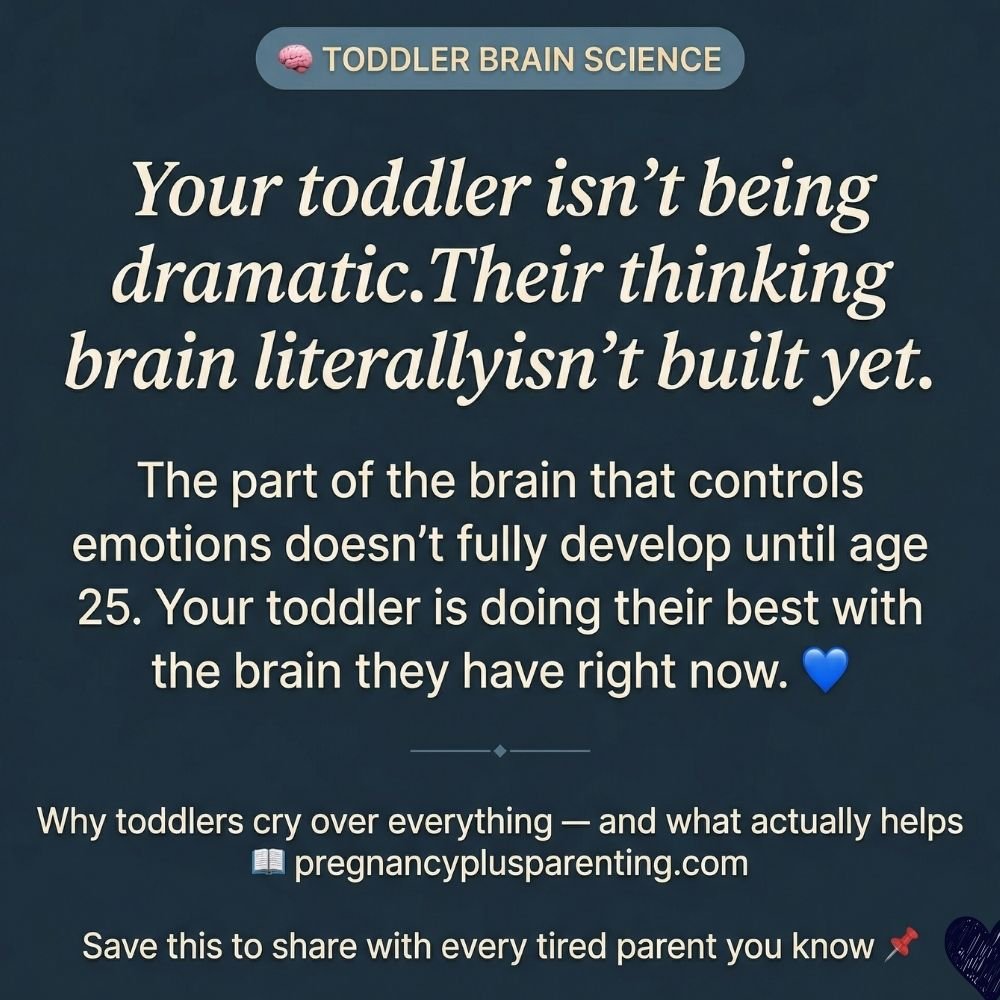
Here is the single most important thing to understand about your toddler’s crying, and it is rooted in brain biology rather than behavior: toddlers cry so much because their brain is literally not built yet to handle emotions any other way.
Let me explain what that actually means.
The human brain develops from the bottom up and from the back to front. The emotional center of the brain — called the limbic system, and specifically the amygdala — is highly active from infancy. It fires intensely, it responds to everything, and it is exceptionally good at detecting threats, discomfort, disappointment, and change. Your toddler’s emotional brain is not just active — it is exquisitely sensitive and operating at full capacity.
What is not yet developed is the prefrontal cortex — the region of the brain directly behind your forehead that is responsible for logic, reasoning, impulse control, delayed gratification, perspective-taking, and emotional regulation. This part of the brain doesn’t fully mature until the mid-twenties. During toddlerhood, it is so underdeveloped that it offers almost no meaningful check on the emotional signals coming from the amygdala.
So when your toddler cries because you broke their banana trying to peel it — that is not irrational behavior. That is a fully functioning emotional brain firing intensely about a genuine disappointment, with zero neurological infrastructure available to regulate, contextualize, or soften that response. The meltdown is not a choice. It is a biological reality.
Add to this the fact that toddlers between the ages of one and four are also:
Language-limited: They are experiencing complex, layered emotions they cannot name or articulate. Crying is often the only available communication tool for feelings they have no words for yet.
World-discovering: Everything is new, surprising, and often overwhelming. Sensory experiences that adults filter automatically hit a toddler’s nervous system raw and completely unfiltered.
Transition-struggling: Moving from one activity to another, one place to another, one person to another — each transition requires emotional flexibility that is simply not yet wired in.
Autonomy-seeking: Between 18 months and 4 years, children are in a critical developmental push for independence. When their will is blocked by physical limitation or adult decision, the gap between what they want and what they can control produces genuine distress.
Chronically tired: Growing at the rate toddlers grow is physically exhausting. Fatigue dramatically reduces the already limited capacity for emotional regulation.
When you put all of this together, the question is not “why does my toddler cry so much?” The real question becomes: given all of this, how does any toddler manage to not cry more?
Studies published in the journal Child Development confirm that emotional dysregulation peaks between 18 months and 3 years, then gradually decreases as language development and prefrontal cortex maturation progress. Frequent toddler crying is not a red flag — it is a developmental milestone marker. The children who appear to cry the most are often those who are the most emotionally aware.
2. What’s Normal at Each Age (18 Months to 4 Years)
Toddler crying is not the same at every age. Understanding the developmental stage your child is in right now helps you calibrate your expectations and your response.
12 to 18 Months What’s happening in the brain: Object permanence is developing, separation anxiety peaks, and the language explosion is just beginning. Typical crying patterns: Cries when caregivers leave the room, when objects are removed or taken away, when needs aren’t immediately understood. What helps most: Physical closeness, predictable routines, and simple words for feelings repeated consistently.
18 to 24 Months What’s happening in the brain: The autonomy drive surges intensely. “No” becomes an entire personality. Frustration with the communication gap intensifies significantly. Typical crying patterns: Frequent meltdowns over control (“I do it!”), intense stranger anxiety, cries at transitions between activities. What helps most: Offering limited choices, validating feelings without giving in, staying physically calm.
2 to 3 Years What’s happening in the brain: Peak of the so-called “terrible twos” — emotional intensity is at its maximum while language is still catching up. Typical crying patterns: Meltdowns can be very long and very physical. Crying over perceived injustice, rigid thinking (“it has to be THIS way”), strong reactions to even minor disappointments. What helps most: Narrating their feelings aloud, connection before correction, consistent gentle limits.
3 to 4 Years What’s happening in the brain: Language accelerates significantly, emotional literacy is beginning to develop, and imaginative fears emerge. Typical crying patterns: Crying may shift from pure frustration to fear-based or fairness-based distress. More verbal expression of unhappiness alongside the tears. What helps most: Emotion coaching, naming feelings with precision, collaborative problem-solving.
4 to 5 Years What’s happening in the brain: The prefrontal cortex is beginning to connect more reliably. Peer relationships become important and influential. Typical crying patterns: Crying decreasing in frequency but may intensify around social situations, school transitions, or perceived failure. What helps most: Validation, problem-solving support, and actively building emotional vocabulary.
Notice that this shows a general arc of improvement with age — but it is not linear. Many children have regression spikes around major life events such as a new sibling, moving house, or starting nursery, as well as during illness or during developmental leaps where a lot of new cognitive wiring is happening simultaneously.
3. The Most Common Crying Triggers (And What They’re Really About)
Parents often describe their toddler as crying “for no reason.” I promise you — there is always a reason. It just may not be the surface-level trigger you can see. Here are the most common real drivers behind those tears:
Hunger: Toddlers’ blood sugar drops fast. A child who was perfectly fine an hour ago can be emotionally unravelling simply because their body needs food. “Hangry” is a real neurological state, and toddlers experience it acutely.
Tiredness: Overtiredness is one of the single biggest amplifiers of toddler emotional sensitivity. A well-rested child handles disappointment. An overtired child dissolves over a shadow falling at the wrong angle.
Overstimulation: Too much noise, too many people, too many transitions in one day. The toddler nervous system has a limited load capacity. When that capacity is exceeded, crying is the release valve that the system reaches for automatically.
Disconnection: Many toddler crying episodes are fundamentally bids for connection — with you specifically. When a child hasn’t had quality one-on-one time with their parent, even small things become emotional triggers that are really saying: I need you.
Loss of Control: Toddlerhood is a fierce push for autonomy in a world that largely doesn’t accommodate it. When a child cannot do something they want to do, or when something doesn’t go according to their mental plan, the helplessness is real and genuinely overwhelming.
Physical Discomfort: Teething, a mild illness brewing, clothing that itches, a tag that scratches, shoes that feel wrong, a temperature that’s slightly off — toddlers cannot always localize or describe physical discomfort. It simply comes out as crying or emotional fragility.
Fear and Anxiety: Especially from age 2.5 onwards, imaginative fears, separation anxiety, and fear of new situations become significant crying triggers that parents sometimes misread as defiance or manipulation.
Transitions: Stopping one activity to start another requires emotional flexibility that toddlers simply don’t have. Even pleasant transitions — like ending screen time to go to a birthday party — can trigger genuine distress.
I used to track the crying pattern for a week and I noticed something striking — almost every single major meltdown happened between 4pm and 6pm. My daughter wasn’t becoming “difficult.” She was tired, her blood sugar was low, and she had been regulating her emotions at nursery all day. By the time she got to me, she was empty. The evenings got dramatically easier once I understood that the 5pm meltdown wasn’t really about the cup, or the snack, or the television. It was about a little body and mind that had simply run out of capacity.
4. Signs It’s Completely Normal
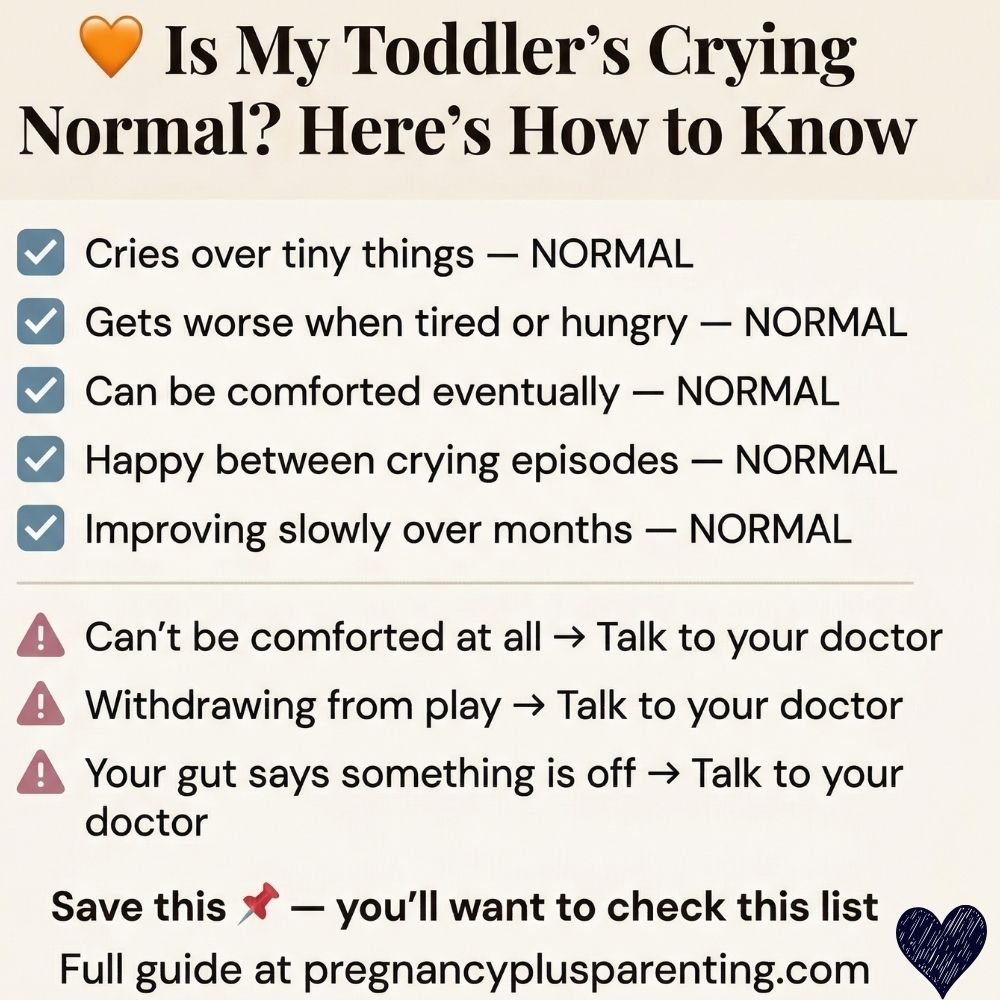
Let me give you something concrete to hold onto. Here are the signs that your toddler’s frequent crying is developmentally normal and nothing to worry about:
The crying has an identifiable trigger — even if that trigger seems completely absurd to you. A wrong-coloured plate is a real disappointment to a toddler. A banana that has broken is a genuine loss. The size of their reaction relative to the size of the event does not indicate a problem.
Your child can be comforted — it may take time, it may take a lot of patience, but eventually they come back to you and accept comfort. The storm passes. They return to connection with you after the episode.
Crying episodes are worse when tired or hungry — this is a hallmark of normal toddler emotional dysregulation rather than an underlying issue. Track the timing for a week and you will almost certainly see a pattern that reveals a practical cause.
Your child is developing normally in other areas — language is growing, they are playing, exploring, eating, and sleeping (even if imperfectly). Social engagement is present and there is no regression across multiple developmental areas.
The crying is improving, even slowly, over months — you may not notice week to week, but over a period of several months there is a general trajectory toward better regulation and fewer meltdowns.
Your child seems happy between crying episodes — they laugh, play, engage, show affection. The distress is episodic, not a constant baseline state that pervades all their waking hours.
Meltdowns are worse around major changes — a new sibling, moving home, starting nursery, illness, or any significant disruption. Regression and increased crying around transitions is completely expected and almost always temporary.
Child psychologist Dr. John Gottman, in his decades of research on emotional intelligence in children, found that the children who expressed emotions most freely in toddlerhood — including crying frequently — often developed the strongest emotional regulation skills by middle childhood. The expression is not the problem. In many cases, it is actually a sign of emotional awareness and depth.
5. Signs You Should Talk to Your Pediatrician
I want to be genuinely honest here — not alarmist, but not dismissive either. The vast majority of toddlers who cry over everything are completely developmentally normal. But there are specific patterns that do warrant a conversation with your child’s doctor. Not because they necessarily indicate something serious, but because early support for whatever is happening is always better than waiting.
Please speak to your pediatrician if you notice any of the following:
Crying that is impossible to interrupt or redirect — if your child’s crying escalates for hours regardless of your response, and no amount of comfort, distraction, or time seems to help at all, this warrants a check-in with your doctor.
Developmental regression alongside increased crying — if your potty-trained toddler starts having accidents again, if a child who was sleeping well suddenly cannot sleep, or if language skills appear to be going backwards alongside a spike in emotional distress, this combination is worth investigating.
Complete withdrawal from play or social interaction — a toddler who stops wanting to play, who shows no interest in other children or in activities they previously loved, combined with persistent crying, is a child who needs support.
Physical symptoms alongside the crying — stomach aches, headaches, disrupted eating, or persistent sleep disruption alongside emotional dysregulation can sometimes indicate anxiety or sensory processing issues that respond very well to early intervention.
Self-harming behavior during meltdowns — head-banging on hard surfaces, scratching themselves, or breath-holding that leads to fainting. Some of these behaviors exist on a spectrum of normal, but any behavior that is injuring your child needs professional assessment.
Crying that has significantly worsened after a specific event — a house move, a bereavement, witnessing something frightening, or any significant change. If emotional dysregulation clearly spiked after a particular event and hasn’t improved after four to six weeks, a pediatrician or child psychologist can genuinely help.
Your parental instinct is telling you something is off — this one is not scientific, but it is real. You know your child. If something feels different to you — not just challenging, but genuinely different to how they were before — trust that instinct enough to have a conversation with a professional.
Seeking pediatric input is not catastrophizing. It is parenting intelligently. A five-minute conversation with your doctor can either reassure you completely or give your child access to support that genuinely changes their developmental trajectory. Either outcome is worth the conversation.
6. Could My Toddler Be Highly Sensitive?
One of the most important pieces of understanding I found during those exhausting toddler years came from the work of Dr. Elaine Aron, a research psychologist who first identified the trait of high sensitivity in the 1990s. Her research suggests that approximately 15 to 20 percent of the population — children and adults alike — have what she calls a Highly Sensitive nervous system. These individuals process sensory and emotional information more deeply and thoroughly than average.
Highly sensitive toddlers are not broken or disordered. They are wired differently — more finely tuned, more aware, more deeply affected by their experiences. The same trait that makes them cry because their sock seam feels wrong is the same trait that makes them notice the color of the light changing at sunset, that makes them deeply empathetic, profoundly creative, and exquisitely attuned to the emotional states of the people around them.
Your toddler may be highly sensitive if:
They are significantly bothered by clothing textures, tags, seams, or the way certain fabrics feel against their skin — to a degree that other children don’t seem to experience.
Loud noises, crowded spaces, or busy environments are genuinely overwhelming and regularly trigger distress rather than excitement.
Food textures, temperatures, or mixed-together foods cause genuine crying and distress rather than simple preference or picky eating.
They notice things other children don’t — subtle changes in a room, a shift in someone’s expression, a different smell, a change in routine that nobody else registered.
They are deeply affected by the emotions of others — upset when other children cry, overwhelmed in emotionally charged environments, unusually aware of tension between adults.
They take significantly longer to settle after stimulating experiences, and need more quiet decompression time than other children their age seem to need.
They are deeply engaged by beauty, art, music, or nature in a way that seems more intense and meaningful than other children their age.
If this sounds like your child — take a breath. A highly sensitive toddler is not a toddler with something wrong with them. They are a toddler who needs parenting that matches their depth. Less over-scheduling, more advance warning before transitions, environments with lower sensory load when possible, and above all, a parent who names and validates what they are feeling rather than asking them to feel less of it.
When I finally read about high sensitivity, I cried. Not because there was something wrong with my daughter — but because for the first time I had a framework that made her make complete sense to me. She wasn’t being dramatic. She wasn’t being manipulative. She was experiencing the world at a volume the rest of us simply couldn’t hear. Once I stopped trying to turn down the volume and started trying to understand it, everything changed between us.
7. What Actually Helps When Your Toddler Cries Over Everything
This is the practical section. Here is what actually works — not in theory, but in real kitchens, real supermarkets, and real 6pm witching hours.
Stop Trying to Stop the Crying
I know this sounds counterintuitive, but the single most effective thing I changed was this: I stopped making it my urgent mission to end the crying as fast as possible. When we treat the crying as the emergency, we unintentionally communicate to our child that their feelings are dangerous or intolerable. The crying isn’t the problem. The feeling underneath it is what needs attending to. When you shift from “how do I stop this” to “how do I help my child through this,” the entire energy of the interaction changes.
Connect Before You Correct
Before any boundary-setting, any explaining, any redirection — connect first. Get low, soften your face, and say something that communicates: I see you, I’m here, and what you’re feeling makes sense to me. This takes ten seconds and it changes the trajectory of the next ten minutes entirely.
Name the Feeling With Precision
Not just “you’re upset.” Try to be specific: “You’re frustrated because that didn’t work the way you wanted.” “You’re disappointed because the playdate ended.” “You’re scared because that sound was really loud and sudden.” Precision in emotion labeling builds your child’s emotional vocabulary and genuinely activates the regulatory regions of the brain — it is doing real neurological work.
Look for the Pattern
Keep a loose mental note — or an actual written note if you are that kind of person — of when the worst crying happens. What time of day? Before meals? After nursery? On days with lots of transitions? The pattern almost always reveals a biological or logistical cause that can be adjusted. Many parents discover that one simple change — moving snack time earlier, adding a twenty-minute quiet time after nursery, reducing activities on certain days — dramatically reduces crying frequency.
Build Emotional Vocabulary Proactively
Don’t wait for meltdowns to talk about feelings. Name emotions in calm, happy moments too. “You look really proud of that tower you built!” “Did that make you feel excited?” “I notice you seem a bit worried about tomorrow — do you want to talk about it?” Over time, children whose feelings are regularly named in everyday moments develop significantly better capacity to communicate emotions verbally rather than only through crying.
Protect Sleep and Blood Sugar Fiercely
These are non-negotiable. An overtired, hungry toddler is a toddler who will cry over everything — not because something is fundamentally wrong, but because their physical state makes emotional regulation biologically impossible. Regular snacks, consistent nap or rest time, and an age-appropriate bedtime are among the highest-return parenting investments you can make for emotional stability.
Create Transition Rituals
Many crying episodes happen at transition points — ending screen time, leaving the park, switching from play to dinner. You can reduce these significantly by building predictable rituals around them. “Five more minutes, and then we will say goodbye to the park together.” “After your bath, we will read two books and then it is sleep time.” Predictability reduces anxiety. Rituals give children a sense of agency and preparation rather than the feeling of things being done to them without warning.
Adding a ten-minute “connection snack” immediately after nursery pickup — just sitting together with a small snack, no screens, no agenda — reduced our afternoon meltdown rate by what felt like seventy percent. The crying was telling me she needed me. When I gave her me before she had to ask, she did not need to ask as urgently or as loudly.
8. What This Does to Parents (And Why That Matters)
I cannot write this article honestly without saying this: a toddler who cries constantly is genuinely hard to parent. It wears you down in ways that are real, physical, and cumulative. The sound of toddler crying activates the stress response in the parent’s brain in measurable ways — your cortisol rises, your patience shortens, your own emotional regulation capacity depletes.
This is not weakness. This is biology. You are not a bad parent because you feel frayed and frazzled. You are a parent responding normally to a genuinely demanding situation.
You cannot regulate your child’s nervous system from a depleted state of your own. When you feel yourself at the edge — the moment where you can feel the frustration rising and your voice wants to sharpen — that is a signal that you need regulation first. Step away briefly if you have a co-parent or a safe situation that allows it. Take a breath. Splash cold water on your face. Text a friend. Come back when you have ten more percent to give.
And please stop holding the moments where you lose patience as evidence that you’re failing. Every parent loses patience. Repair after rupture teaches your child more about healthy relationships than perfect patience ever would. When you come back and say, “I got frustrated and I’m sorry. I love you,” you are modeling the most important relational skill a human being can have.
You are also teaching your child that big feelings are survivable. That the relationship holds even after hard moments. That love is not conditional on behavior. These are the foundational truths that healthy attachment is built on — and you are building them every single day. In the bathroom at 2am. On the kitchen floor. In the supermarket aisle. Every time you stay.
9. Normal vs. Worth Discussing — Quick Reference Summary
Typically Normal:
- Crying over seemingly trivial things
- Worse meltdowns when tired or hungry
- Can eventually be comforted and returns to connection
- Happy and engaged between crying episodes
- Improving slowly over months
- Worse during transitions or major life changes
- Language and development on track overall
- Highly sensitive to sensory input
- Regression during significant life events
Talk to Your Pediatrician:
- Cannot be comforted at all, regardless of response
- Crying episodes lasting many hours every day
- Developmental regression across multiple areas
- Withdrawal from play and social interaction
- Physical symptoms alongside emotional distress
- Self-harming behavior during meltdowns
- Significant worsening after a specific event
- No improvement over several months
- Your parental instinct says something feels different
10. Frequently Asked Questions
Is it normal for toddlers to cry over everything?
Yes — completely and genuinely normal. Toddlers between 1 and 4 years old have a highly active emotional brain and an almost non-existent capacity for independent self-regulation. Frequent, intense crying over things that seem trivial to adults is one of the most universal features of toddlerhood across all cultures and all parenting styles. The volume of your toddler’s feelings is not a sign of a problem. It is a sign of a brain that is exactly at the developmental stage it should be.
Why does my toddler cry for no reason?
There is always a reason — it is just not always visible on the surface. The most common hidden causes of apparently random toddler crying are hunger, tiredness, overstimulation, a need for connection, frustration with the gap between what they want to do and what they can do, physical discomfort, or the cumulative emotional load of a busy or demanding day. When you cannot find the reason, tiredness and a need for connection are always the first two places to look.
My toddler cries at the tiniest things. Am I spoiling them by responding?
No. This is one of the most persistent and damaging myths in parenting culture. Responding to your toddler’s emotional distress does not spoil them or teach them to cry more. Research consistently shows the opposite — children whose emotional experiences are consistently validated by a responsive caregiver develop better emotional regulation, not worse. What builds resilience is not learning to suppress or ignore feelings. It’s learning that feelings are manageable, temporary, and that there is a safe person there when they are hard. You are building that every time you respond.
When will my toddler stop crying over everything?
Most parents notice meaningful improvement between ages 3.5 and 5, as language development accelerates and children gain both the vocabulary to express feelings verbally and more neurological capacity to regulate themselves. The improvement is gradual and non-linear — there will be regression spikes and harder weeks — but the general direction of travel is toward less crying and more words. Children raised with consistent emotional validation tend to make this transition more smoothly and earlier than those who are taught to suppress their feelings.
My toddler cries much more than other children their age. Should I be worried?
Comparing toddlers can be misleading — some children express emotions outwardly and intensely, while others internalize. Neither is inherently better or worse. If your child is meeting developmental milestones, is happy and engaged between crying episodes, can eventually be comforted, and the crying is worst when tired or hungry, then high crying frequency alone is unlikely to indicate an underlying issue. If any of the red-flag signs covered in this article are also present, a pediatric conversation is worthwhile regardless of what other children around you seem to be doing.
Could my toddler’s constant crying be anxiety?
Some toddlers do experience anxiety, and it is worth knowing the signs. Anxiety-driven crying tends to be particularly pronounced around specific situations such as separation, new environments, or unfamiliar people. It often comes with physical symptoms like stomach aches or disrupted sleep and is present even in situations that are not objectively distressing. If the crying is situation-specific and accompanied by worry-type behaviors, it is worth mentioning to your pediatrician. Anxiety in toddlers responds very well to gentle, attachment-focused approaches and in some cases to brief play-based therapeutic support.
I lose my patience every time my toddler cries. Does that make me a bad parent?
Absolutely not. Persistent toddler crying activates a stress response in the adult nervous system that is biological and involuntary. Feeling frustrated, overwhelmed, or depleted by constant crying is a universal parent experience, not a character flaw. What matters is not that you never lose patience, but that you repair when you do. Modeling repair — coming back, apologizing, reconnecting — teaches your child more about emotional health than perfect patience ever could. Be genuinely kind to yourself. You are doing one of the hardest jobs there is.
The Answer to the 2am Question
So — is it normal?
In the vast, overwhelming majority of cases: yes. Completely, genuinely, developmentally normal.
Your toddler is not broken. They are not manipulating you. They are not badly behaved. They are a small human being whose brain is flooded with feelings they cannot yet name, regulate, or manage without your help. The crying is not the problem. The crying is the communication.
And the fact that you are here — reading this, searching for understanding, trying to do better — means you are already giving your child what they need most. Not a parent who never loses patience. Not a parent who always says the perfect thing. A parent who keeps showing up, keeps trying to understand, and keeps choosing connection over control.
That is it. That is the whole answer.
Keep showing up. The crying will ease with time, with language, with development, and with the steady accumulation of experiences that tell your child: my feelings are safe here. My parent stays. Everything is going to be okay.
And on the days when you sit on the bathroom floor at 2am wondering if you’re doing it right — you are. The fact that you’re asking the question is proof enough.
Want more honest, research-backed gentle parenting guides? Read more at pregnancyplusparenting.com