
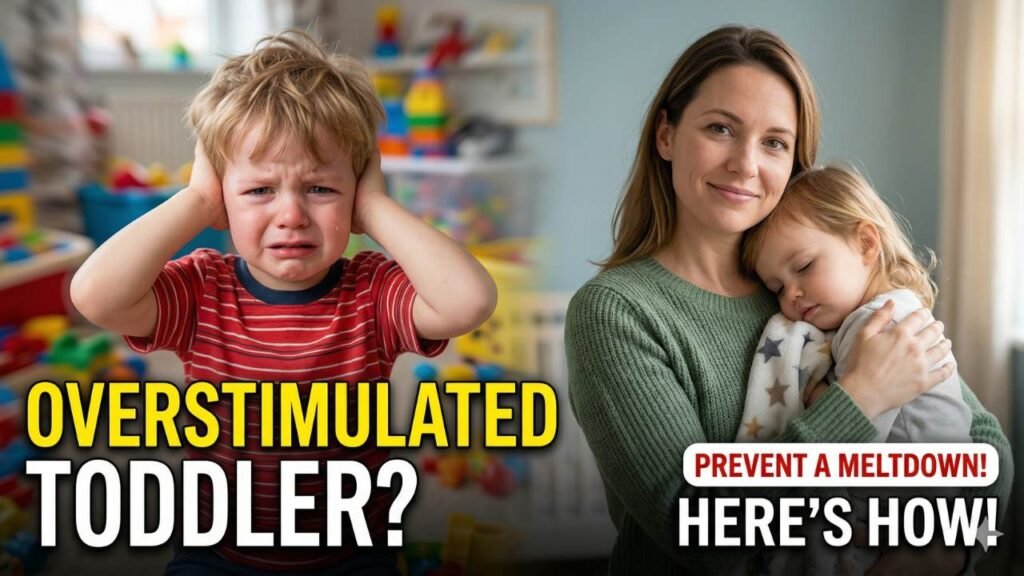

The meltdown didn’t come out of nowhere. Your toddler was telling you for a long time before the screaming started. Here’s how to read those early signals — and what to do the moment you catch them.
She was telling me. I just didn’t know how to listen yet.
This article is everything I’ve learned since — as a parent, an early childhood educator, and someone who has spent a lot of time studying toddler nervous systems. Once you know what to look for, you will start seeing these signals everywhere. And once you can catch them early, meltdowns become dramatically less frequent, less intense, and less mysterious.
What Overstimulation Actually Means for a Toddler’s Brain
Overstimulation happens when the sensory input coming into a child’s nervous system exceeds its current capacity to process it. Sight, sound, touch, movement, social demands — all of it is information. And a toddler’s brain, while miraculous, has a very finite bandwidth.
Unlike adults, toddlers have almost no self-regulatory capacity. The prefrontal cortex — the part of the brain responsible for filtering, moderating, and managing — is in the earliest stages of development and won’t be fully online until their mid-20s. Toddlers have essentially no internal brakes.
When sensory input overwhelms the system, the stress hormone cortisol floods the brain. The child moves from regulated to dysregulated. The tipping point is rarely the thing that seems to cause the meltdown — it’s the cumulative load that built up for the hour or two before it.
The Three-Phase Warning System: Green, Amber, Red
Overstimulation doesn’t arrive without warning — it builds in phases. Once you understand the three stages, you’ll stop reacting to the Red and start intervening at the Amber — or even the Green.
Your toddler is alert, playful, and responsive. Making eye contact, engaging with environment, tolerating transitions reasonably well. This is the window to act proactively — offer quiet breaks before they’re needed.
Subtle behavioral shifts appear. Glazed eyes, reduced eye contact, clinginess, yawning, avoiding interaction, tugging clothes or ears, becoming unusually rigid. This is your intervention window. Act here and you prevent the meltdown entirely.
Screaming, throwing, dropping to floor, hitting, inconsolable crying. Reasoning is impossible at this stage. The only goal now is safety, presence, and waiting for the storm to pass. No words, no logic, no problem-solving.
Early Warning Signs Parents Almost Always Miss
These are the signals in the Amber phase. Subtle. Easy to dismiss. But once you know what you’re looking at, they are impossible to unsee.
The More Obvious Signs (And Why It’s Not Too Late)
These are the Red phase signals — the ones most parents recognize, because they usually come right before or during a full meltdown. If you’re here, you haven’t missed your window entirely — there’s still a brief intervention opportunity at the very start of the Red phase before full dysregulation sets in.
- !Inconsolable crying — not the whimpering of disappointment but the full-body, can’t-catch-breath kind of cry that escalates when you try to comfort them.
- !Physical aggression — hitting, biting, kicking, throwing objects. Not deliberately naughty — the motor cortex is venting what the emotional system can’t hold.
- !Dropping to the floor — the classic toddler floor collapse. The body is shutting down the locomotion systems to prioritize emotional processing.
- !Covering ears or eyes — a last-ditch attempt to reduce incoming sensory load. This is the nervous system physically trying to close the door on more input.
- !Complete rigidity or total limpness — either frozen stiff or going completely limp when you try to pick them up. Both are dysregulation responses, just different ends of the stress spectrum.
- !Screaming without words — language has fully gone offline. The Broca’s area (language center) shuts down during extreme stress. They literally cannot use words right now.
Common Overstimulation Triggers by Age and Environment
Not all toddlers are overstimulated by the same things. But certain environments and situations are reliably high-load for most toddlers. Understanding your specific child’s trigger landscape is the foundation of prevention.
| Age | Common Overstimulation Triggers | Why It Happens |
|---|---|---|
| 12–18 months | Crowded spaces, sudden loud sounds, being passed between multiple adults, schedule disruption | Limited language to express overwhelm; heavily dependent on caregiver proximity for co-regulation |
| 18–24 months | Long outings, too many toys or choices, sibling interaction, transitions without warning | Independence drive is increasing but regulatory ability hasn’t caught up; frustration gap is at its peak |
| 2–3 years | Birthday parties, grocery stores, busy playgrounds, screen time removal, overscheduled days | Social awareness is expanding rapidly; processing social dynamics alongside sensory input is extremely taxing |
| 3–4 years | New environments, performance pressure (show Grandma what you can do), large group settings, hunger + stimulation combined | Imagination and anticipation are now adding cognitive load on top of sensory input — more to process than ever |
What to Do the Moment You Spot the Signs
You’ve caught the Amber signals. The window is open. Here’s exactly what to do — in order.
- 1Reduce input immediately. Move to a quieter space. Lower the lights if you can. Remove as much sensory load as possible within the next 60–90 seconds. This alone can prevent the Red phase.
- 2Get on their level and speak softly. Crouch or kneel. Your large presence looming over them is extra sensory input. Soft voice, slow movements, gentle eye contact — or none if they’re avoiding it.
- 3Offer physical anchor, not words. A hand on the back, a slow hug if they want it, sitting close. Physical co-regulation works faster than language for a flooded nervous system.
- 4Name what you see, not what they should do. “You’re feeling really overwhelmed right now. That’s okay.” Not “calm down” or “there’s nothing to be upset about.” Naming the feeling activates the language-emotion integration circuit and genuinely accelerates regulation.
- 5Make breathing visible. Take a slow, audible breath yourself. Toddlers will biologically match your breathing rhythm over 1–3 minutes. Don’t ask them to breathe — just breathe yourself, visibly.
- 6Offer a sensory anchor if available. A snack, a familiar soft toy, a sip of water, or access to a known comfort item can rapidly reduce arousal. Familiar sensory input signals safety to the primitive brain.
The fastest path through a toddler’s overwhelm is not around it — it’s alongside them, regulated and steady, until they can borrow your calm.
Core principle of co-regulation science
After the Meltdown: How to Help Your Toddler Recover
A meltdown is neurologically exhausting. After the peak passes, your toddler’s body needs time to clear the cortisol and return to baseline. What you do in this window is just as important as what you did during the storm.
- ✓Don’t debrief immediately. The brain is not ready. Quiet closeness — a cuddle, sitting together — without words or processing is what the recovering nervous system needs most.
- ✓Offer water and a light snack. Cortisol depletes glucose. A small snack helps the body stabilize blood sugar and signals that the threat has passed.
- ✓Don’t punish or lecture. A post-meltdown toddler is in a state of neurological recovery. Punishment at this point only adds cortisol back into a system that is trying to clear it — and teaches nothing except that you become threatening when they’re most vulnerable.
- ✓Reconnect warmly. A short, warm reconnection — “I love you so much. That was really hard. You’re okay now” — is the single most important message to deliver when they come back online.
- ✓Rest time after high-stimulation events. If the meltdown followed a party, a long outing, or a busy day — plan for a quiet, low-demand hour before any next activity. Recovery time is not optional.
Designing a Calmer Daily Life: Long-Term Prevention Strategies
Prevention isn’t about bubble-wrapping your toddler’s life. It’s about designing a daily rhythm that keeps the nervous system below the tipping point more consistently — so that when life inevitably gets stimulating, there’s capacity to handle it.
You’re Already a Step Ahead Just by Knowing This
Most meltdowns aren’t inevitable. They’re the result of a nervous system that didn’t get heard early enough. Now that you know what to look for — the glassy eyes, the ear tugging, the sudden clinginess — you have something most parents don’t: an early warning system.
Use it. Trust it. And on the days when you miss the Amber phase entirely and end up on the floor of a birthday party negotiating with a screaming toddler — that’s okay too. That’s parenting. You catch more of them next time.
Your toddler isn’t giving you a hard time. They’re having a hard time. And you’re the safest person they have to have it with.
You’ve got this. 🧡