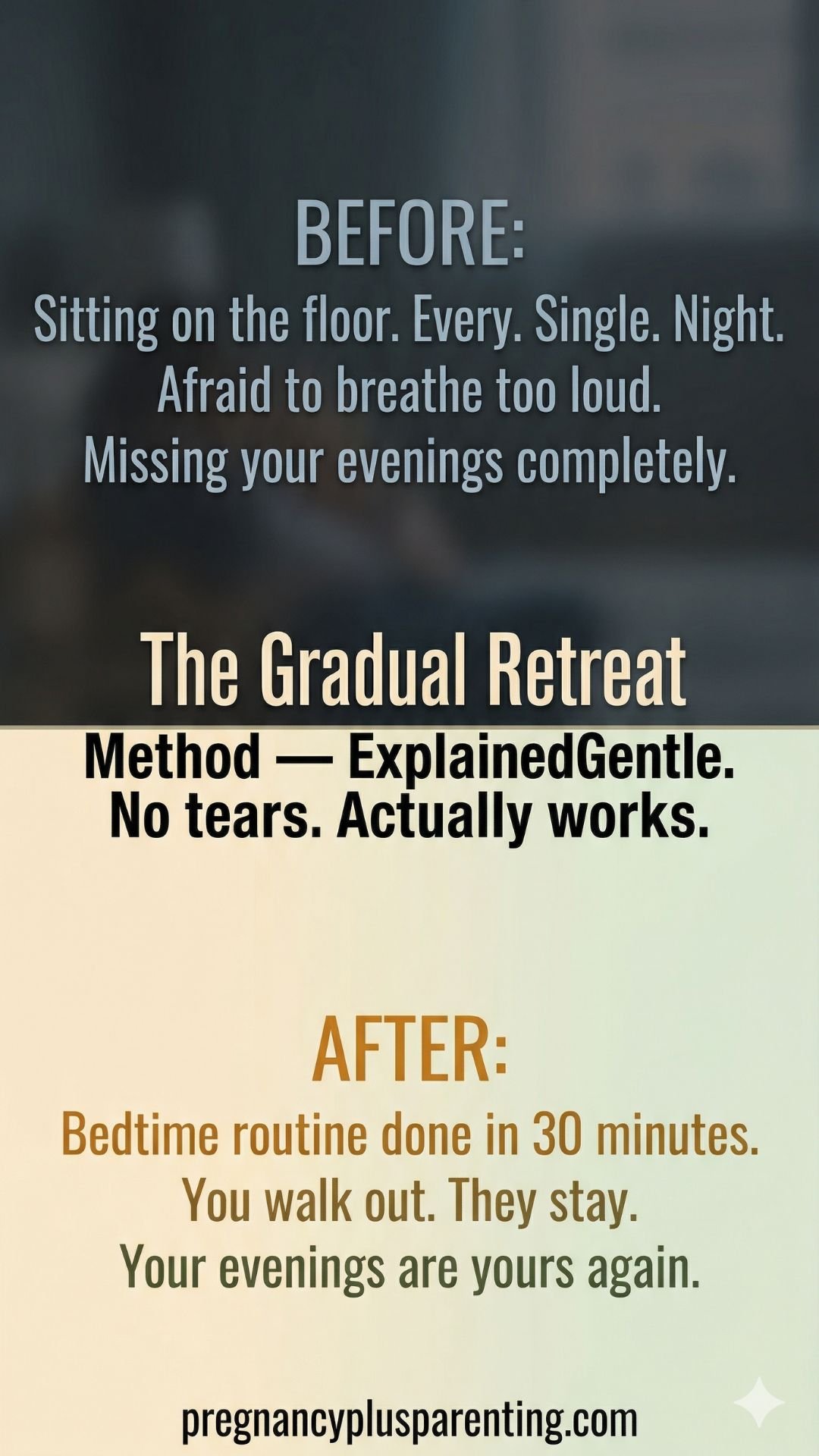


My husband and I hadn’t had a single evening to ourselves in over a year. By the time she was finally asleep and I had crept out of her room like I was defusing a bomb, it was 9:30 at minimum. I was exhausted, resentful in a way that made me feel guilty, and completely at a loss for what to do.
I didn’t want to do cry-it-out. Not because I judged anyone who had — I truly didn’t — but because it didn’t feel right for my daughter’s temperament or for how I wanted to parent. She was sensitive. She needed connection. And I knew that abandoning her to cry alone at night wasn’t something I could follow through with.
But I also knew something had to change.
What followed was about six weeks of intentional, gradual, gentle work — and it changed everything. Not just our nights, but our relationship, my own mental health, and honestly, my daughter’s confidence during the day too.
This article is everything I learned, everything I tried, and everything that actually worked. If your toddler won’t sleep unless you’re in the room, this is for you.
Why Toddlers Develop This Habit in the First Place
Before we talk about how to change anything, I think it helps enormously to understand why this happens. Because when you understand the why, you stop feeling like you’ve done something terribly wrong — and you start making decisions from a place of knowledge rather than guilt.
Toddlers are not biologically wired to sleep alone. For most of human history, children slept near caregivers for warmth, protection, and survival. The expectation that a small child should willingly be placed in a dark room, alone, and drift off to sleep independently is — from an evolutionary standpoint — a very recent and somewhat unusual cultural norm.
This doesn’t mean it’s impossible or wrong to work toward. It just means that when your toddler protests, they are not being manipulative or difficult. They are being entirely, completely human.
How the Habit Builds
Most families arrive at room-dependent sleep gradually and innocently. Maybe your toddler went through a bout of illness and you stayed with them until they fell asleep to help them feel better. Maybe there was a new sibling, a move, a period of heightened separation anxiety. Maybe it was simply easier at the time, and easier became the new normal.
What happened neurologically is this: your toddler learned that sleep is associated with your presence. Your presence became part of their sleep onset — the condition under which their brain learned to let go into sleep. So when that condition is absent, the brain stays alert. It keeps searching for the missing piece. It cannot settle.
This is called a sleep association. And it’s not a character flaw — it’s just a learned pattern. Learned patterns can be unlearned. That’s the good news.
Why It Often Gets More Intense Around Ages 2 to 3
If you’ve noticed that this has gotten significantly harder in the last few months, you’re not imagining it. Around age two, several things happen simultaneously that intensify sleep dependency:
- Toddlers develop a stronger awareness of cause and effect — they know that protesting keeps you in the room
- Imagination expands, bringing new nighttime fears
- Language develops enough to negotiate, delay, and make very compelling arguments for why you need to stay
- Separation anxiety resurges at this age after a period of relative calm
- The drive for autonomy creates internal conflict — they want independence but also desperately want you
All of this is normal. All of it is temporary. And all of it responds to the right approach.
See More : How to Help a Sensitive Child Calm Down Without Losing Your Own Mind
First, Let’s Settle Something: Your Toddler Is Not Spoiled
I need to say this plainly because I heard it too many times from well-meaning people — family members, strangers on forums, even a pediatrician who should have known better.
“You’ve spoiled her.”
“She has you wrapped around her finger.”
“You need to just leave her and let her cry it out.”
None of this is rooted in how child development actually works. A toddler who needs your presence to sleep is not manipulating you. They don’t have the neurological capacity for the kind of calculated manipulation that word implies. What they have is a genuine need for felt security — and they have learned, accurately, that you are the source of that security.
Responding to that need is not spoiling. Responding to that need has built the attachment and trust that will now make it possible for them to gradually, safely learn to extend that security into independent sleep.
You haven’t done anything wrong. You’ve actually done quite a lot right. Now we’re just taking the next step.
What You Need Before You Start
Before you change anything about bedtime, there are a few things worth putting in place. Rushing into sleep changes without these foundations is like trying to build on sand — things shift and crumble quickly.
Alignment With Your Co-Parent
If there are two adults in the home, you both need to be doing the same thing every single night. Inconsistency is the single biggest reason gentle sleep work fails. If one parent does gradual retreat and the other parent stays until the child is fully asleep, your toddler will simply learn to request the parent who stays. Decide on the approach together, talk through the hard moments in advance, and support each other through the weeks ahead.
A Stable Schedule
Overtiredness and schedule inconsistency undermine every sleep strategy. Before you change how you leave the room, make sure your toddler is going to bed at roughly the same time every night — ideally between 7:00 and 8:30 p.m. — and getting adequate total sleep. A child who is already running a sleep debt is much harder to settle independently.
No Big Changes Happening Simultaneously
If you’re in the middle of potty training, starting a new daycare, expecting a new sibling, or dealing with any other major transition — give it a few weeks to settle first. Your toddler can only process so much change at once. Sleep work goes much more smoothly when it is the only new thing on their plate.
Your Own Commitment and Patience
I’m going to be honest with you: the first week is hard. Your toddler will protest. They will cry. They will say things that break your heart (“Don’t go Mama, please don’t go”). You need to have decided — really decided — that you’re going to stay consistent, because the moments when you most want to cave are usually right before the breakthrough.
Step 1 — Build a Bedtime Routine That Does the Work For You
A strong bedtime routine is not just a nice parenting touch. It is a neurological tool. When done consistently, a bedtime routine begins to signal to the brain and body — through a series of predictable cues — that sleep is approaching. Cortisol drops. Melatonin rises. The nervous system shifts from active to receptive.
For a toddler who needs your presence to sleep, the routine is even more important because it becomes a container for connection. You’re giving them a concentrated dose of closeness, warmth, and calm before the separation. Think of it as filling their tank so full that they have enough to carry them through the night.
What a Good Toddler Bedtime Routine Looks Like
The whole routine should take between 30 and 45 minutes. Here is the structure that worked for us and that I’ve seen work for many other families:
Wind-down begins 45 minutes before lights out: Screens off. Lights dimmed. Activity shifts from active play to calm play — puzzles, drawing, building with blocks. No rough-housing, no exciting television, no stimulating games.
Bath (optional but powerful): A warm bath followed by the cooler air of the bedroom creates a natural drop in body temperature that triggers sleepiness. It also provides lovely sensory input that helps sensitive toddlers decompress from the day.
Pajamas and teeth: Make this part of the ritual, not a battle. Let them choose their pajamas from two options. Give them the toothbrush and let them “do it first” before you finish. Autonomy at this stage reduces resistance later.
Into the bedroom: From this point, stay in the bedroom. Keep the lighting dim or use just a nightlight. The message is: we are in sleep space now.
Two books: A set number of books prevents endless negotiation. We always read two. After fourteen months of the same routine, my daughter knew: two books, then song, then sleep. She stopped asking for more because the limit was so predictable it wasn’t worth fighting.
A song or prayer: Something short, consistent, and calm. The same song every night. This became the most powerful sleep cue of all — by the second verse, her eyes were already drooping.
Goodnight ritual: We said goodnight to specific things in the room — her stuffed animals, the moon through the window, the nightlight. This gave her a sense of completion and closure before I left.
The magic of a routine like this is that it puts the sleep cues into the routine itself rather than into your presence. Over time, the routine becomes the sleep association — not you specifically.
Step 2 — Set Up the Sleep Environment Strategically
The physical environment of your toddler’s room does more work than most parents realize. Small changes here can make a meaningful difference in how easily your child settles and how well they stay asleep.
White Noise
A white noise machine is one of the highest-impact, lowest-effort sleep tools available. It serves two purposes: it creates a consistent auditory environment that helps the brain associate sound with sleep, and it masks household sounds that might wake or startle your toddler during the night. We used a fan-sound machine on medium volume placed across the room — not right next to her bed.
Darkness
The brain produces melatonin in response to darkness. Even small amounts of light — from streetlights through curtains, from a hallway light under the door — can suppress melatonin production and make it harder to fall and stay asleep. Blackout curtains made a noticeable difference in our house. If your toddler is afraid of complete darkness, a very dim amber or red nightlight is fine — just keep it dim.
Temperature
A cooler room — around 68 to 72 degrees Fahrenheit — supports deeper, more restorative sleep. Dress your toddler in appropriate layers rather than heating the room.
A Special Sleep Space
If your toddler is in a toddler bed or a floor bed rather than a crib, consider making the sleep space feel special and cozy — their own little nest. Let them help choose a few stuffed animals that “live” on the bed. This builds positive associations with the bed itself rather than with you being present in the room.
Step 3 — The Gradual Retreat Method (What Actually Worked For Us)
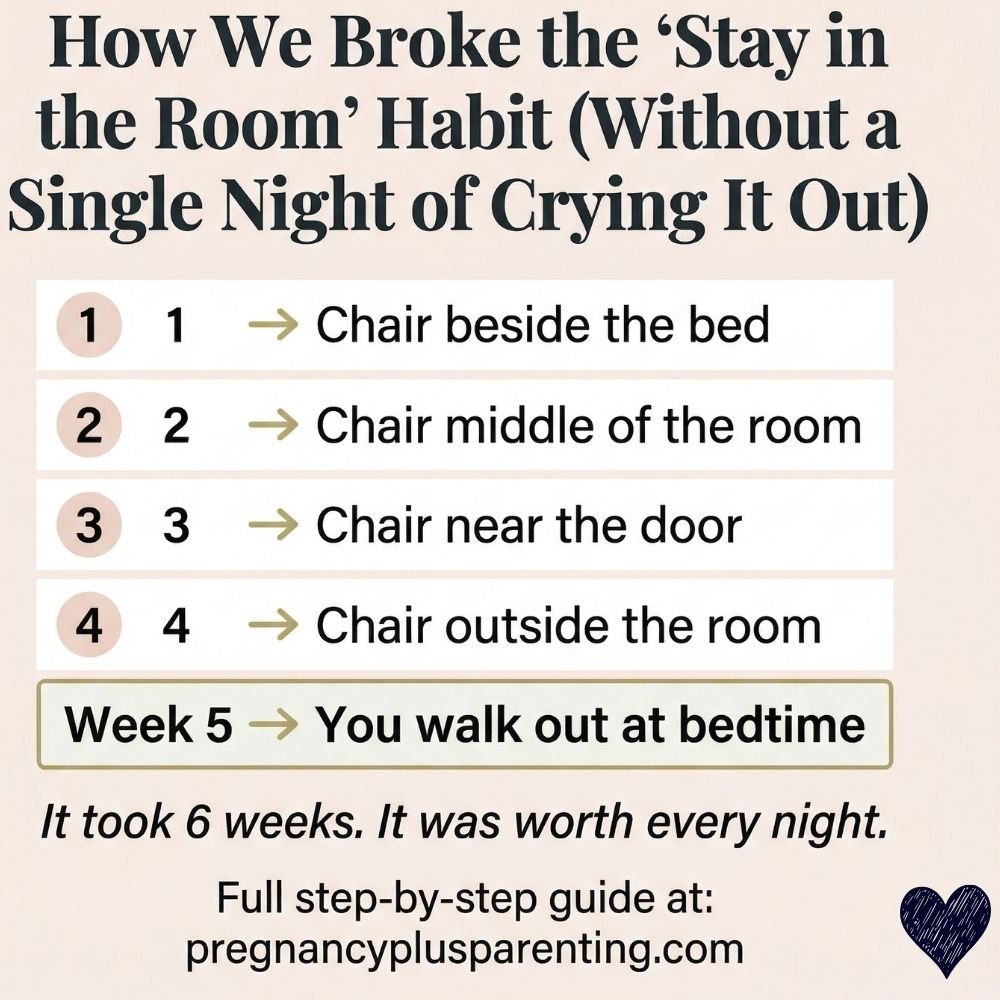
This is the heart of what changed everything in our house. The gradual retreat method — sometimes called the sleep lady shuffle or chair method — is exactly what it sounds like: you slowly, incrementally move yourself out of the room over the course of several weeks, giving your toddler time to adjust to each new position before you move again.
It is slower than cry-it-out. It requires more patience. But it works in a way that preserves your child’s trust and your relationship, and the results tend to be more stable long-term because your child builds genuine comfort with independent sleep rather than simply learning that protest doesn’t bring you back.
How the Gradual Retreat Works
Week 1 — Chair beside the bed: After your bedtime routine, sit in a chair right beside your toddler’s bed. You can pat them, shush them, offer quiet reassurance — but you’re not lying with them, not engaging in conversation, not telling more stories. You’re present but boring. The message is: I’m here, and there’s nothing more happening tonight. Most toddlers take about 15 to 30 minutes to fall asleep this way in the first few nights. Some take longer. Stay consistent.
Week 2 — Chair in the middle of the room: Move the chair to the middle of the room. You’re still visible, still present, but you’re further away. Continue the same quiet, boring presence. Offer verbal reassurance if they call for you (“I’m right here. It’s sleeping time.”) but don’t go back to the bedside unless they are genuinely distressed — and even then, offer brief comfort and return to the chair.
Week 3 — Chair near the door: Move the chair to just inside the doorway. Your toddler can still see you if they look, but you’re at the edge of the room. Continue the same approach.
Week 4 — Chair outside the door: Move just outside the open doorway, still in your toddler’s sightline if they sit up. You’re technically out of the room but still present. Many families find this week the hardest because it feels like a real separation — and your toddler will sense it. Stay consistent. The chair is still there. You are still there.
Week 5 and beyond — Checking in: Now you leave after the bedtime routine with a promise to check back. “I’m going to go do one thing and then I’ll come check on you.” Check back within five minutes the first few nights. Gradually extend the time between check-ins. Eventually, the check-in becomes a formality — they’re asleep before you return.
What to Say During the Process
Your words matter during this. Keep them brief, calm, and consistent. The same phrases every night create predictability, which creates safety. Here are the ones that worked for us:
- “It’s sleeping time. Mama is right here.”
- “Your body is safe. Your room is safe.”
- “I love you so much. Close your eyes.”
- “I’m not going anywhere. It’s time to rest.”
What you want to avoid: long conversations, explanations, negotiations, or new promises (“I’ll stay just five more minutes…”). These teach your toddler that talking is a way to keep you engaged. Brief, warm, and consistent is the goal.
See More : Why Does My 2 Year Old Wake Up Screaming at Night? (Causes and Gentle Fixes)
What About When They Get Out of Bed?
This is the moment most parents find hardest. Your toddler climbs out of bed and comes to you in the chair. What do you do?
Calmly, silently, walk them back to bed. Tuck them in. Say your phrase. Return to the chair. Do this as many times as needed. The key is silence and consistency — no frustration, no long explanations, no giving in. The very consistency of your response teaches them that getting out of bed leads to exactly one outcome: going back to bed.
The first night we did this, I walked her back to bed eleven times. The second night, six. The third night, twice. The fourth night, once. The fifth night, not at all.
Step 4 — Introduce a Comfort Object With Intention
A comfort object — a stuffed animal, a small blanket, a soft toy — can serve as a transitional object between your presence and independent sleep. Child development experts have long recognized the power of these objects: they become associated with safety, warmth, and closeness, and they can genuinely help a toddler feel less alone during the night.
The key is to introduce the object with intention rather than just handing it over and hoping for the best.
How to Make a Comfort Object Feel Special and Safe
- Sleep with it yourself for a few nights — let the stuffed animal carry your scent. This sounds small but it genuinely helps. Your scent is the most powerful regulatory cue your toddler has.
- Give it a name and a role — “This is Biscuit. Biscuit sleeps with you every night and keeps you company.” Children this age have rich imaginative lives — a named, purposeful companion becomes real in the best way.
- Include it in the bedtime routine — say goodnight to Biscuit, tuck Biscuit in, tell Biscuit it’s sleeping time. The object becomes part of the ritual.
- Reference it during the gradual retreat — “Biscuit is right there with you. You’re not alone.”
Not every toddler takes to a comfort object immediately. If yours doesn’t seem interested, try a few different options — texture matters enormously to some children. Some toddlers prefer something with more weight, like a small weighted stuffed animal.
Step 5 — Fill the Connection Tank During the Day
This step is one that most sleep advice completely ignores — and I think it’s one of the most important pieces of the puzzle.
Your toddler’s resistance to sleeping alone is, at its core, about connection. They want you close because you are their safe place, their anchor, the person their nervous system is calibrated to. The way to make it easier for them to let go at night is not to withhold connection — it’s to give so much of it during the day that they go to bed feeling genuinely full.
What Filling the Connection Tank Looks Like
Special time: Even fifteen to twenty minutes of completely undivided, child-led play each day does remarkable things for a toddler’s sense of security. Put your phone down, get on the floor, follow their lead. Let them choose the game. Your full presence during this time is more powerful than an hour of distracted togetherness.
Physical connection: Toddlers regulate through touch. Cuddles, tickles, piggyback rides, dancing together — these physical connection moments fill the tank in a way that words alone cannot.
Transitions with warmth: When you leave them at daycare, when you hand them to another caregiver, when you go from one activity to the next — these transitions go better when handled with warmth and a clear goodbye rather than slipping away. It builds the trust that separation is safe because you always come back.
Acknowledge their feelings about nighttime: During the day — not at bedtime when emotions run hot — talk about the sleep changes. “I know it feels different falling asleep now. You’re learning something new and that can feel hard. I’m so proud of how you’re trying.” Validation during calm moments builds resilience for the harder ones.
Step 6 — Handle Night Wakings Consistently
Getting your toddler to fall asleep independently at bedtime is half the battle. The other half is what happens when they wake in the night — because a child who is learning to fall asleep without you will, at least initially, still wake up and seek you out.
Consistency here is everything. The response you give at 2 a.m. needs to match the message you gave at 7:30 p.m. If you did gradual retreat at bedtime and then brought them into your bed at 2 a.m., you’ve sent two completely different messages about what nighttime looks like — and toddlers will always optimize for the version that involves the most parental proximity.
A Consistent Night Waking Response
When your toddler wakes and calls for you:
- Go to them — don’t leave them to cry
- Offer brief, calm reassurance: “I’m here. It’s still sleeping time. You’re safe.”
- Tuck them back in, hand them their comfort object
- Return to the chair position you’re currently at in the gradual retreat process
- Stay until they’re settled, then leave
Yes, this means getting up at 2 a.m. and sitting in a chair in the dark. It is not fun. But the consistency of it teaches your toddler that nighttime wakings lead to the same outcome as bedtime — brief reassurance, then back to sleep.
Within two to three weeks of consistent responses, most toddlers stop calling out during the night. They wake briefly between sleep cycles, as all humans do, and they resettle on their own because they’ve learned that their room is safe and that sleep is what happens there.
See More : Exactly What to Say to Your Toddler During a Meltdown (Scripts That Actually Calm Them Down)
Step 7 — Dealing With Toddler Stalling Tactics
Oh, the stalling. If you have a verbal two or three-year-old, you already know what I’m talking about.
“I need water.”
“My tummy hurts.”
“I need to tell you something.”
“I love you Mama. Do you love me? How much do you love me?”
“One more hug. Just one more. Okay one more.”
Stalling is developmentally intelligent — your toddler has figured out that certain requests reliably keep you in the room longer. It doesn’t mean they’re manipulative; it means they’re smart and they miss you and they’d rather be with you than alone in the dark.
Here’s how to handle it with warmth but firmness:
Pre-empt the Requests
Build water, a last bathroom trip, and a final hug into the bedtime routine. Make them explicit parts of the ritual: “Okay — last water, last bathroom, and then we’re getting into bed.” When everything has already been done, “I need water” loses its power because you can truthfully say: “You already had your water. It’s sleeping time now.”
The “One More Thing” Rule
Give them one legitimate extra after the routine is complete — one more hug, one more question answered, one more minute. And then: “That was your one more thing. Now it’s sleeping time.” Being generous with the one extra thing makes the limit feel fair rather than harsh.
The Worry Dump
For toddlers who use “I need to tell you something” as a stalling strategy — and many genuinely do have something to process — build a brief “worry time” into the bedtime routine. Before the books: “Is there anything on your mind tonight? Anything you want to tell me?” Let them empty it out. Then: “Okay. You told me everything. Now your brain can rest.” This pre-empts the stalling and also genuinely serves your child’s emotional needs.
What to Do When It Falls Apart
It will fall apart at some point. I want to prepare you for that so it doesn’t feel like failure when it happens.
Your toddler will get sick, and you’ll stay with them because that’s the right thing to do. You’ll travel and routines will go out the window. A new sibling will arrive. There will be a night terror that shakes you both. And after any of these things, the old patterns may resurface.
This is normal. This is not starting over from scratch. This is a temporary regression, and regressions almost always resolve faster the second time because the neural pathways for independent sleep have already been built — they just need to be reactivated.
When things fall apart:
- Go back to wherever you were in the gradual retreat and restart from there — you don’t have to go back to the beginning
- Increase daytime connection if there’s been a stressful event
- Be patient with yourself and with your child
- Remember that one hard night does not undo weeks of good work
I want to be honest: we had a full regression when my daughter got a bad cold at month three of this process. Two weeks of staying with her again. And then two weeks of gradual retreat again. The second time took about five days instead of six weeks. The foundation was there. We just had to rebuild the top floor.
How Long Does This Take?
This is the question I get asked most, and the honest answer is: it depends. But I can give you realistic ranges.
Most families doing consistent gradual retreat see meaningful improvement — toddler falling asleep within 20 to 30 minutes without significant protest — within two to three weeks. Full independence, meaning the parent does the routine and leaves at the end and the child falls asleep without needing any presence at all, typically takes four to eight weeks.
Factors that make it faster:
- Consistent routine already in place
- Both parents doing the same thing every night
- Child is well-rested and on a good schedule going in
- No major life changes happening simultaneously
Factors that make it slower:
- Inconsistency between caregivers
- Illness during the process
- High-sensitivity temperament (takes longer but absolutely gets there)
- Giving in during the hard moments and then restarting
Whatever your timeline, I promise you: the nights on the other side of this work are worth every hard evening you invest. The first night my daughter fell asleep while I was still doing dishes — before I had even come in for the routine — I stood in the hallway and cried. Happy tears. The kind that come from a year and a half of hoping something would change finally, actually, really changing.
A Word on Gentle Parenting and Sleep Independence
One of the things that held me back for a long time was a quiet, nagging fear that wanting my daughter to sleep independently was somehow in conflict with gentle parenting. That wanting my evenings back, wanting privacy with my husband, wanting to stop sitting on a cold floor for an hour every night — meant I was putting my needs above hers in a way that would harm her.
I want to gently push back on that, if you’ve felt the same thing.
Gentle parenting is not the same as sacrificing every need of your own on the altar of your child’s comfort. It is about responding to your child’s genuine needs with warmth, understanding, and connection — while also modeling what it looks like to be a whole person with needs of your own.
Teaching your toddler to sleep independently — gently, gradually, with full emotional support — is not abandoning them. It is giving them a skill. One of the most important skills they’ll ever have. The ability to settle themselves, to feel safe in their own space, to trust that the people who love them are still there even when they can’t be seen — this is the foundation of emotional regulation, resilience, and confidence.
You are not doing this to your child. You are doing this for them. And for yourself. And both of those things matter.
Frequently Asked Questions
My toddler screams and gags when I try to leave the room. Is this normal?
Yes, and it is one of the most distressing things to witness. Some toddlers, particularly those with sensitive temperaments, will escalate dramatically when a new limit is introduced. The gagging is a genuine physical response to emotional distress — it is not intentional manipulation. Stay as calm as you can. If your toddler vomits from crying, clean it up matter-of-factly without a lot of drama or extra attention, resettle them, and continue. Responding calmly and consistently to escalation is what teaches the nervous system that this level of distress is not warranted.
Can I do gradual retreat if my toddler is in a big kid bed and can just get out?
Yes — and this is actually common. Every time they get out of bed, walk them back silently and calmly. No lecture, no frustration, just a quiet return to bed. The consistency of the response is what teaches them that leaving the bed doesn’t change the outcome. Most toddlers stop testing this within a few days once they see it’s not productive.
What if my toddler won’t stay in bed long enough to fall asleep during gradual retreat?
Try moving the chair even closer to the bed in the first few nights — right beside it. Physical proximity gives enough reassurance that they can settle. Once they’re consistently falling asleep with you right there, you have the foundation to begin moving away.
Should I use a toddler clock to help with this?
Absolutely. A toddler clock — the kind that changes color to signal wake time — is a wonderful tool that gives your child a concrete, visual reference for when it’s okay to get up. “When the light is red, it’s sleeping time. When the light turns green, you can come find Mama.” This works especially well for early morning wakings.
My partner thinks we should just do cry-it-out. How do I get on the same page?
The most important thing is that you both choose a method you can both implement consistently. Share what you’ve read about gradual retreat — the research supporting it is strong, and the outcomes are comparable to more abrupt methods in terms of sleep quality, with better outcomes in terms of parental relationship stress and child emotional wellbeing. If your partner is willing to try the gradual method for four weeks with full consistency, that’s usually enough time to see results that make the case for itself.
Is it okay to lie down with my toddler for part of the routine?
If lying down together is part of your intentional routine — reading books, having quiet time — that’s completely fine. The key is to not let it become the means by which they fall asleep. Lie together for the books, then sit up and move to the chair before they’re fully asleep. The goal is for them to cross the threshold into sleep without you lying beside them, so that when they wake in the night, the absence of your body doesn’t startle them into full wakefulness.
How do I handle naps during this process?
Apply the same gradual retreat to naps, but know that naps typically take longer to shift than nighttime sleep. Nighttime has more biological sleep pressure working in your favor. If nap independence takes two or three weeks longer than nighttime independence, that is completely normal.
Final Thoughts — From One Tired Parent to Another
If you’ve read this far, you are clearly someone who cares deeply — about your child, about doing this well, about finding a path that honors the relationship you’ve built.
The fact that your toddler wants you in the room is not a problem. It is evidence of a secure, loving attachment. The work you’re doing now is not undoing that — it is the next expression of it. You are loving your child well enough to help them grow into something new.
It will be hard some nights. There will be evenings where you sit on that chair and feel every fiber of yourself wanting to just give in and lie down with them. And sometimes, on a really hard night, you will. That’s okay. That’s human. Forgive yourself and start again the next night.
But on the other side of those weeks — on the evening when you finish the routine and walk out of the room and hear nothing but quiet — you will feel something you haven’t felt in a long time.
You’ll feel like yourself again.
And your toddler, tucked in with their comfort object, white noise humming softly, will be sleeping peacefully. Independently. Safely. With every bit of love and security you built still wrapped around them.
You’ve got this. I really believe that.