


plain crackers, dry cereal, banana, and the occasional piece of cheese
if the moon was in the right phase and he was feeling particularly
generous toward me.
Everything else — and I mean everything — was pushed away with a
force that suggested I had personally offended him by placing it on
his tray. Vegetables? Absolute betrayal. Meat? Don’t even think about
it. Pasta, which he had eaten happily for months? Suddenly
unacceptable, for reasons known only to him.
I tried everything I could think of. I cut food into fun shapes. I
made faces out of vegetables on his plate. I hid spinach in smoothies.
I offered rewards. I bargained. I pleaded. I once spent forty-five
minutes making homemade nuggets shaped like dinosaurs, and he looked
at them, looked at me, and pushed the entire plate off the table.
I remember sitting across from him one evening watching him
methodically eat crackers and thinking: is this it? Is this just what
he eats now? Is he going to be eighteen years old and still surviving
on Ritz and bananas?
The answer, thankfully, was no. But getting from that table to where
we are now took a complete shift in how I thought about feeding — and
it had almost nothing to do with the food itself.
If your two-year-old will only eat crackers — or one or two other
“safe” foods — and refuses everything else, this article is going to
explain exactly why that’s happening, why your instincts to push and
encourage and hide vegetables are probably making it worse, and what
actually works instead.
See Also : Exactly What to Say to Your Toddler During a Meltdown (Scripts That Actually Calm Them Down)
Why Crackers Specifically? The Science Behind
Food Jags
Before we talk about what to do, I think it helps enormously to
understand why crackers in particular become the food of choice for so
many toddlers. Because it’s not random, and it’s not just stubbornness.
There’s genuine developmental logic behind it.
Crackers Are Predictable
This is the single most important thing to understand about toddler
food preferences: toddlers are not choosing food based on flavor. They
are choosing food based on predictability. A cracker looks the same
every time. It smells the same every time. It feels the same in the
mouth every time. There are no surprises.
For a toddler whose entire world is full of unpredictability — who
is still figuring out object permanence, cause and effect, social
relationships, and approximately ten thousand other developmental
tasks simultaneously — a food that is completely, reliably consistent
is genuinely comforting.
Crackers Are Sensory-Friendly
Most crackers share a specific sensory profile that many toddlers
find highly acceptable: dry, crunchy, neutral in flavor, no surprising
textures, dissolves predictably in the mouth. Compare this to, say,
broccoli — variable texture, strong smell, slightly bitter flavor,
unexpected squeaky sensation against teeth — and you begin to
understand why one is embraced and one is launched across the kitchen.
Toddlers are in a period of heightened sensory sensitivity. Their
taste buds are more numerous and more sensitive than they will be in
adulthood. What tastes mildly bitter to you may taste intensely bitter
to them. What has a subtle smell for you may be overwhelming to them.
Their nervous systems are not overreacting — they are accurately
reporting a genuinely more intense sensory experience.
What Is a Food Jag?
When a toddler becomes fixated on one or two foods and refuses
everything else, feeding specialists call this a food jag. Food jags
are completely normal in toddlerhood and typically resolve on their
own — provided parents don’t respond in ways that accidentally cement
the behavior further.
A food jag is essentially your toddler’s nervous system saying:
this food is safe, I know this food, I want this food. It is a
self-protective response, not a personality defect. And the more
anxiety and pressure that surrounds mealtimes, the more intensely a
child will cling to their safe foods.
Toddler Food Neophobia — The Real Reason They
Refuse New Foods
There is an actual clinical term for what your two-year-old is
doing. It’s called food neophobia — literally, fear of new foods. And
it peaks between the ages of two and six, which means your toddler is
right in the thick of it developmentally.
Here’s something fascinating that I learned when I was deep in my
research phase of this: food neophobia is believed to have an
evolutionary basis. When children become mobile — around the time they
start walking — they can suddenly access foods that might be toxic or
dangerous. The biological response is to become suspicious of
unfamiliar foods. To default to the known. To refuse anything new
until proven safe.
This means your two-year-old’s refusal of new foods is not
irrational. It is ancient and intelligent. Their brain is doing
exactly what brains evolved to do. The context has changed — you are
not foraging in a forest, and the broccoli is not poisonous — but the
response is the same.
How Many Exposures Does It Take?
This is where the research really opened my eyes. Studies on toddler
food acceptance consistently show that a child may need between ten and
fifteen exposures to a new food before accepting it. Some research
suggests the number can be even higher — up to twenty or thirty
exposures for highly neophobic children.
Think about that for a moment. If you offered broccoli once, your
toddler refused it, and you concluded they don’t like broccoli — you
were working from about one thirtieth of the data you actually needed.
Exposure, in this context, doesn’t even mean eating. It means
seeing the food on the table. Being in the same room as it. Watching
someone else eat it. Touching it. Smelling it. These all count as
exposures that move your toddler incrementally toward acceptance.
First, Let’s Reframe What’s Actually Happening
I spent months thinking of my son as a picky eater. I said it
constantly — “He’s such a picky eater” — and I watched how that label
followed him into conversations, into playdates, into the pediatrician’s
office. And then a feeding therapist said something to me that I’ve
never forgotten:
“When we call a toddler a picky eater, we make it part of their
identity. And children live up to their identities.”
She was right. Every time I introduced him at a playdate with
“He’s really picky,” I was reinforcing a story about who he was. Every
time I pre-emptively made him something separate from what the family
was eating, I was confirming the story. Every time I sighed or
expressed worry at the table, I was adding another chapter.
What he actually was, was a developmentally normal two-year-old
going through a completely expected phase of food neophobia, in a
feeding environment that had unfortunately become loaded with anxiety
and pressure. The solution wasn’t a new recipe or a better hiding
technique. The solution was changing the entire emotional climate
around food.
See Also : Why Does My 2 Year Old Wake Up Screaming at Night? (Causes and Gentle Fixes)
5 Things Most Parents Do That Make Picky Eating
Worse
I did all five of these. I’m not sharing them to induce guilt — I’m
sharing them because recognizing them is what allowed me to stop doing
them. And stopping them was genuinely more important than anything I
started doing.
1. Pressuring Them to Eat
“Just try one bite.” “You have to eat three more peas before you
can leave the table.” “You’ll eat what I made or you won’t eat at
all.” These are all forms of pressure, and the research on pressure
and toddler eating is consistent and clear: it backfires. Children
who are pressured to eat show more food refusal, more mealtime anxiety,
and a stronger aversion to the pressured food over time. Pressure
activates the fight-or-flight response — and a child in fight-or-flight
cannot engage openly with new food.
2. Short-Order Cooking
When your toddler refuses what’s on the table and you immediately
make them something you know they’ll eat, you’ve taught them something
very efficient: if I refuse this food, a better food will appear. You
have accidentally created a very logical system — from their
perspective — for always getting crackers.
This doesn’t mean you should leave them hungry. There’s a middle
path here, and I’ll explain it shortly. But the full short-order cook
approach — a completely separate meal made on demand — reinforces
food refusal reliably and repeatedly.
3. Hiding Vegetables
I know. We’ve all done it. The spinach smoothie, the cauliflower
mashed into the potato, the zucchini grated into the muffin. And I’m
not saying never do this — getting nutrition into your toddler in any
form has value. But relying on it as your primary strategy has a
significant downside: it teaches your toddler nothing about vegetables.
They never learn to see them, smell them, touch them, tolerate them.
The exposures that would build familiarity and acceptance never happen.
And when the hiding is eventually discovered — toddlers figure this
out — it can damage trust around food.
4. Making Mealtimes Emotionally Charged
Worry is contagious. If you sit down at every meal with an undercurrent
of anxiety about whether your toddler will eat, they feel it. If you
watch their mouth with laser focus waiting to see if they’ll try
something, they feel that too. Toddlers are extraordinarily attuned
to parental emotional states, and a mealtime that feels tense and
watchful creates an environment where relaxed exploration of new food
is simply not possible.
5. Giving Up After One or Two Refusals
If you offered peas three times over three weeks, got three
rejections, and concluded your toddler doesn’t like peas — remember
the research. You were at three exposures out of a potential thirty.
Giving up too early means the repeated exposure that would eventually
build familiarity and acceptance never happens.
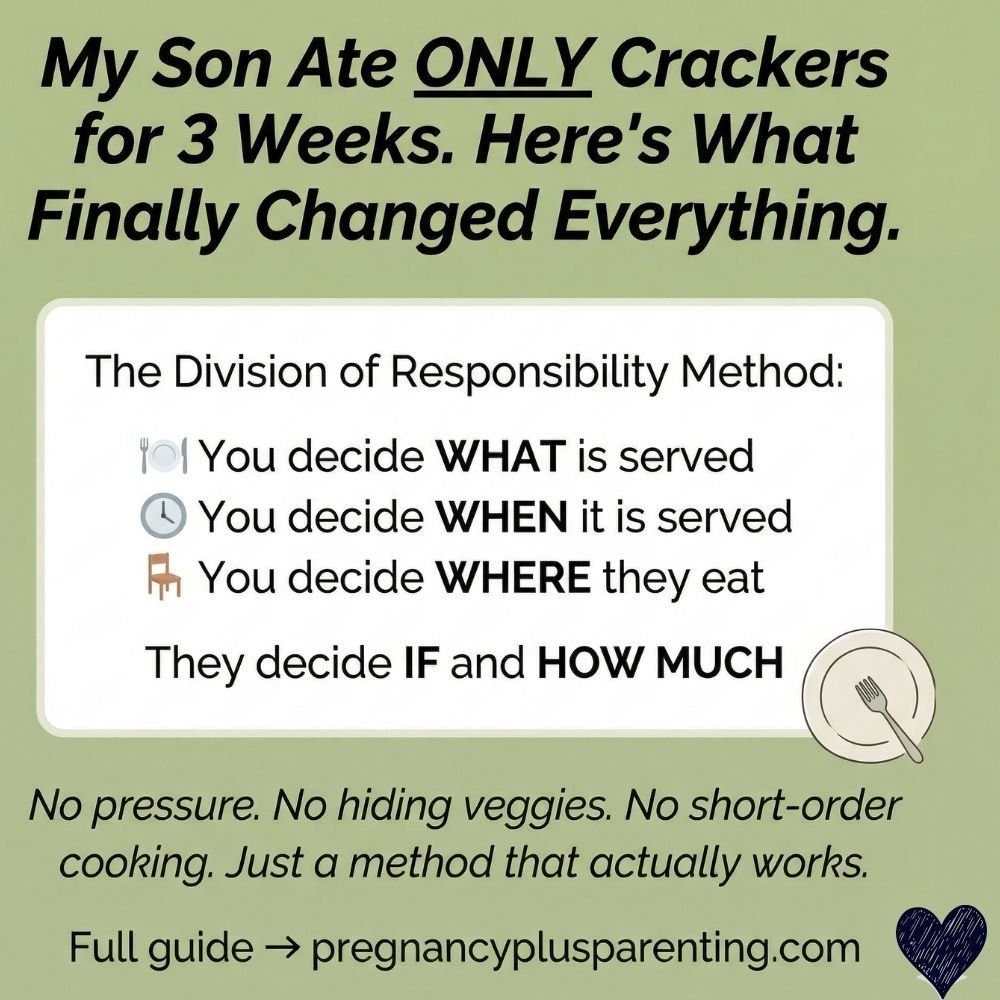
The Division of Responsibility — The Framework
That Changed Everything
The single most transformative thing I learned during our picky
eating journey was a framework developed by registered dietitian Ellyn
Satter called the Division of Responsibility in Feeding. It is
deceptively simple, and it works.
The framework divides the job of feeding between parent and child
based on who is actually equipped to do each part.
The Parent’s Job:
- What food is offered
- When food is offered
- Where food is eaten
The Child’s Job:
- Whether to eat
- How much to eat
That’s it. That’s the whole framework. And it sounds simple until
you realize how much of typical toddler feeding crosses these lines —
parents trying to control how much their child eats, or children
dictating what gets served and when.
When I started applying this — truly applying it, not just
intellectually agreeing with it — the change at our table was almost
immediate. Not in what my son ate, but in the emotional climate of
mealtimes. When I stopped trying to control his eating, I stopped
being anxious. When I stopped being anxious, mealtimes stopped feeling
like a battlefield. And when mealtimes stopped feeling like a
battlefield, he started — slowly, incrementally — becoming more
relaxed and more curious about food.
What This Looks Like in Practice
You decide the menu. You offer a balanced meal with
at least one thing you’re reasonably confident your toddler will eat —
this is their bridge food, their safe harbor. But you don’t make a
completely separate meal. You serve what the family is eating, with
one familiar element on the plate.
They decide whether and how much to eat. If they
eat only the crackers on their plate, that’s their choice. You don’t
comment. You don’t praise. You don’t cajole. You eat your own meal and
have a pleasant conversation that has nothing to do with food.
No short-order cooking, but no forced eating. They
don’t get a different meal. But they also don’t get lectured. If they
leave the table having eaten nothing, they leave. The next scheduled
snack or meal will come, and they’ll have another opportunity.
The first time I did this, I watched my son eat only crackers and
ignore everything else on his plate, and I said nothing. It was one of
the hardest things I’d done as a parent. Every instinct told me to
encourage, to negotiate, to plead. I ate my dinner and talked about
something completely unrelated to food. He watched me. And at the very
end, just before he asked to get down, he picked up a single piece of
roasted carrot, looked at it, put it down, and then picked it up again
and held it in his hand for a full minute before setting it carefully
back on his tray.
He didn’t eat it. But he touched it. And that was his first step.
See Also : Toddler Won’t Sleep Unless You’re in the Room? Here’s How We Broke That Habit Gently
The Power of Repeated Exposure Without Pressure
Once I understood the exposure research, I changed my entire
approach to introducing food. Instead of trying to get my son to eat
new foods, I focused entirely on just getting new foods near him —
on his tray, on his plate, on the table — consistently and without
any agenda attached.
The Steps of Food Exposure
Feeding therapists often describe food learning as a hierarchy —
a series of steps that a child moves through on their way to actually
eating a new food. Understanding this hierarchy changes your definition
of progress completely:
- Food is in the room — child tolerates its presence
- Food is on the table near them — child doesn’t
protest - Food is on their tray or plate — child tolerates
it being there - Child looks at the food with interest
- Child touches the food
- Child smells the food
- Child brings the food to their lips
- Child tastes the food without swallowing
- Child swallows the food
- Child accepts the food regularly
When I reoriented around this hierarchy, every single step became
something worth quietly celebrating inside myself — not out loud,
because praise creates performance pressure — but inwardly. When my
son touched a piece of cucumber for the first time, I did not make a
big deal of it. I registered it privately as: we moved up a step. We
are closer. This is working.
Practical Ways to Increase Exposure Without Pressure
- Food play during non-meal times: Let your toddler
help wash vegetables, tear lettuce, squeeze lemons. When food is
associated with play rather than eating, the anxiety drops and
curiosity rises. - Serve new foods alongside safe foods: Always
include at least one food you know your toddler will eat. The new
food is there for exposure — not for eating. There’s no pressure
attached to it. - Keep portions tiny: A small pile of something
new is less overwhelming than a large portion. One piece of broccoli
on the edge of the tray is very different from a bowl of broccoli
placed in front of them. - Never comment on whether they eat the new food:
No “You didn’t even try it.” No “Good job touching it!” Keep your
face and voice completely neutral about the new food. Your toddler
is watching your reactions closely. - Let them see you eating it: You are the most
powerful food model in your toddler’s life. Eat the vegetables. Eat
them with genuine enjoyment. Don’t perform enjoyment — toddlers see
through that — but eat them calmly and with pleasure.

Why Eating Together Is More Powerful Than Any
Strategy
If there is one single change I would recommend above all others,
it’s this: eat together as a family as often as you possibly can,
eating the same food.
The research on family meals and toddler food acceptance is
remarkable. Children who regularly eat with adults who are eating a
variety of foods show significantly greater food acceptance over time
than children who eat separately or who watch adults eating different
food.
This works for several reasons. First, toddlers learn what is safe
to eat by watching trusted adults eat it without any negative
consequences. If Mama eats broccoli every day and continues to be
healthy and present and happy, the toddler brain slowly updates its
risk assessment of broccoli downward.
Second, shared meals create a social context for food. Eating
together is a connecting, bonding activity. When food is part of
connection rather than conflict, a toddler’s emotional association
with food shifts.
Third — and this is the one that surprised me most — when toddlers
are not the focus of mealtime attention, they relax. When the adults
are talking to each other, when there is conversation and laughter
happening that has nothing to do with whether the two-year-old is
eating his peas, the two-year-old often — quietly, without fanfare —
starts eating the peas.
We had this happen so many times in our house that it became almost
funny. The evenings I was most distracted — when my husband and I were
genuinely absorbed in conversation — were consistently the evenings
my son ate the most adventurously. The evenings I was focused on
watching him eat were the evenings he ate only crackers.
When It Might Be More Than Picky Eating — Sensory
Processing
For most toddlers, selective eating is a normal developmental phase
that responds to the approaches described in this article. But for
some children, food refusal goes deeper — rooted in sensory processing
differences that make certain textures, smells, or appearances of food
genuinely overwhelming rather than just unfamiliar.
It’s worth knowing the signs that might indicate something more than
typical toddler pickiness:
Signs That May Indicate Sensory-Based Feeding Difficulties
- Your toddler accepts fewer than twenty foods total and the list
is shrinking rather than staying stable or growing - Food refusal is based almost entirely on texture rather than
flavor — for example, they’ll eat pureed carrot but absolutely
cannot tolerate any solid piece of carrot - They gag frequently on foods that other toddlers manage without
difficulty - Mealtimes regularly end in complete meltdowns rather than just
refusal - They show strong reactions to food smells — leaving the room,
covering their nose, becoming distressed - The selectivity is affecting their growth — they’re consistently
falling off their growth curve - They have other sensory sensitivities beyond food — strong
reactions to clothing textures, sounds, touch
If several of these resonate, it doesn’t mean something is terribly
wrong. It means your child may benefit from working with a pediatric
feeding therapist — an occupational therapist or speech-language
pathologist who specializes in feeding — who can assess what’s
happening and provide targeted support. This is not a failure of
parenting. It is recognizing that some children need more specialized
help, and getting that help early makes an enormous difference.
See Also : Why Does My 2 Year Old Have Meltdowns for No Reason? (What’s Really Happening in Their Brain)
Practical Steps to Gently Expand Your
Toddler’s Diet
Now that we’ve laid the foundation of understanding, here are the
concrete, practical things you can do starting today. These are not
tricks or hacks. They are consistent, research-aligned practices that
work over time.
Step 1 — Establish a Predictable Meal and Snack Schedule
Toddlers who graze all day — who can access crackers or milk or
snacks whenever they want — are rarely hungry at mealtimes. And a
toddler who isn’t hungry has very little motivation to try anything
new. Structure the day into three meals and two planned snacks, with
nothing in between except water. This builds genuine appetite, which
is the greatest sauce of all.
Step 2 — Always Include a Safe Food at Every Meal
This is the bridge between where you are and where you’re going. At
every meal, make sure there is at least one thing on the plate that
your toddler will reliably eat. This might be crackers. That’s fine.
The cracker is the safe harbor that makes the rest of the plate
explorable rather than threatening. Knowing the cracker is there
allows their nervous system to relax enough to be curious about
what else is on the plate.
Step 3 — Offer New Foods Alongside Familiar Ones Repeatedly
Pick three or four new foods you’d like to introduce over the next
month. Put a tiny portion of one of them on the tray alongside the
familiar foods at every meal. Don’t comment on it. Don’t encourage
engagement with it. Just keep putting it there. Week after week. Let
the exposure work in the background.
Step 4 — Involve Them in Food Preparation
Toddlers who help prepare food are dramatically more willing to try
it. This doesn’t have to be complicated — washing vegetables in the
sink, tearing lettuce, stirring, pouring, placing items on a baking
sheet. The act of handling food in a low-pressure context builds
familiarity that transfers to the table.
My son’s first real breakthrough with vegetables came from growing
cherry tomatoes on our balcony. He watered the plant, watched the
tomatoes grow, picked them himself — and then ate them. The same
tomatoes served on his plate at dinner had been refused for months.
The difference was ownership and context.
Step 5 — Take Them Food Shopping
The grocery store or market is an underrated food exposure
opportunity. Let your toddler hold the apple, smell the herbs, choose
between two types of fruit. Naming foods, seeing them in their whole
form, having positive sensory interactions with them in a context
completely removed from the pressure of eating — all of this builds
the familiarity that eventually leads to acceptance.
Step 6 — Read Food-Positive Books Together
Books about food, eating, and trying new things can gently shift a
toddler’s relationship with unfamiliar foods. When they see a character
they love eating a vegetable, or a story that normalizes trying new
things, it works on their attitude at a narrative level. There are
wonderful picture books specifically designed around food exploration
for this age group — make them part of your regular reading rotation.
Step 7 — Never Comment on What They Eat or Don’t Eat
This one is hard. It goes against every parenting instinct. But
the goal is to make food neutral — not a source of praise, not a
source of anxiety, not a topic of conversation at the table. When
you stop commenting, mealtimes decompress. And decompressed mealtimes
are where food exploration actually happens.
Cracker-Adjacent Foods to Bridge the Gap
One practical strategy I found genuinely useful was working within
my son’s existing preferences to find foods that shared the sensory
profile he liked — dry, crunchy, mild, predictable — but offered more
nutritional variety. These cracker-adjacent foods became stepping
stones toward a wider diet.
Foods That Share the Cracker Sensory Profile
- Rice cakes — same crunch, same neutral flavor,
similar texture. Can be topped with thin smears of different foods
over time. - Breadsticks — dry, crunchy, hand-held. Often
accepted by toddlers who like crackers. - Dry toast cut into strips — familiar texture,
different shape. Toast soldiers are widely loved by the cracker crowd. - Plain corn tortilla chips — crunchy, mild,
slightly different flavor profile that introduces variety while
staying in the comfort zone. - Puffed rice cereal — light, crunchy, very
neutral. Often accepted even by highly selective eaters. - Freeze-dried fruits — this was our gateway to
fruit. Freeze-dried strawberry has the same light, crunchy texture
as a cracker but introduces both a new flavor and genuine nutrition.
My son went from freeze-dried strawberry to fresh strawberry over
about six weeks. - Thin corn cakes — similar texture and hand feel
to crackers, naturally gluten-free if that’s relevant for your child. - Pretzel sticks — crunchy, hand-held, slightly
salty. Often a natural bridge food for the cracker-loving toddler.
The strategy with these bridge foods is not to sneak them in or
switch them without your toddler noticing. It’s to offer them
alongside the familiar cracker, no pressure attached, repeatedly. The
familiarity of the profile makes them less threatening. Over time,
the repertoire quietly expands.
How to Make Sure Your Toddler Is Getting Enough
Nutrition
One of the things that made this whole phase harder was the constant
background anxiety about nutrition. Was he getting enough iron? Enough
protein? Enough calories? Every pediatrician visit felt like a
potential judgment on what I was or wasn’t feeding him.
Here’s what I learned — and what genuinely helped me relax enough
to implement the pressure-free approach:
Toddlers Have Small Stomachs and High Caloric Efficiency
A two-year-old’s stomach is roughly the size of their fist. They do
not need adult-sized portions of anything. The amount of food that
looks pitifully small to you may be exactly the right amount for their
body. Pediatric nutritionists often reassure parents by reminding them
to look at what the child eats across a week rather than at any single
meal or day.
Nutritional Safety Nets for the Selective Toddler
Whole milk or fortified plant milk: If your toddler
is still drinking milk, this provides significant calories, fat,
protein, calcium, and often vitamin D. Most two-year-olds drinking
16 to 24 ounces of whole milk daily are getting meaningful nutritional
coverage even if their solid food intake is limited.
A toddler multivitamin: Ask your pediatrician about
a daily multivitamin formulated for toddlers. This removes the
nutritional anxiety from mealtimes and allows you to implement the
pressure-free approach without worrying that every refused vegetable
is a crisis.
Smoothies: While I cautioned against hiding
vegetables as a primary strategy, smoothies are genuinely useful as a
nutritional supplement — not a replacement for exposure at meals. A
smoothie that includes spinach, fruit, yogurt, and milk can provide
significant nutrition. Just don’t call it a vegetable smoothie or make
a point of what’s in it.
Nut butters: If your toddler tolerates them, nut
butters are calorie-dense, protein-rich, and often accepted by
selective eaters — especially on crackers. A cracker with peanut
butter or almond butter is actually a reasonably nutritious snack.
Cheese and dairy: Many selective toddlers accept
cheese when they reject most other proteins. Cheese provides protein,
fat, and calcium. It counts. It matters. If your toddler eats cheese
every day, that is genuinely nutritious, not just a concession.
When to Genuinely Worry About Nutrition
You should discuss nutrition concerns with your pediatrician if:
- Your toddler is dropping weight or consistently falling off their
growth curve - They are so selective that fewer than fifteen to twenty foods are
accepted and the list is shrinking - They are showing signs of specific deficiency — extreme fatigue,
pallor, hair loss, delayed development - They are refusing liquids as well as solids
For most toddlers in a food jag or a typical picky eating phase,
nutrition is less compromised than it looks. Their bodies are remarkably
efficient at this age, and the emotional health of the feeding
relationship matters at least as much as the nutritional content of
any single meal.
When to Talk to Your Pediatrician or a Feeding
Therapist
Most toddler pickiness — including the cracker-only phase — is
completely within the range of normal development and responds over
time to the approaches described in this article. But there are
situations that warrant professional support, and I want to be clear
about what those look like so you have a genuine framework rather than
vague reassurance.
Talk to Your Pediatrician If:
- Your toddler’s weight is declining or they have dropped
significantly on the growth chart - They gag or vomit frequently during meals
- They are refusing liquids or showing signs of dehydration
- You have implemented a pressure-free approach consistently for
two to three months with no improvement whatsoever - Your gut tells you something is genuinely wrong
Consider a Pediatric Feeding Therapist If:
- Accepted foods number fewer than fifteen to twenty and the list
is actively shrinking - Mealtimes regularly end in complete behavioral shutdown or
extreme distress - Your toddler is only accepting one specific texture across all
foods — only purees, or only crunchy, with absolute rejection of
anything in between - There is a history of reflux, tongue tie, or any medical issue
that may have affected feeding in infancy - Your toddler is also showing significant sensory sensitivities
in other areas — clothing, sounds, touch — alongside food selectivity
A pediatric feeding therapist — usually an occupational therapist
or speech-language pathologist specializing in feeding — can assess
the oral-motor mechanics of your child’s eating, identify any sensory
processing contributions, and provide a targeted intervention plan.
Early support, if it’s needed, produces much better outcomes than
waiting and hoping.
The Day Everything Shifted
I want to end with a story rather than a checklist, because I think
stories are what we actually remember.
About four months into implementing the Division of Responsibility
and genuinely — not performatively — letting go of control around food,
we had a Sunday lunch. I had made soup. Not a child-friendly soup, not
a hidden-vegetable soup — just a real vegetable and lentil soup that
I wanted to eat. I put a bowl of it on the table, I put crackers in a
small bowl beside it, and I sat down and started eating and talking
to my husband about something completely unrelated to our son or his
eating.
About five minutes in, I noticed my son dip a cracker into the soup.
Then he licked the soup off the cracker. Then he dipped it again. Then
— and I had to look away so I wouldn’t react — he lifted the spoon
from his bowl, and he took a sip of the soup directly.
He ate half a bowl of lentil soup that day. Soup with five
vegetables in it. He ate it because nobody was watching, nobody was
encouraging, nobody had made it into a moment. It was just lunch.
That is what this approach looks like when it works. Not a dramatic
breakthrough. Not a moment where your child suddenly loves vegetables.
Just a quiet afternoon where the crackers led to the soup, and the
soup turned out to be okay, and nobody made it into a bigger deal than
it was.
Those quiet moments are how toddlers learn to eat. They need your
steady, patient, low-pressure presence to get there. You can do this.
And they will get there.
Frequently Asked Questions
Is it normal for a 2-year-old to only want to eat crackers?
Yes, this is within the range of completely normal toddler behavior.
Food jags — fixations on one or two safe foods — peak between ages two
and three and are driven by food neophobia, sensory preferences, and
the toddler’s drive for predictability and control. With a
pressure-free approach and consistent exposure, most children naturally
expand their diets over time.
How long does toddler picky eating last?
Food neophobia typically peaks between ages two and six and gradually
decreases as the child’s nervous system matures and their food
experiences expand. Many children who were highly selective at two and
three are much more adventurous eaters by ages five to seven. The
feeding environment during this period matters enormously —
pressure-free, repeated exposure approaches shorten the duration and
severity.
Should I let my toddler go to bed hungry if they refuse dinner?
The Division of Responsibility says yes — if they chose not to eat
at dinner, the next opportunity is breakfast. However, many families
find a middle path: a small, neutral bedtime snack (crackers and milk,
for example) that is available to everyone regardless of dinner
consumption. This prevents the genuine hunger that disrupts sleep
without becoming a short-order cooking situation.
How do I handle grandparents or family members who push food on
my toddler?
This is genuinely one of the harder social aspects of this approach.
Have a calm, private conversation with extended family members
explaining that you’re working with your toddler on food and that
commenting on what they eat — positively or negatively — is something
you’re deliberately avoiding. Most grandparents, when they understand
the reasoning, are willing to support the approach even if they find
it counterintuitive.
My toddler used to eat everything and now eats nothing. What
happened?
This is incredibly common and has a name: the twelve-to-eighteen
month feeding shift. Many babies who were enthusiastic and adventurous
eaters suddenly become highly selective around their first to second
birthday. This coincides exactly with the onset of food neophobia and
the developmental drive for autonomy. It is not regression — it is a
new developmental stage. The approaches in this article apply
regardless of whether pickiness has always been there or appeared
suddenly.
Will my child ever eat vegetables?
In most cases, yes. The timeline varies enormously — some children
expand their diets noticeably within a few months of a pressure-free
approach, others take a year or two. But the trajectory for most
children in a low-pressure feeding environment is toward expansion
rather than contraction. Trust the process, trust your child’s
developmental timeline, and get professional support if the signs
indicate it’s needed.