

Bedtime Tantrums in Toddlers: What Finally Worked After Four Months of Nightly Battles
For four solid months, bedtime in our house was a war zone. Not an exaggeration. Every single night, without fail, the moment I said the words “time for bed” — or sometimes even before I said them, as if my daughter had developed some kind of bedtime sixth sense — it started. The crying. The throwing herself on the floor. The sudden, urgent need for water, for one more hug, for me to explain in detail why the sky is blue and where butterflies go in winter.
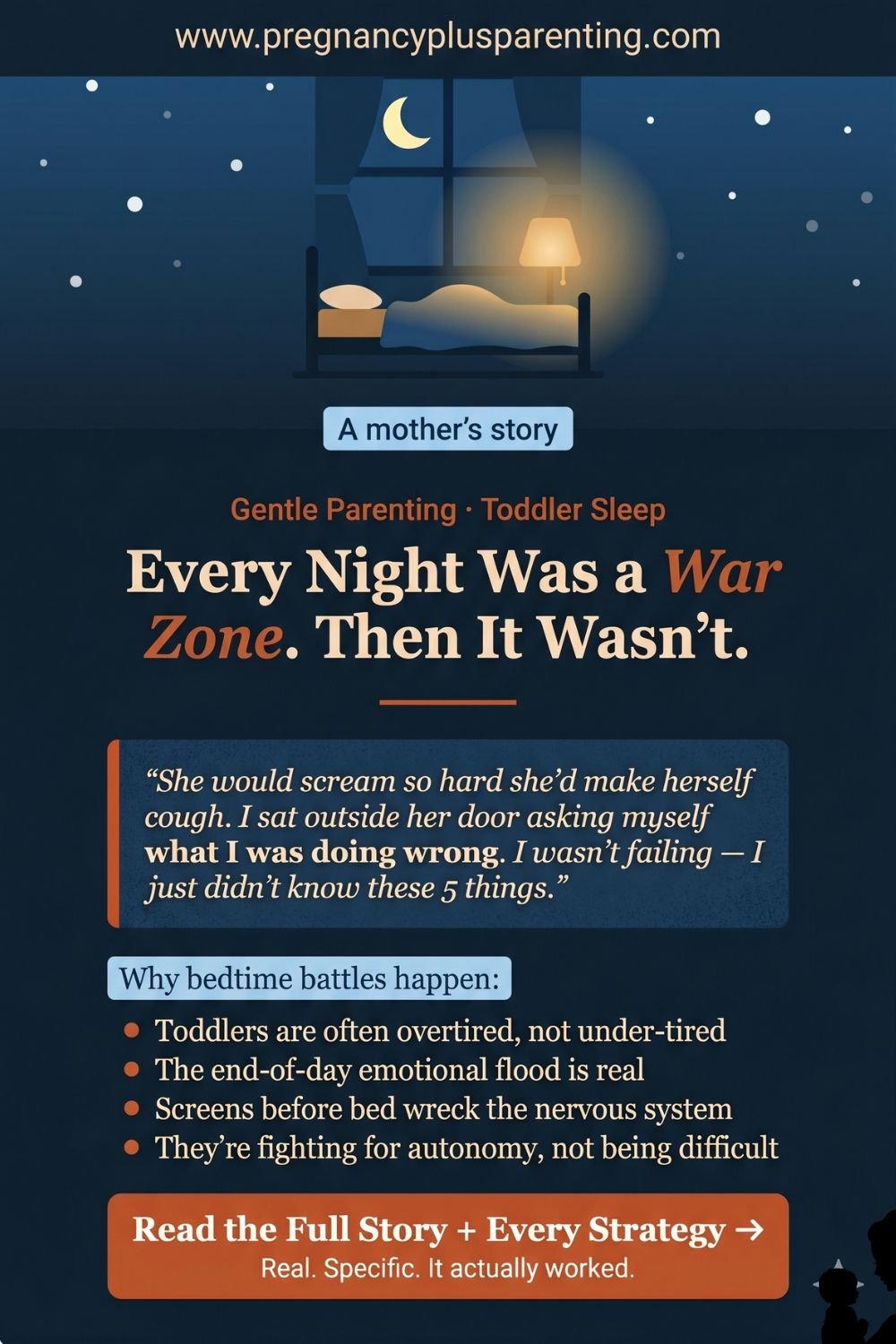
She would scream so hard she’d sometimes make herself cough. She would go completely rigid when I tried to carry her upstairs. One night she cried for forty-five minutes straight, and I sat outside her door on the hallway floor, back against the wall, eyes closed, asking myself what I was doing wrong.
Because I must have been doing something wrong. Right?
Bedtime was supposed to be sweet. It was supposed to be the soft, golden end to the day — stories and songs and sleepy cuddles. That was what parenting books described. That was what I had imagined. What I had instead was a nightly meltdown that left both of us exhausted and emotionally wrung out before she’d even closed her eyes.
If you are living this right now — if every single evening ends in tears and battles and a bedtime that stretches two hours past when it should have started — I want you to know two things. First, you are not alone and you are not failing. Second, there are real, specific reasons this is happening, and when you understand those reasons, the path forward becomes much clearer than it feels right now.
This article is everything I learned, everything I tried, and everything that actually worked.
Why Bedtime Is the Hardest Part of the Day for Toddlers
Before we talk about solutions, I think it’s worth spending a moment really understanding why bedtime is so uniquely hard for toddlers. Because it genuinely is harder than any other transition in the day — and for reasons that make complete sense once you see them clearly.
Bedtime Asks Everything of a Toddler at Once
Think about what you are actually asking your toddler to do at bedtime. You are asking them to stop an activity they’re engaged in. You are asking them to leave the room where the people they love most are. You are asking them to go into a dark or semi-dark room alone. You are asking them to lie still. You are asking them to surrender consciousness — which, from a toddler’s perspective, is genuinely not that different from disappearing.
Each one of those things is hard for a two or three-year-old. All of them together, every single night, is a genuinely enormous ask. When you hold that reality in your mind, the tantrum starts to make a different kind of sense. Your toddler isn’t being unreasonable. They’re being overwhelmed.
The End-of-Day Emotional Flood
Toddlers spend enormous energy during the day regulating their emotions — holding it together at daycare, managing disappointment at the playground, navigating conflicts with other children, processing the approximately ten thousand new things their developing brain encounters between breakfast and dinner. By the time evening comes, that emotional regulation reserve is completely depleted.
Child development specialists sometimes call this the end-of-day emotional flood. All the feelings that your toddler successfully managed during the day — the frustration, the excitement, the sadness, the overwhelm — come rushing out the moment they are home and safe with you. Because you are the safe place. Because with you, they don’t have to hold it together anymore.
The bedtime tantrum is often not really about bedtime at all. It is the day’s accumulated emotional weight finally finding an exit. Understanding this doesn’t make it easier to manage in the moment — but it does change how you respond to it, and that changes everything.
The Overtired Spiral — The Root Cause Nobody Told Me About
When my daughter’s bedtime tantrums were at their worst, I made what I now recognize as one of the most common parenting mistakes in this situation. I thought: she’s fighting sleep so hard, she must not be tired enough. So I started keeping her up later, thinking that more tiredness would mean easier sleep.
It made everything dramatically worse.
Here is the thing about toddlers and tiredness that is counterintuitive but absolutely critical to understand: overtired toddlers do not sleep more easily. They sleep harder. They fight harder. They melt down harder. And they stay awake longer.
The Cortisol Problem
When a toddler passes their sleep window — that narrow period when their body is biologically ready for sleep — the brain responds to the continued wakefulness by releasing cortisol, a stress hormone that promotes alertness and keeps the nervous system activated. This is the body’s survival response: if sleep isn’t coming and I’m still awake, I must need to stay alert.
A toddler flooded with cortisol cannot settle easily. Their body is literally working against sleep. They become hyperactive, emotionally dysregulated, prone to meltdowns, difficult to soothe. They look wired rather than tired. And they are — they are wired on stress hormones, which is why making them stay up longer makes everything worse rather than better.
How to Tell If Overtiredness Is the Problem
- The tantrums are worst when bedtime runs late — even by thirty minutes
- Your toddler gets a second wind in the evening and becomes hyperactive or giddy rather than winding down
- They fall asleep very quickly once they finally do settle — within five minutes — suggesting they were deeply tired all along
- Early morning wakings happen consistently — overtired toddlers often paradoxically wake earlier
- Nap refusal is happening alongside the bedtime battles — skipped or shortened naps accumulate into an overnight sleep debt
What to Do About Overtiredness
Move bedtime earlier. I know this sounds wrong. I know every instinct says keeping them up later will make them sleep better. But try it. Move bedtime thirty minutes earlier than where it currently is — so if bedtime is currently 8:30 p.m. and the tantrums start around 8:00, try a 7:30 bedtime — and hold it consistently for two weeks. For most families dealing with overtired-driven bedtime tantrums, this single change produces a visible difference within three to five days.
See Also : Signs Your Toddler Is Overstimulated (And What to Do Before a Meltdown Hits)
The Autonomy Battle — Why Toddlers Fight Things They Actually Need
My daughter wanted to stay up. Not because she wasn’t tired — she was clearly exhausted. Not because there was anything particularly wonderful happening after 7:30 p.m. that she was missing. She wanted to stay up because she wanted to be the one who decided when she went to bed.
This is the heart of the autonomy battle, and it is one of the defining developmental features of toddlerhood. Between ages one and three, children are in the process of individuating — discovering that they are separate people from their parents, with their own desires, preferences, and will. The word “no” becomes their most powerful tool. The ability to refuse, to resist, to assert their own agenda — this is not defiance for its own sake. This is the healthy, necessary work of becoming a person.
Bedtime sits right at the intersection of two things toddlers find most threatening to their emerging autonomy: being told what to do, and losing control of their environment. It is the perfect storm for an autonomy-driven meltdown.
Working With Autonomy Instead of Against It
The mistake most parents make — and I made it constantly — is trying to overpower toddler autonomy at bedtime. Firm instructions, countdown warnings, removing choices. This triggers the opposition reflex. The more you push, the harder they push back.
The shift that changed our bedtime was learning to offer controlled autonomy — real choices within a structure I controlled. Your toddler cannot choose whether to go to bed. But they can choose:
- Which two books you read tonight
- Which pajamas they wear
- Whether they brush teeth before or after putting pajamas on
- Which stuffed animal sleeps with them tonight
- Whether you sing one song or two songs
- Whether the nightlight is on the dresser or the shelf
These choices are small. They are real. And they give your toddler enough sense of agency over the bedtime process that the fight-or-flight response to “I’m losing control” never fully activates. They are not losing control. They are choosing. And choosing feels completely different from being forced.
Separation Anxiety After a Long Day
If your toddler attends daycare or is away from you for significant portions of the day, bedtime carries an extra layer of emotional weight that purely home-based toddlers may not experience in the same way.
By the time a daycare toddler gets home in the evening, they have been separated from you for eight, nine, sometimes ten hours. They have been holding their need for you at bay all day long. And now, just as they are finally reunited with you — just as they have you back — you are asking them to separate again. To go into a room alone. To let go of you for another eight hours.
From a toddler’s emotional perspective, the bedtime request can feel genuinely cruel, even when it is entirely reasonable from an adult perspective. Their protest is not manipulation. It is attachment working exactly as it should — a child fighting hard to stay close to the person they most need.
What Helps With Separation-Driven Bedtime Resistance
- A longer, more connected wind-down: Give yourself an extra thirty minutes before the actual bedtime routine begins — just for connection. No screens, no tasks, just you and your toddler. Floor time, cuddles, talking about their day. Fill the attachment tank before the routine begins.
- Physical closeness throughout the routine: Stay physically close during the routine — bath together if possible, lying beside them for the books, lots of skin contact during the pajama process. Front-load the physical connection so they go into sleep already feeling full.
- A transitional object: Something of yours — a scarf, a small photo, an item with your scent — that stays with them while you’re apart. This is not a trick. It is a genuine developmental tool that research shows helps children bridge separations.
- The promise of morning: “When you wake up, I will be right here. The very first thing that happens in the morning is I come to you.” Toddlers have limited time concepts but they understand sequences. The promise of morning reconnection genuinely helps some children release into sleep.

Overstimulation — When the Day Was Simply Too Much
Some toddlers — particularly those who are more sensitive by temperament — arrive at bedtime carrying so much sensory and emotional input from the day that their nervous system simply cannot transition to rest without help. The tantrum is not defiance. It is a dysregulated nervous system with no other way to discharge.
Screen time in the hour before bed is one of the most significant contributors to this. The blue light from screens suppresses melatonin production. The stimulating content of most children’s programming — even the gentle shows — keeps the visual and auditory cortex in an activated state. A toddler going from forty-five minutes of a fast-paced cartoon directly to “okay, sleep now” is being asked to make a neurological shift that their brain is not equipped to make quickly.
Signs Your Toddler Is Overstimulated at Bedtime
- They seem wired and hyperactive rather than sleepy even when bedtime is age-appropriate
- They are more emotionally reactive than usual — crying over very small things
- They cannot seem to settle their body even when lying down
- The tantrum escalates rather than de-escalates when you try to soothe
- The worst nights follow the most stimulating days
Building a Genuine Wind-Down Period
The solution is structural — build a genuine decompression period into the evening before the bedtime routine even begins. Forty-five minutes to an hour of:
- No screens of any kind
- Dimmed lights throughout the house
- Calm, quiet activities — puzzles, drawing, building, looking at books
- Lowered voices and reduced noise levels in the home
- A warm bath if your child responds well to it
This wind-down period is not part of the bedtime routine. It comes before the bedtime routine begins. Its purpose is to bring the nervous system from activated to receptive — to create the neurological conditions under which the bedtime routine can actually work.
Hunger and Blood Sugar at Bedtime
This one is so simple that it gets overlooked constantly. A toddler who is hungry at bedtime will struggle to settle. Blood sugar drops in the evening create irritability, emotional dysregulation, and difficulty self-soothing — all of which look exactly like a bedtime tantrum and are often misread as resistance or manipulation.
Look at your toddler’s dinner timing. If dinner was at 5:30 and bedtime is at 8:00, that is two and a half hours — a long time for a small stomach with a fast metabolism. A small, protein-containing snack offered as part of the wind-down period — cheese and crackers, half a banana with peanut butter, a small cup of warm milk — can make a meaningful difference in how easily your toddler settles.
Warm milk in particular has a genuine physiological effect beyond just the nutrition. The warmth is calming and regulating for the nervous system, and the ritual of the warm milk cup can become one of the most powerful sleep cues in your entire bedtime toolkit.
The Transition Problem — Why “Time for Bed” Feels Like an Attack
Toddlers are notoriously bad at transitions. Not because they’re difficult — because their brains are not yet equipped with the executive function that makes transitions manageable. The prefrontal cortex, which handles planning, anticipation, and flexible thinking, is the last part of the brain to develop — it won’t be fully online until your toddler’s mid-twenties.
What this means practically is that your toddler is not being stubborn when they can’t shift from play to bedtime smoothly. They genuinely cannot make that shift easily. The abruptness of “okay, time for bed” lands on their nervous system like an interruption rather than a transition — and interruptions activate the threat response.
Making Transitions Gentler
- The five-minute warning: “In five minutes we are going to start getting ready for bed.” This gives the toddler brain time to begin processing the upcoming shift. It doesn’t always prevent protest — but it reduces the shock of the transition.
- The natural stopping point: Wherever possible, time the bedtime transition to coincide with a natural stopping point in the activity — the end of a block structure, the completion of a drawing, the finish of a book. “Let’s finish this page and then we’ll head upstairs.”
- The bridge: Connect the ending activity to the first element of the bedtime routine with language that makes the transition feel continuous rather than abrupt. “We’re going to take those blocks upstairs with us and then you can choose your pajamas.” Moving something from the play space into the bedtime space reduces the felt rupture of the transition.
- Make bedtime the destination, not the ending: “It’s time for stories!” instead of “It’s time for bed.” “Let’s go choose your books!” instead of “Put the toys away, we’re going upstairs.” When the focus is on what comes next rather than what is ending, the emotional charge shifts.
See Also : My 7-Year-Old Has Anxiety: 9 Things I Wish Someone Had Told Me Sooner
Signs Your Current Bedtime Routine Is Working Against You
Sometimes the bedtime routine itself is contributing to the tantrums. Not because routine is bad — routine is essential — but because certain elements of the routine, or the way it is structured, can inadvertently heighten arousal rather than reduce it.
- It starts too late: If the routine begins when your toddler is already overtired, you are trying to implement a calming process on a nervous system that has already passed its window and is flooded with cortisol. The routine needs to begin before they hit that wall.
- It is inconsistent: A routine that varies significantly from night to night — different order, different length, different location — provides none of the predictability that makes routines work. Toddlers need the routine to be almost identical every night for it to function as a sleep cue.
- It includes stimulating activities: Roughhousing, tickling, exciting play, stimulating television — even if these happen before the official routine starts — can undo the wind-down work and make settling harder.
- It ends with a power struggle: If the final moments of the routine consistently involve negotiation, pleading, or conflict, your toddler’s last emotional experience before sleep is stress. This makes the next night harder because sleep becomes associated with conflict.
- It is too long: A routine that stretches beyond forty-five minutes starts to lose its structure and becomes fertile ground for stalling and manipulation. Thirty to forty minutes is the sweet spot for most toddlers.
What Finally Worked — Our Complete Bedtime Transformation
I want to tell you exactly what changed in our house, because I think specifics are more useful than principles when you’re in the middle of nightly battles and need something concrete to try.
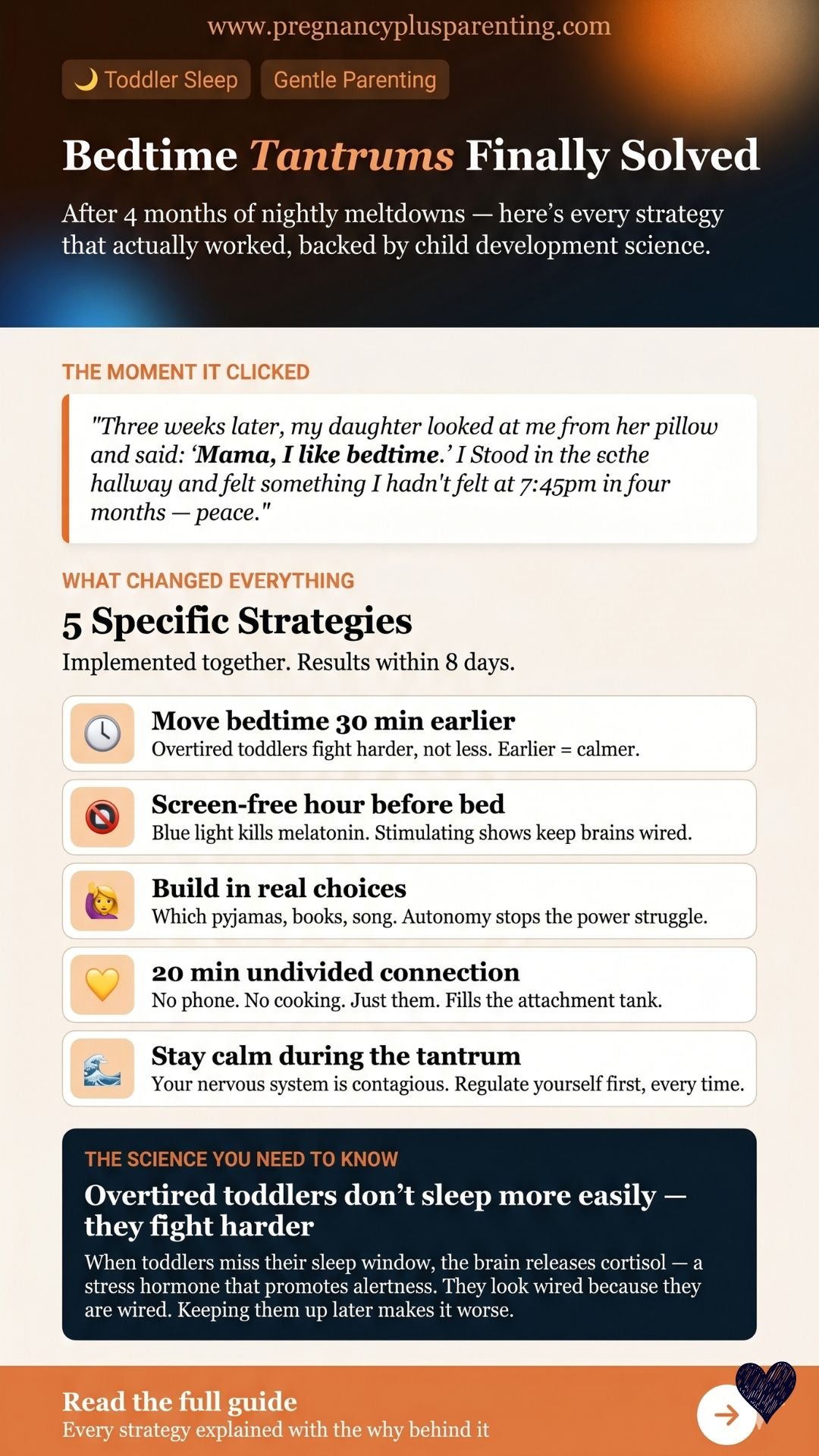
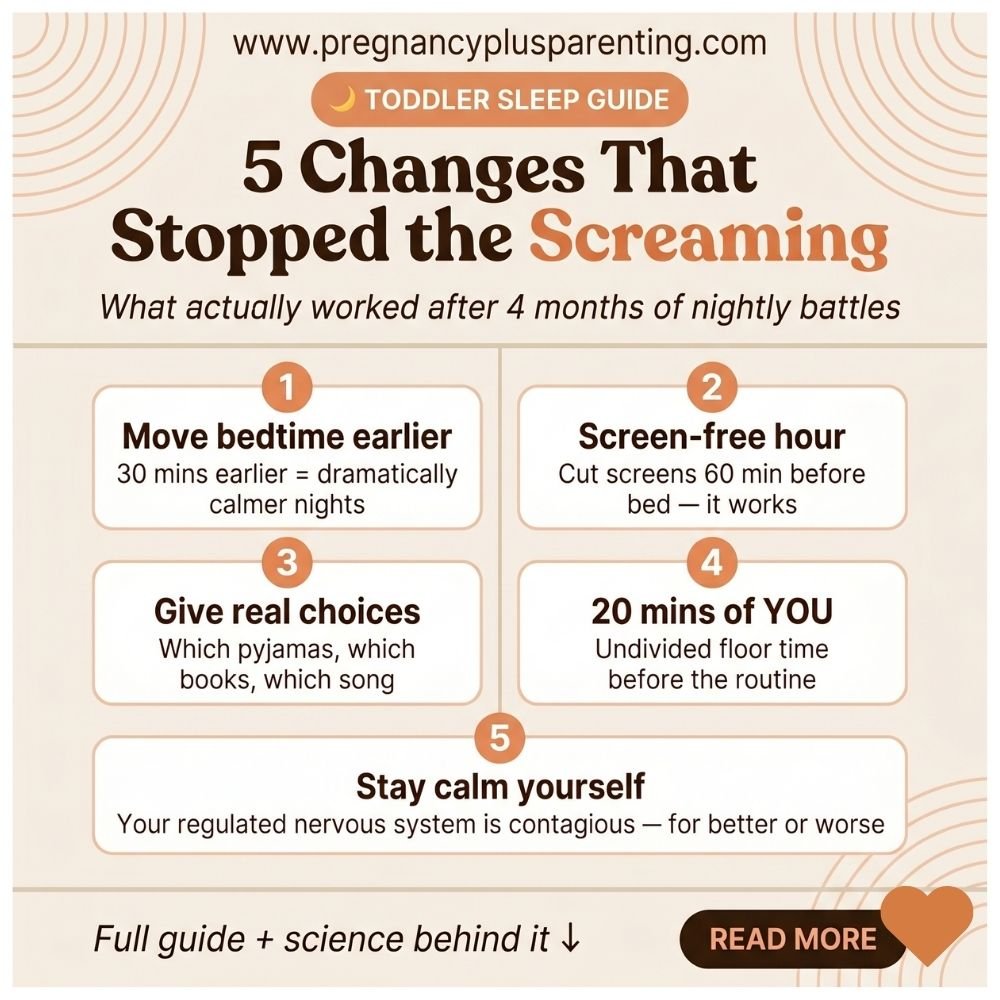
We made five changes simultaneously. I don’t know which one made the biggest difference — I suspect it was the combination rather than any single element — but within eight days of implementing all five, the tantrums had reduced dramatically. Within three weeks, bedtime had become the sweet, golden thing I had originally imagined.
Change 1 — We Moved Bedtime Thirty Minutes Earlier
From 8:15 to 7:45. Immediately. And we held it even on weekends, which was the hard part. Within four days the hyperactive wired behavior in the evenings — which I had been reading as her not being tired enough — disappeared. She was tired enough. She had been overtired.
Change 2 — We Introduced a Screen-Free Hour
All screens off by 6:45. For the first week this produced its own protest — she wanted her shows. But we held firm, offered calm alternatives, and by week two she had stopped asking. The difference in her evening demeanor was visible within days. Calmer. More connected. More able to be redirected.
Change 3 — We Built Choices Into Every Step
Which pajamas, which books, which song, which stuffed animal, nightlight on dresser or shelf. She chose everything she could reasonably choose. The power struggle almost evaporated because there was nothing to struggle over — she was already in control of the parts that mattered to her.
Change 4 — We Added a Connection Buffer Before the Routine
Twenty minutes of completely undivided floor time before the routine started. No phone, no cooking, no other tasks. Just me and her, playing whatever she wanted to play. This was the change that surprised me most with how much it helped. I think she had been fighting bedtime partly because she hadn’t had enough of me during the day and the idea of another eight hours of separation was unbearable. Twenty minutes of real connection seemed to fill something that hours of distracted togetherness hadn’t.
Change 5 — I Changed How I Responded to the Tantrum
When the tantrum still happened in those first weeks — and it did, less intensely but still — I stopped responding with logic, negotiation, or frustration. I got down to her level. I kept my voice genuinely calm — not performatively calm, which toddlers see through immediately, but actually regulated myself first and then spoke. I said almost nothing. I just stayed close, breathed slowly, and waited for the storm to pass. And it passed faster. Every time. Because a calm nervous system is genuinely contagious.
10 Gentle Strategies That Stop Bedtime Tantrums
Here are the specific strategies, pulled together in one place, that research and real parenting experience support for reducing bedtime tantrums in toddlers:
- Move Bedtime Earlier. If tantrums are worst when bedtime is late, move it earlier by thirty minutes immediately. Most two and three-year-olds do best with a bedtime between 7:00 and 8:00 p.m. — earlier than most parents expect.
- Create a Consistent, Predictable Routine. The same steps, in the same order, at roughly the same time every night. Predictability is safety for a toddler’s nervous system. The routine itself becomes the sleep cue over time.
- Build in Real Choices. Offer genuine autonomy within the structure. Let them choose the elements they can choose. Save the non-negotiables for things that are truly non-negotiable.
- Use Transition Warnings. Five-minute warnings before bedtime begins. Natural stopping points. Language that leads toward the routine rather than away from play.
- Front-Load Connection. Twenty minutes of undivided, child-led connection before the routine starts. Fill the attachment tank proactively rather than reactively.
- Eliminate Screens for One Hour Before Bed. Replace screens with calm, sensory-friendly activities — drawing, puzzles, books, quiet music, a warm bath.
- Offer a Small Bedtime Snack. A small protein and carbohydrate snack — cheese and crackers, warm milk, half a banana — prevents blood sugar dips that contribute to emotional dysregulation at bedtime.
- Make the Sleep Environment Inviting. White noise, appropriate darkness, comfortable temperature, a comfort object. The room itself should feel safe and cozy rather than like a place of exile.
- Stay Regulated Yourself. Your nervous system is the most powerful regulating force in your toddler’s environment. When you are calm — genuinely calm, not gritted-teeth calm — their nervous system has something to co-regulate with. Regulate yourself first. Every time.
- End the Routine on a Warm, Positive Note. Whatever the last element of your routine is — a song, a prayer, a specific goodnight phrase — make it warm, brief, and consistent. End on connection, not conflict.
What to Do During the Tantrum Itself
Even with the best routine in the world, there will be nights when the tantrum happens anyway. A long day, a missed nap, an exciting event, an illness coming on — any number of things can push even a well-routined toddler over the edge at bedtime. Here is what to do in those moments.
- Step 1 — Regulate Yourself First. Before you do anything else, take one slow breath. Seriously. One slow, deliberate exhale before you speak or act. This is about activating your parasympathetic nervous system so that what you bring into the room is calm rather than reactivity. Your toddler’s amygdala is already in full alarm mode. If yours joins it, there is no regulated nervous system in the room for them to borrow from.
- Step 2 — Get Down to Their Level. Physically lower yourself to their level — kneel, sit on the floor, whatever brings you to eye level. Standing over a tantruming toddler increases the felt threat. Getting down beside them signals safety rather than dominance.
- Step 3 — Name the Feeling Without Solving It. “You’re really upset right now. You don’t want it to be bedtime.” Not a question. Not a negotiation. Just an accurate reflection of what is happening. Feeling accurately seen and named reduces the intensity of emotional distress in toddlers — this is well established in developmental psychology and it genuinely works even when you don’t believe it will in the moment.
- Step 4 — Stay Close and Say Little. You do not need to talk your toddler out of the tantrum. You cannot. The part of their brain that processes language and reason is offline during a full tantrum — flooded by the emotional centers. What reaches them is your physical presence, your regulated breathing, your calm body beside theirs.
- Step 5 — Wait for the Wave to Break. Tantrums are like waves. They build, they peak, they break. The peak feels endless when you’re in it but it almost never lasts more than ten minutes for a purely emotional tantrum. When the wave breaks — when you feel the tension in their body release — that is the moment for connection.
- Step 6 — Do Not Capitulate to the Demand. If the tantrum is about staying up later, getting more screen time, avoiding bedtime — giving in teaches one lesson very efficiently: tantrums work. Stay warm. Stay close. Stay consistent. The bedtime is still happening.
See Also : Our Family’s No-Yelling Screen Time Limit System (That the Kids Actually Follow)
Why Consistency Is Everything — And How to Actually Achieve It
Consistent, predictable repetition is what teaches the toddler nervous system that bedtime is safe, expected, and non-negotiable. But consistency is also the hardest thing to maintain when you’re exhausted, when you’ve had a long day, when your partner isn’t home, when you’re traveling, when your toddler is sick.
- Write the routine down. A simple written or picture-based chart of the bedtime routine steps — visible to both you and your toddler — removes the decision-making from tired evening moments and gives your toddler something concrete to reference.
- Brief both caregivers. If more than one adult puts your toddler to bed, they need to be doing virtually the same routine. Even small differences teach your toddler that the routine is negotiable depending on who is on duty. Align. Then hold the alignment.
- Protect the routine on difficult nights. Sick nights, travel nights, late-return nights — a shortened version of the routine is better than no routine. Even three of the five usual elements, in the usual order, provides enough familiarity for the nervous system to begin its settling response.
- Repair without shame after a bad night. There will be nights you give in. These are not failures — they are human moments. What matters is that the next night you return to the routine without drama or lengthy explanation. Just: “Tonight we’re back to our bedtime routine.” And then you do it.
About three weeks into our new bedtime approach, on a Tuesday night in November, my daughter and I finished our second book, sang our song, said goodnight to her stuffed animals, and I stood up to leave. She looked at me from her pillow — small face in the dim light, hair fanned out, eyes already heavy — and said: “Mama, I like bedtime.”
I stood there for a second because I wasn’t sure I’d heard correctly. “You do?” I said. “Mm-hm,” she said. And she closed her eyes.
That is what is waiting on the other side of this for you. Not perfection — there will still be hard nights. But a general shift toward ease, toward warmth, toward a bedtime that feels like what it was always supposed to feel like. You are closer to that than you think. Keep going.
Frequently Asked Questions
Is it normal for toddlers to have tantrums specifically at bedtime?
Yes, completely normal. Bedtime is uniquely challenging for toddlers because it combines multiple difficult things — transition, separation, loss of control, and end-of-day emotional depletion — all at once. Many families experience a peak of bedtime resistance between ages two and four that resolves with consistent routine and gentle strategy.
My toddler’s bedtime tantrum lasts over an hour. Is that normal?
Extended tantrums of this length, happening every night, often indicate either significant overtiredness — meaning bedtime needs to move earlier — or a feeding environment that is accidentally reinforcing the behavior by ultimately giving the toddler what they want after the tantrum. Review both the timing of bedtime and your response to the tantrum itself.
Should I stay in the room until my toddler falls asleep to avoid the tantrum?
Staying in the room prevents the tantrum but also prevents your toddler from learning to fall asleep independently — which means the tantrum will happen whenever the condition changes. A gradual retreat approach — slowly moving yourself out of the room over several weeks — addresses both the immediate distress and the longer-term sleep independence goal.
My toddler only has bedtime tantrums with me, not with my partner. Why?
This is more common than you might think, and it is almost always a sign of secure attachment rather than a problem with your parenting. Your toddler feels safe enough with you to fully express their distress. They may also have learned that you are more likely to negotiate or extend the routine than your partner. Align your approaches as closely as possible and hold the same limits.
Can teething cause bedtime tantrums in toddlers?
Absolutely. The two-year molars arrive between twenty-three and thirty-three months and cause significant discomfort that worsens in the evening and at night. A toddler in molar pain may resist bedtime because lying down changes the pressure in the jaw and increases discomfort. If bedtime battles coincide with drooling, chewing, and gum swelling, pain management before bed — per your pediatrician’s guidance — may be part of the solution.
How long will it take to stop the bedtime tantrums?
Most families implementing consistent changes see meaningful improvement within one to two weeks. Full resolution — where bedtime is consistently calm and manageable — typically takes three to six weeks of consistent routine and strategy. Inconsistency is the primary reason the process takes longer than it needs to.
What if my toddler makes themselves sick from crying at bedtime?
Some highly sensitive toddlers do gag or vomit from intense crying. Handle it matter-of-factly — clean up calmly, resettle, continue the routine. Reacting with significant alarm or abandoning the routine when this happens teaches the toddler that this level of distress changes the outcome. If vomiting from crying is happening frequently, discuss it with your pediatrician.