


Introduction: The Day I Realized We Had a Screen Problem
I am going to tell you something I have never written publicly before. At the peak of our screen time problem, my two year old daughter was watching close to six hours of YouTube Kids every single day. Six hours. I did not plan it that way. I did not sit down one morning and decide that screens would become our entire day. It crept in slowly, the way these things always do.
It started with twenty minutes while I made breakfast. Then twenty minutes became forty because I needed to answer emails. Then forty became two hours because she was content and I was exhausted and honestly, I just needed the quiet. Then one day I looked up and realized my daughter would cry the moment I turned the television off, that she had stopped asking to go outside, that her attention span for books and toys had shrunk to almost nothing, and that the first words out of her mouth every single morning were “tablet, tablet, tablet.”
I felt guilty. I felt defensive. I felt like I had failed her somehow. And then I went online looking for help and found approximately ten thousand contradictory articles that either shamed me for letting it get this far or gave me a three step plan that lasted approximately one afternoon before everything fell apart.
What I could not find was someone who had actually been in the thick of it, who understood that cold turkey does not work, that the guilt is real but not helpful, and that there is a way out that does not involve weeks of daily meltdowns.
This article is that guide. Everything in it I learned through trial and error, through research, through honest conversations with other parents, and through the actual experience of taking our household from six hours of daily screen time to a calm, manageable routine where screens are a small and peaceful part of our day rather than the entire axis around which everything else revolves.
It took about eight weeks. It was not always smooth. But it worked. And it can work for you too.
See also : Why Won’t My 2 Year Old Eat Anything But Crackers? (And How to Gently Expand Their Diet)
1. Why Toddlers Get So Attached to Screens (It Is Not Your Fault)
Before we talk about how to reduce screen time, I think it is genuinely important to understand why screens become such a powerful force in toddler life in the first place. Because understanding the mechanism makes the solution make so much more sense, and it also helps release some of the guilt that many of us carry around this topic.
Screens are not passively entertaining. They are engineered to be irresistible. The content your toddler watches — whether it is YouTube Kids, nursery rhyme channels, or cartoon programmes — is designed by teams of people whose entire job is to maximize engagement and retention. Bright colors, fast movement, surprising sounds, constant novelty, and characters that respond to emotional cues — all of these activate the dopamine system in the brain powerfully and reliably.
Dopamine is the brain’s reward and anticipation chemical. When your toddler watches their favorite show, their brain releases dopamine. When the show ends, dopamine drops. That drop feels genuinely unpleasant — not just disappointing, but physically uncomfortable in the way that any withdrawal from a pleasurable stimulus feels uncomfortable. The crying when you turn the television off is not manipulation. It is a real neurological response to a real drop in dopamine.
Now layer on top of this the fact that toddler brains are specifically wired to seek novelty and stimulation. Their nervous systems are developing at an extraordinary pace, and they are drawn to anything that provides rapid, varied, high-contrast input. Screens provide this perfectly and effortlessly. Real life — books, puzzles, outdoor play — provides it too, but it requires more initial effort from the child to access the reward. The screen is like a vending machine. Real life is like a garden. Both provide nourishment, but one requires more from you before you get it.
Add to all of this the very real context of modern parenting. Most of us are doing this with less support than any previous generation. We are tired. We are working. We are managing households, relationships, and our own mental health while simultaneously trying to raise small humans. Screens are genuinely helpful in that context. They are not a moral failure. They are a tool that became overused because the need was real.
So please hear this clearly before we go any further: you did not break your child by letting screens creep in. You are not a bad parent. You are a tired parent who used an available tool and now wants to rebalance. That is not failure. That is parenting.

2. Why Cold Turkey Almost Never Works
Every time I tried to simply remove screens all at once, we had three to four days of absolute chaos. My daughter was dysregulated, clingy, and unable to engage with anything. I was stressed, second-guessing myself, and usually caved by day three.
I used to think this meant I lacked willpower. Now I understand it means I was attempting the wrong approach entirely.
Cold turkey withdrawal from screens is difficult for toddlers for several reasons. First, the dopamine adjustment. When a regular source of dopamine stimulation is suddenly removed, the brain needs time to recalibrate. During that recalibration period — which can last anywhere from a few days to a couple of weeks — everything feels flat, boring, and unsatisfying. Toddlers respond to this with the only tools they have: crying, clinging, and persistent demanding.
Second, toddlers thrive on predictability. Their sense of safety is built on knowing what comes next. When you remove something that has been a reliable, daily part of their routine without a clear replacement, you are not just taking away entertainment. You are removing a structural element of their day that they counted on. The distress is partly about the screen and partly about the loss of familiar pattern.
Third, cold turkey gives you no data. You cannot learn anything useful from three days of chaos. You cannot identify which times of day are hardest, which replacement activities work, or what triggers the most intense resistance. A gradual approach gives you all of this information.
The approach that works — the one I am going to walk you through — is slow, systematic, and respectful of both your child’s nervous system and your own. It takes longer. But the changes it creates are permanent rather than lasting until the next time they spot the remote.
3. Before You Start — The Mindset Shift That Changes Everything
There are two things I needed to genuinely believe before any of this worked. I want to share them with you because without them, the practical steps feel like rules being imposed on a problem rather than a real shift in how your household relates to screens.
The goal is not zero screens. The goal is healthy screens.
I want to say this clearly because a lot of the content around toddler screen time is soaked in shame and absolutism. The research does not say screens are evil. It says that excessive passive screen consumption, particularly of fast-paced content, is associated with some developmental concerns in very young children. It also says that co-watching, high quality content, and age-appropriate screen use are genuinely fine. The target here is balance and intention, not elimination.
When I stopped trying to achieve a screen-free life and started trying to achieve a screen-intentional life, everything became more sustainable. We still watch television in our house. We still use the tablet sometimes. But it is now a choice we make rather than a current we are swept along by.
You are not taking something away. You are adding something better.
This reframe is important for how you talk to your toddler about the changes you are making, and also for how you feel about making them. Every time you redirect your child from a screen to an activity, you are not punishing them. You are offering them an experience that will build their attention span, their creativity, their physical development, and their relationship with you in ways that no screen can replicate. Lead with the addition, not the subtraction. More on this later.
See also : Why Does My 2 Year Old Wake Up Screaming at Night? (Causes and Gentle Fixes)
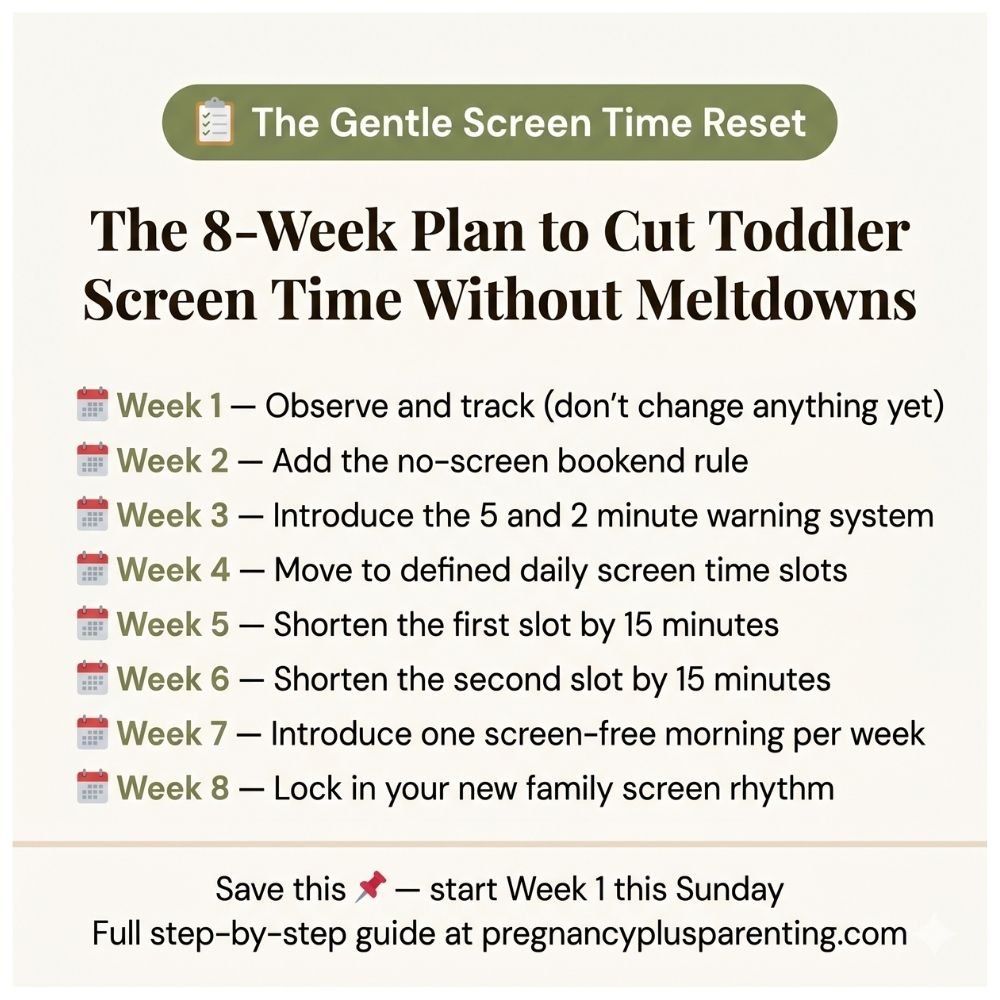
4. The 8 Week Step by Step Plan to Reduce Screen Time Without Meltdowns
This is the plan I wish someone had handed me. It is gradual, realistic, and built around the actual neuroscience of habit change in young children. Each week builds on the last. Do not skip ahead. The slow pace is the whole point.
Week 1 — Observe and Track (Do Not Change Anything Yet)
Before you change a single thing, spend one full week simply observing and tracking your current screen time patterns honestly. Note what time of day screens come on, how long each session lasts, what triggers the screen going on (your need for a break, your child’s request, meal preparation), and what happens when screens go off.
You are looking for patterns. Most families discover that screen time clusters around two or three predictable times of day. You are also building a realistic baseline so that you can measure genuine progress over the coming weeks.
During this week, also begin observing which non-screen activities your toddler currently engages with most willingly — even briefly. This information will be gold in the coming weeks.
Do not feel guilty about what you observe. You are a scientist this week, not a judge.
Week 2 — Add the Bookend Rule
Still no reduction in total screen time yet. This week you are adding one structural rule: screens do not come on for the first hour after waking, and screens go off at least one hour before bedtime.
These two bookend periods are the most neurologically important parts of your toddler’s day. The morning hour sets the tone for their entire day in terms of attention, mood, and engagement. The evening hour before bed is critical for melatonin production and sleep quality — screens in this window suppress melatonin and make sleep harder, which then makes everything the next day harder.
If your toddler currently watches screens immediately upon waking, this change will be the hardest one in the entire eight weeks. Expect resistance. Hold the boundary warmly and consistently. Have a simple morning activity ready — a favourite toy set out the night before, a simple breakfast activity, music playing. The key is filling the space before they have a chance to ask for the screen.
Week 3 — Introduce the Transition Warning System
This week you are not changing how much screen time your toddler gets. You are changing how it ends. Most screen time meltdowns happen not because of the screen itself but because the ending is abrupt and unwarned.
Starting this week, every single screen session ends with two warnings. A five minute warning and a two minute warning. Say them calmly, matter-of-factly, and without negotiation: “Five more minutes and then the television is going off.” Then at two minutes: “Two more minutes. Almost time.”
This is it for week three. Just the warnings. Consistently, every time.
Within a week or two you will notice that endings become calmer. Your toddler’s nervous system has time to begin transitioning before the abrupt dopamine drop. They are no longer ambushed by the off switch.
Week 4 — Introduce Screen Time Slots
This week you are moving from screen time that happens whenever to screen time that happens in defined slots. You are not necessarily reducing the total time yet — you are containing it in predictable windows.
Look at your tracking data from Week 1 and identify the two or three times of day that screen time naturally clusters. These become your official screen slots. Outside of these slots, screens are off and unavailable. Inside the slots, screens happen as usual.
The predictability this creates is profoundly helpful for toddlers. When they know that screens happen after lunch and in the late afternoon, they stop constantly asking for screens at other times. The asking is often about uncertainty — “maybe if I ask enough times it will appear.” A consistent slot removes that uncertainty and with it a significant amount of the asking.
Week 5 — Shorten the First Slot by Fifteen Minutes
Now we begin actual reduction. This week you shorten just the first screen time slot of the day by fifteen minutes. Only the first slot. Everything else stays the same.
Fill those fifteen minutes with a specific activity you have prepared in advance. Do not wing it. Have something ready. A playdough set on the table, a simple craft, a favourite book pile, a water play tray if you can manage the mess. The replacement activity needs to be ready and inviting before the screen goes off, not hastily assembled after.
If there are tears, that is okay. Validate: “I know you wanted more. That was a hard stop today. Look what we have here though.” Then engage with the replacement activity yourself — your involvement is the single most powerful factor in whether a toddler engages with an alternative to screens.
Week 6 — Shorten the Second Slot by Fifteen Minutes
Same principle, second slot. Fifteen minutes less, specific replacement activity ready in advance, your physical presence and engagement for the first five to ten minutes of the transition.
By this point most families are already seeing meaningful reduction without significant ongoing distress. The combination of consistent slots, transition warnings, and gradual reduction means your toddler’s nervous system has had time to adjust at each step rather than being thrown into sudden withdrawal.
Week 7 — Introduce One Screen Free Morning Per Week
Choose the day carefully. Pick a day when you genuinely have more time and energy — not a Monday when everyone is tired from the weekend, not a day with lots of other stress. Saturday or Sunday morning often works well.
Plan the morning in advance. Have activities ready. Go outside if you can — nature and physical movement are the most powerful natural dopamine regulators for toddlers. A walk, a park visit, a simple outdoor exploration replaces what the screen was providing neurologically in a way that is genuinely good for their developing brain.
The first screen free morning will likely be harder than subsequent ones. By week eight and nine, most toddlers surprise their parents with how well they adapt.
Week 8 — Establish Your Family Screen Time Rhythm
By now your total daily screen time has reduced by at least thirty minutes, you have defined slots and transition rituals, one morning per week is screen free, and both you and your toddler have a new set of expectations and habits around screens.
This week is about consolidating and making the new rhythm official in your household. Sit down and define your going-forward screen time rules simply and clearly. You do not need a complicated system. Most families find that something like this works well:
No screens for the first hour after waking. No screens during meals. Screen time in two defined slots of no more than thirty to forty five minutes each. No screens for one hour before bed. One morning per week fully screen free.
Total: roughly sixty to ninety minutes per day in structured, intentional slots. This aligns with the guidance from most major paediatric organisations and feels genuinely manageable for real families.
5. What to Replace Screen Time With (Age by Age)
The single most common reason that screen time reduction plans fail is that parents focus entirely on removing screens without thinking carefully about what goes in their place. The replacement activities need to meet the same neurological needs that screens were meeting — novelty, stimulation, engagement, and for many toddlers, a sense of connection with their parent.
For 12 to 18 Month Olds:
Sensory play is your best friend at this age. Water play in a small tub with cups and funnels. Playdough — even just a salt dough you make together. Treasure baskets with interesting objects of different textures. Simple board books read with exaggerated voices and sound effects. Music and movement — toddlers this age are deeply responsive to music and love moving their bodies to rhythm. Simple stacking and sorting toys.
For 18 Months to 2.5 Years:
This age group responds brilliantly to anything that involves imitation and real life play. Toy kitchens with real utensils. Simple arts and crafts — large crayons, finger paint, stickers. Outdoor exploration — a small patch of garden or a park where they can dig, collect, and observe. Simple puzzles. Books with lift-the-flap elements. Playing alongside you while you do real household tasks — stirring, pouring, sorting laundry.
For 2.5 to 4 Years:
Imaginative play becomes the dominant mode at this age. Set up small world scenes — a farm, a village of small figures, a dinosaur landscape. Simple building materials like Duplo or wooden blocks. Drawing and early mark-making with purpose. Cooking and baking simple things together. Library visits. Nature walks with a simple collection bag for leaves, stones, or seeds. Audiobooks and story CDs are excellent screen-free alternatives that still provide the passive entertainment experience but without the visual stimulation concerns.
The most important ingredient in all of these: Your presence and engagement for at least the first five to ten minutes. You do not need to play with your toddler for hours. But showing genuine interest in the activity you have set up for the first few minutes is the difference between them engaging independently for thirty minutes and abandoning it within thirty seconds to demand the tablet back.
See also : Exactly What to Say to Your Toddler During a Meltdown (Scripts That Actually Calm Them Down)
6. How to Handle the Transition Meltdowns When They Happen
Even with the most gradual, well-planned approach, there will be moments of resistance. A day when they are overtired. A week when everything feels harder. A moment when the transition warning lands badly and the meltdown comes anyway.
Here is what to do in those moments:
Do not turn the screen back on to stop the crying. I know this is hard. But returning the screen in response to crying is the single most powerful lesson you can teach your toddler that crying produces screens. One instance of caving teaches the behavior more effectively than ten instances of holding the boundary.
Validate the feeling without changing the decision. “I know you wanted more. That is really disappointing. The television is off now and I know that is hard.” The acknowledgment of their feeling and the boundary can coexist. They do not cancel each other out.
Get physically close. Meltdowns at screen-off time are often as much about the abrupt loss of connection and stimulation as they are about the screen itself. Your physical presence — getting on the floor with them, offering a hug, staying calm and warm — provides the co-regulation their nervous system is looking for.
Have the replacement activity genuinely ready. Not “go find something to play with” but “look, I set up the playdough while you were watching. Want to show me what you can make?” The invitation with your engagement changes the energy.
Expect the hardest resistance in the first three to five days of any new reduction. This is the adjustment window. Most toddlers who are transitioned gradually and consistently show significant improvement in their response to screen-off time within one week of a new limit being introduced.
7. The Most Common Mistakes Parents Make When Cutting Screen Time
I made most of these myself. Knowing them in advance can save you a lot of frustrating backtracking.
Going too fast. Trying to go from four hours to one hour in a single week is asking too much of a toddler’s nervous system and your own. The plan above takes eight weeks for a reason. Respect the timeline.
Not having replacement activities ready. Removing screens without a specific, prepared alternative is setting everyone up to fail. The alternative needs to be ready before the screen goes off, not scrambled together in the middle of a meltdown.
Being inconsistent. One parent holding the screen limit while the other allows unlimited access is one of the most common reasons these plans collapse. Both caregivers need to be aligned on the plan, the rules, and the approach. A brief conversation before you begin is worth a thousand arguments in the middle of the process.
Using screens as the solution to every difficult moment. If screens are your go-to response to boredom, hunger, tiredness, upset, and transition resistance, then reducing screens without addressing those underlying moments means those moments now have no solution. Think through what you will do instead when your toddler is bored at the supermarket, upset at a restaurant, or melting down in the car.
Talking about it as a punishment. “No more tablet because you were naughty” teaches children that screen access is a behavior reward and its removal is a behavior punishment. This creates a fundamentally unhealthy relationship with screens. Frame all changes as “our family is trying something new” rather than as consequences.
Expecting a linear journey. There will be weeks that are harder. Illness, travel, disruption to routine, stress — all of these will make screen time creep back up temporarily. This is normal and it is not failure. Get back to the rhythm when the disruption passes without drama or self-criticism.

8. Screen Time Rules That Actually Stick Long Term
After going through this process and talking to many other families who have done the same, here are the rules and principles that seem to hold up over time rather than collapsing after a few weeks:
Rules built on rhythm beat rules built on restriction. “Screens happen after lunch and during the pre-dinner window” is much more sustainable than “only thirty minutes per day” because it is tied to a daily rhythm rather than a clock-watching exercise. Toddlers understand and respect rhythm far better than they understand abstract time limits.
Co-watching beats solo watching. When you watch with your toddler — even for part of their screen time — you are transforming passive consumption into a connected experience. You can comment on what is happening, ask questions, laugh together. This dramatically changes the developmental impact of the screen time and also means the ending is less of a disconnection because you have been present throughout.
The physical environment matters. Keeping tablets and remotes out of sight and out of reach removes the constant visual cue that triggers the asking. Out of sight genuinely is out of mind for toddlers to a significant degree. If the tablet lives on the coffee table, it will be asked for constantly. If it lives in a cupboard, it will be asked for far less.
Saying yes intentionally is as important as saying no consistently. When it is screen time, be warm and relaxed about it. Let them enjoy it without guilt or commentary. The goal is a healthy relationship with screens, and that includes genuine enjoyment of screen time when it is happening. Anxious, guilt-laden screen time is not better than relaxed, boundaried screen time.
Review and adjust every few months. What works for a two year old will not work for a three year old. As your child’s developmental needs change, as their language grows and their capacity for independent play increases, the screen time plan should evolve with them. Build in a quarterly review of what is working and what needs to shift.
9. What the Research Actually Says About Toddler Screen Time
Since I am asking you to make significant changes to your daily routine, I think you deserve to know what the research actually says rather than just what the internet sometimes screams at parents.
The American Academy of Pediatrics recommends no screen time except video calling for children under 18 months, limited high quality programming for children 18 to 24 months when parents watch together, and no more than one hour per day of high quality programming for children aged 2 to 5.
The World Health Organization recommends no sedentary screen time at all for children under two and less than one hour for children aged three to four.
However it is worth knowing what these guidelines are based on. The research shows associations between high levels of screen time — particularly passive consumption of fast-paced content — and delayed language development, reduced sleep quality, decreased physical activity, and shorter attention spans. These associations are real but they are also dose-dependent and context-dependent. A child watching thirty minutes of a high quality slow-paced programme with a parent is not in the same category as a child watching four hours of fast-paced YouTube auto-play alone.
What the research also shows is that the activities displaced by screen time matter as much as the screen time itself. Screen time that replaces physical play, outdoor time, reading, and face-to-face interaction has a different impact than screen time that exists alongside a rich variety of other experiences.
This means that the goal is not to hit a specific number of minutes. The goal is to ensure that screens are not crowding out the experiences that toddlers genuinely need for healthy development — movement, nature, conversation, imaginative play, and connection with the people who love them.

10. Frequently Asked Questions
My toddler is completely addicted to screens. Is it too late to change this?
It is never too late to change habits, including screen habits. Toddler brains are extraordinarily neuroplastic — they adapt and adjust far more rapidly than adult brains. The gradual approach in this article is specifically designed for families where screen use has become heavy and entrenched. What it requires is consistency and patience, not perfection. Many families have made this transition successfully from a much heavier baseline than you might imagine.
My toddler will not engage with anything except screens. How do I find replacement activities?
This is extremely common in children who have had high screen exposure, and it has a neurological explanation. The dopamine hits from screens are so consistent and immediate that real-life activities feel boring and unrewarding by comparison — at first. The key is starting with the most sensory and physically engaging alternatives available. Water play, playdough, outdoor physical play, music and dancing. These provide more immediate neurological reward than quiet activities like puzzles or drawing. Start physical and sensory, and introduce quieter activities once the nervous system has had a few weeks to recalibrate.
What do I do about screen time at grandparents or other caregivers?
This is genuinely one of the harder parts of screen time reduction and it requires a real conversation rather than an assumption that everyone will follow your lead. Have a brief, non-judgemental conversation with other regular caregivers. Explain what you are working on and why. Give them a simple version of your current screen rules. Most caregivers want to support what you are doing — they just need the information to do so. For less frequent visits, be more relaxed. One afternoon of more screen time at grandma’s house will not derail a well-established home routine.
Is educational content different from entertainment content?
For very young toddlers — under two — the research suggests that even educational content has limited developmental value when watched alone. Toddlers this age learn from human interaction rather than screens regardless of content quality. For older toddlers, content pace and format matter more than educational labelling. Slow-paced, repetitive, narrative content — programmes like Bluey, Sesame Street, or Mr Rogers style shows — have better developmental profiles than fast-paced, high-stimulation content regardless of what the packaging says about learning outcomes.
My toddler only has meltdowns about screens when they are tired. Should I just avoid screens when they are tired?
You are actually identifying something very useful here. Tired toddlers have even less regulatory capacity than usual, which means screen transitions are harder when overtiredness is a factor. Yes — avoiding screen time in the hour or so before predicted tired periods is genuinely helpful. If the witching hour in your house is 5pm, a screen session ending at 4:45pm on a tired day is going to be harder than one ending at 3pm. Use your knowledge of your toddler’s tiredness patterns to schedule screen slots at neurologically easier times.
How do I deal with my own screen time habits around my toddler?
This is the question I most needed someone to ask me. Our own phone use is a form of screen time that significantly affects our toddlers — not because it directly stimulates them, but because it removes our presence and attention from them. Children whose parents are frequently on their phones during the day often have higher screen demands themselves, partly because they are seeking stimulation and connection that is not available in a parent who is distracted. Reducing your own phone use during the times you are with your toddler is one of the most impactful changes you can make alongside the formal screen time plan.
See also : Toddler Won’t Sleep Unless You’re in the Room? Here’s How We Broke That Habit Gently
A Final Word: You Are Already Doing the Hard Part
The hardest part of changing any deeply embedded family habit is not the logistics. It is the decision to begin. If you have read this far, you have already made that decision. You already care enough to learn, to plan, and to try something different. That is not nothing. That is everything.
This is not going to be a perfect eight weeks. There will be days when the tablet goes on longer than you planned because you are sick, because something hard happened, because you are simply too tired to hold the boundary today. Those days are not failures. They are data. They tell you what needs more support, what times of day are hardest, what your own triggers are.
What I want you to take from this article more than any specific strategy is this: you are not fighting your toddler when you reduce screen time. You are building something with them. You are building a family culture where real life is interesting and worth showing up for. Where attention is cultivated rather than constantly captured. Where boredom is survivable and sometimes even magical.
My daughter, who once woke up asking for the tablet before she had said good morning to me, now spends her mornings drawing and playing and chattering about what she dreamed. It did not happen overnight. It happened one small, imperfect, consistent step at a time.
You can do this. Start with Week 1. Just observe. The rest will follow.
Want more gentle parenting guides and toddler behavior strategies? Read more at pregnancyplusparenting.com