
I yelled. I felt terrible. I learned a completely different way — and I’m sharing everything here
Yelling at toddlers does not work as a discipline strategy — and child development research explains exactly why. More importantly, it tells us what does. This article covers both.
And I yelled. Not a lot — but enough. Enough to see her little face crumple. Enough to feel the shame settle in my chest like a stone before the sound had even finished leaving my mouth. Enough to spend the next hour after bedtime sitting in the kitchen asking myself whether I was doing irreparable damage and whether I would ever actually get this right.
If you have been in that kitchen — and I believe most of us have — this article is for you. Not to add to the guilt, but to replace it with something genuinely useful: a clear understanding of what is happening in your toddler’s brain when they behave the way they do, and exactly what child development research says actually changes that behavior over time.
Because there is a way through this that doesn’t require yelling. And once I found it — really understood it at a cellular level — everything shifted. Not perfectly. Not overnight. But genuinely, measurably shifted.
Why Yelling Doesn’t Work — The Brain Science
Before we talk about what to do instead of yelling, I want to spend a moment on why yelling fails as a discipline strategy — because understanding this was the thing that actually changed my behavior, not guilt, not willpower, not good intentions.
When you yell at a toddler, here is what happens neurologically:
The critical irony of yelling at a toddler is this: the very neurological state it creates in your child is the state in which they are least able to learn the lesson you are trying to teach. You are, in the most literal biological sense, working against yourself.
A landmark study published in the journal Child Development followed families over several years and found that harsh verbal discipline — including yelling, shouting, and demeaning language — was associated with increased behavioral problems in children, not decreased ones. The researchers concluded that the children of parents who yelled more did not become more compliant over time — they became more defiant. This is not a moral argument against yelling. It is a practical one. Yelling does not work.
What Discipline Actually Means at Age Two
Here is something that nobody told me when I became a parent and I genuinely wish they had: the word “discipline” does not mean punishment. It comes from the Latin disciplina — meaning teaching, learning, instruction. True discipline is about teaching your child the skills they need to behave well — not about making them suffer sufficiently in response to behaving badly.
This distinction matters enormously when you’re dealing with a two-year-old, because a two-year-old who is misbehaving is almost never making a calculated choice to defy you. They are demonstrating, loudly and inconveniently, that they do not yet have the skills to handle the situation they’re in.
A child who is misbehaving is not a bad child. They are a child whose skills have not yet caught up with their needs. Discipline is the process of closing that gap — not punishing the gap for existing.
— Dr. Ross Greene, child psychologist
Understanding this changes the entire frame. Instead of asking “how do I punish this behavior?” you start asking “what skill is my child missing right now, and how do I teach it?” That question has much more useful answers — and leads to strategies that actually change behavior over time, rather than just suppressing it temporarily.
What two-year-olds are actually capable of — and not capable of
Two-year-olds have:
An enormous amount of emotional experience — they feel joy, fear, frustration, love, and jealousy intensely. Almost no ability to regulate those emotions independently. Limited language to express what they need or feel. A powerful drive toward autonomy and independence. An undeveloped prefrontal cortex that makes impulse control essentially impossible. A nervous system that co-regulates with the adults around them — meaning your calm directly influences their ability to calm.
Knowing this tells you something crucial: discipline strategies that rely on your toddler’s ability to reason, reflect, control impulses, or delay gratification will fail — not because your child is difficult, but because those capacities are not yet developed. Strategies that work with their developmental stage — that teach, connect, and co-regulate rather than punish and isolate — have the evidence behind them.
What Works vs. What Doesn’t — A Clear Comparison
Based on child development research and what developmental psychologists consistently recommend for toddler discipline, here is a clear comparison of approaches:
✓ Calm, clear limit-setting with brief explanations
✓ Acknowledging the emotion before addressing the behavior
✓ Natural and logical consequences that directly relate to the behavior
✓ Redirection toward an acceptable alternative behavior
✓ Consistent, predictable routines and expectations
✓ Positive reinforcement of good behavior
✓ Teaching replacement behaviors during calm moments
✓ Brief, calm time-in or time-out when developmentally appropriate
✓ Staying regulated yourself — co-regulation
✗ Yelling, screaming, or harsh verbal responses
✗ Long explanations or lectures during misbehavior
✗ Shaming or labeling the child (“you’re bad,” “you’re naughty”)
✗ Threatening consequences you won’t follow through on
✗ Bribery as the primary motivation strategy
✗ Inconsistent responses to the same behavior
✗ Physical punishment of any kind
✗ Expecting reasoning and reflection mid-meltdown
✗ Ignoring behavior that genuinely needs a response
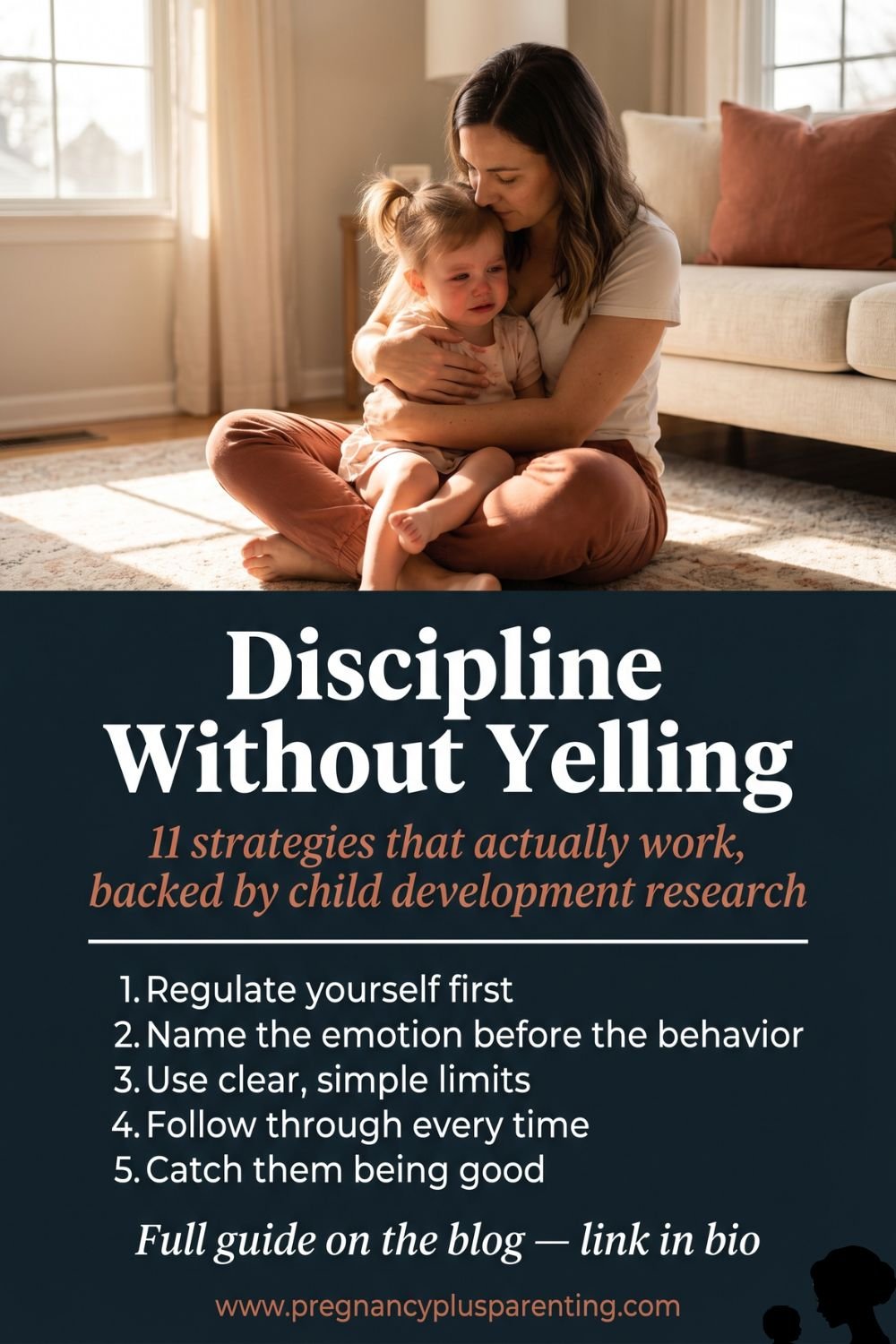
11 Discipline Strategies That Work Without Yelling
These are the strategies backed by child development research and — more importantly — by real experience in real households with real two-year-olds. Not all will work for every child or every family. Take what fits and adapt it to your child’s temperament and your family’s values.
Regulate yourself first — every single time
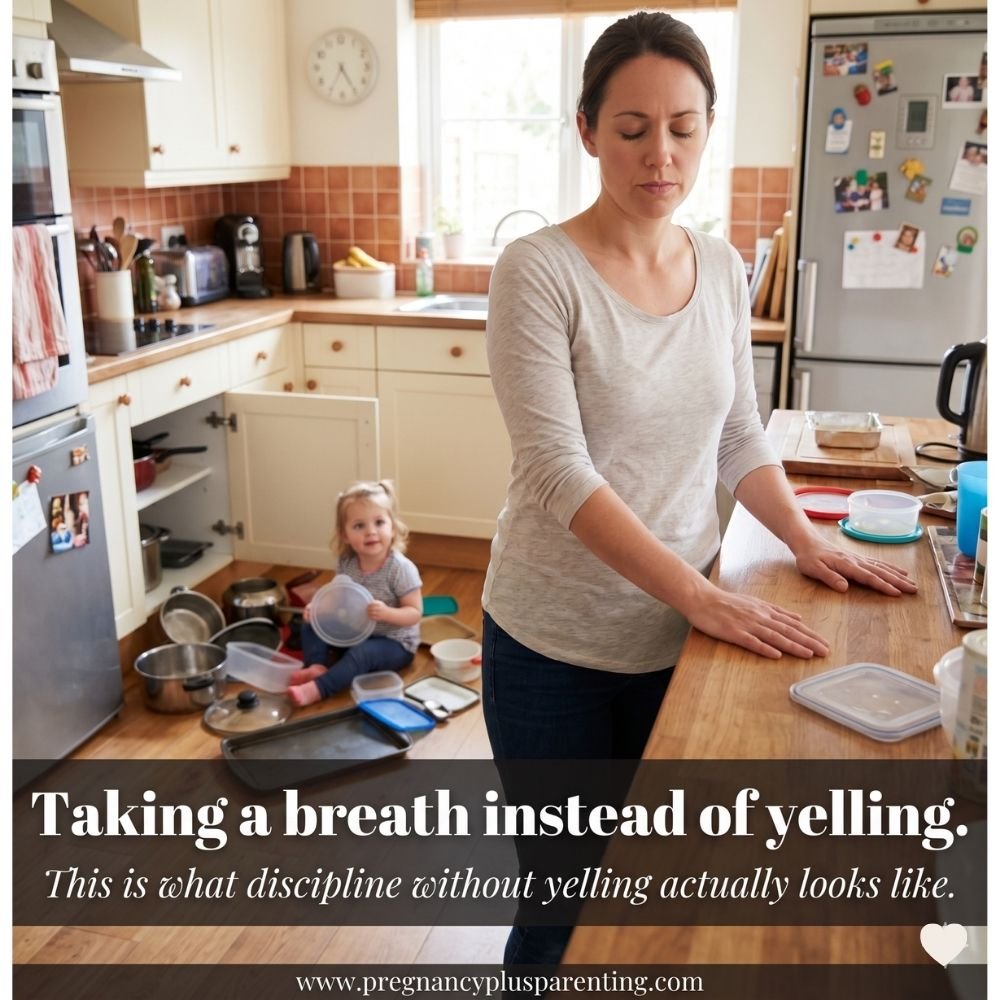
This is not a platitude. This is neuroscience. Your toddler’s nervous system co-regulates with yours — meaning when you are calm, their brain has a scaffold to come down from dysregulation. When you are escalated, they escalate further. Before you respond to any behavior, take one breath. Soften your face. Lower your shoulders. Not for their comfort — for the literal neurological effectiveness of what comes next. A calm parent is the single most powerful discipline tool you have. Everything else works better when this is in place.
Name the emotion before addressing the behavior
Before you redirect, correct, or consequence — name what you see. “You’re really frustrated that we have to leave the park.” “You’re so angry that your sister has the toy you wanted.” This step feels counterintuitive because it doesn’t address the misbehavior immediately — but it does something more important: it activates the language centers of your child’s brain, which actually competes with the emotional flooding. Naming an emotion helps regulate it. A child who feels heard is neurologically more open to guidance than a child who feels attacked.
Use clear, simple, positive language for limits
Two-year-old brains process positive directives much more effectively than negative ones. “Walk, please” lands better than “Don’t run.” “Gentle hands” works better than “Stop hitting.” “Food stays on the table” is clearer than “Don’t throw your food.” Keep it short — one sentence maximum. Keep it calm — matter-of-fact, not pleading or threatening. And say it once. Repeating the same instruction in increasing desperation doesn’t help. State the limit, give them a moment, then follow through.
Follow through consistently — every time
Consistency is the backbone of toddler discipline. A limit that is sometimes enforced and sometimes ignored teaches your child to test every limit every time — because sometimes testing pays off. This is not defiance or manipulation; it is basic operant conditioning. Your child is learning the rules of their world, and inconsistent rules make that learning chaotic and stressful for them. If you say “one more throw and the ball goes away,” put the ball away when it happens. The follow-through builds the credibility that makes limits meaningful.
Offer choices within your limits
So much of toddler misbehavior is fundamentally about autonomy — a desperate need to have some control over their world in a life that is largely controlled by adults. Offering genuine choices within your non-negotiables gives them that autonomy without giving up your limits. “You need to put shoes on — do you want to do it yourself or do you want my help?” “We’re leaving the park in five minutes — do you want one more go on the slide or the swings?” The choice is real. The limit is intact. The power struggle often dissolves.
Use natural and logical consequences
A natural consequence flows directly from the behavior without parental imposition — if your toddler throws their food, they no longer have food. A logical consequence is related and reasonable — if they scribble on the wall, they help wipe it off. These work far better than unrelated punishments because they make intuitive sense to a toddler brain: the consequence directly illustrates why the behavior was a problem. Avoid consequences that are punitive, prolonged, or disconnected from the behavior — they teach fear rather than understanding.
Catch them being good — genuinely and specifically
Research on behavior change in children consistently shows that positive reinforcement of desired behavior is more effective at building lasting behavioral change than punishment of undesired behavior. This does not mean constant praise — it means noticing and naming the specific behavior you want to see more of. Not “good girl!” but “I noticed you shared your toy with your brother just now — that was so kind.” Specific praise teaches a child what exactly they did that was right, and makes them more likely to repeat it. Aim for a ratio of at least four positive noticing moments for every limit-setting moment.
Use redirection — redirect toward, not just away
Redirection is most effective when it offers a real alternative rather than just removing the problem behavior. Not just “stop drawing on the wall” but “walls aren’t for drawing — here is your paper, let’s draw here.” Not just “stop hitting your sister” but “hands are not for hitting — if your body needs to hit, here’s the pillow.” You’re giving the underlying need — to draw, to discharge energy — a legitimate outlet. This is what makes redirection work rather than just temporarily interrupting the behavior.
Give transition warnings — always
A disproportionate number of toddler meltdowns and resulting misbehavior happen at transitions — leaving the park, stopping play for dinner, ending bath time. This is because toddlers have almost no capacity to mentally prepare for change without warning. A five-minute warning (“in five minutes we’re leaving the park”) followed by a two-minute warning gives their nervous system time to begin adjusting. It does not eliminate all protest — but it significantly reduces the shock of abrupt transitions and the explosive behavior that often follows.
Only use time-out thoughtfully — and briefly
Time-out is not inherently harmful — but it is often used incorrectly. The research-supported use is brief (one minute per year of age maximum), calm (not as a punishment but as a reset), and followed by reconnection and brief teaching once the child is regulated. Time-out mid-tantrum, for very young toddlers, for behaviors driven by dysregulation rather than testing, or without follow-up teaching — these uses tend to be ineffective and can increase distress. Consider “time-in” as an alternative: staying with the child through the dysregulation rather than sending them away from you.
Teach the skills during calm moments — not in the chaos
The behaviors you want to see more of have to be practiced, not just demanded. During calm, connected moments — bath time, car rides, play — practice the skills. Role-play sharing with stuffed animals. Practice “gentle hands” when they’re already being gentle. Read books about feelings and talk about what the characters could do differently. Rehearse what “walking feet” looks like when there’s no urgency. You are literally wiring new neural pathways through repetition, and those pathways are built during calm — not in the heat of the moment.
Exact Scripts for the Hardest Real Situations
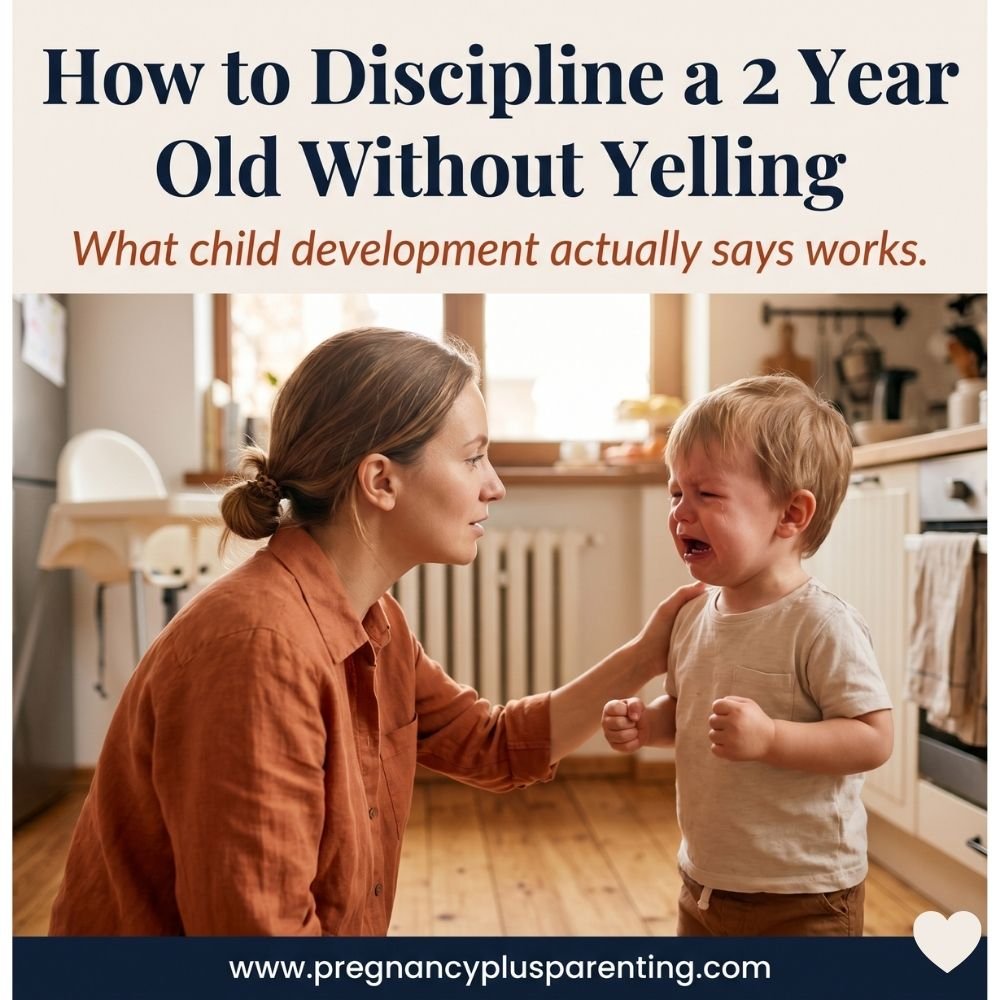
Let me get practical. Here are the most common toddler behavior situations that make parents want to yell — and exactly what to say and do instead:
🍽️
They throw food off the high chair — deliberately, with eye contact
This is almost always about cause-and-effect exploration (under 18 months) or testing limits (18 months+). Either way, your reaction is the fuel. A dramatic response makes it more interesting. A calm one makes it less so.
“Food stays on the tray. If the food goes on the floor, dinner is done.” — Then follow through calmly and without anger when it happens again. No lecture, no repeat warning. Just the consequence, delivered matter-of-factly.
🛒
Full meltdown in the grocery store
Public meltdowns trigger parental panic because we’re aware of being watched. Your child does not care about the audience — they are in genuine distress. Get low, get close, get calm.
“I see you. You’re having really big feelings right now. I’m going to stay right here with you.” — Then wait. Don’t reason. Don’t bribe. Don’t threaten. Just be present and calm until the storm breaks, then finish the shopping or leave — whatever you’d decided before the meltdown.
👊
They hit another child at a playdate
Act immediately — calmly but without delay. The response needs to come within seconds to be connected to the behavior in your toddler’s mind.
“I won’t let you hit. Hitting hurts.” — Move them away gently but firmly. Briefly attend to the child who was hit in front of your toddler — this is more powerful than any lecture. Then: “When your body wants to hit, you can hit the pillow. Hitting people is not okay.”
🙅
They say “NO” to everything and refuse all cooperation
This is peak autonomy development — and it is developmentally healthy even as it is maddening. The worst response is a power struggle. The best response is sidestepping the confrontation entirely.
“Do you want to put your shoes on the right foot first or the left foot first?” — Offer the choice within your non-negotiable. Give them a “job” within the task. Make it a game. A toddler who is given a role in the process is a toddler who cooperates with the process.
😤
They melt down because you cut their sandwich the wrong way
Yes, this is real. No, it is not manipulative. Their nervous system has limited tolerance for frustration, and when it tips over, anything can be the tipping point. Arguing about the sandwich is futile.
“You really wanted it the other way. That’s really frustrating.” — Validate the feeling without fixing the sandwich (which teaches that meltdowns result in getting what they want). Offer connection: “Want to sit with me while you calm down?” Give it time. This passes.
🌙
Bedtime refusal — every single night
Bedtime resistance at two is extremely common and often connected to separation anxiety, FOMO, or simply the autonomy drive kicking in at the worst possible time.
“I know you don’t want to sleep yet. Your body needs rest even when your brain doesn’t want it. I’ll check on you in two minutes.” — Mean the two minutes. Follow through. Keep returns calm and brief. The routine itself is the most powerful signal — protect it above almost everything else.
What to Say Instead of Yelling — In the Exact Moment
When you feel the yell rising — and you will, we all do — having a rehearsed alternative ready in your nervous system is what gets you through. Here are the phrases worth practicing until they come automatically:
The yell-spiral phrases
“STOP IT RIGHT NOW!”
“How many times do I have to tell you?!”
“You are driving me CRAZY.”
“WHAT IS WRONG WITH YOU?”
“I have had ENOUGH of this today.”
“Fine! Do whatever you want!”
“You are being so BAD right now.”
The calm-response alternatives
“I need you to stop. Right now. Thank you.”
“We’ve talked about this. Here’s what happens now.”
“I’m feeling frustrated. I’m going to take a breath.”
“I can see you’re really upset. I’m right here.”
“This is hard for both of us. Let’s try again.”
“That behavior is not okay. Here is what I need from you.”
“You made a bad choice. Let’s figure out what to do now.”
Prevention — How to Reduce Behavior Problems Before They Start
The best discipline is the kind you don’t need to use. A significant portion of toddler misbehavior is predictable and preventable when you understand the conditions that create it:
Protect sleep above almost everything. An overtired two-year-old has a cortisol level that makes emotional regulation essentially impossible. The single most reliably effective “discipline strategy” I know is an appropriate bedtime and protected nap. A rested toddler is not a different child — but they are a significantly more manageable version of the same child.
Feed before you go. Hunger is a direct path to dysregulation for toddlers. I keep snacks in every bag, coat pocket, and car compartment. Running errands with a hungry toddler is asking for a meltdown that nobody — not you, not them — chose to have.
Toddler-proof your environment strategically. “Don’t touch that” is a losing battle when applied to an entire house of interesting things. Toddler-proofing — removing the most dangerous and most argued-over items from easy access — reduces the number of conflicts you need to have every day. Fewer battles means more bandwidth for the ones that actually matter.
Give 15–20 minutes of undivided, child-led play daily. Research by Dr. Stanley Greenspan and others consistently shows that children who receive daily, undivided, child-led attention from a parent show significantly fewer attention-seeking misbehaviors throughout the day. This is not a guilt trip — it is an investment. Twenty minutes of full presence pays dividends in reduced conflict for hours afterward.
Keep transitions predictable and warned. Structure your toddler’s day with consistent rhythms and always give transition warnings. A toddler who knows what is coming — “after lunch we’ll have quiet time, then we’ll go to the park” — is a toddler whose nervous system is not in a constant state of surprise. Predictability is deeply regulating for young children.
Pick your battles deliberately. Not every behavior requires a response. A toddler who insists on wearing their shoes on the wrong feet, or eating their apple from the core outward, or calling their cup a “hat” — these battles cost emotional capital without returning any benefit. Save your limit-setting energy for the things that genuinely matter: safety, harm to others, and your non-negotiables. Let the rest go.
Protect your own nervous system. You cannot reliably offer calm regulation to your child when you are depleted, triggered, and running on empty. Sleep when you can. Ask for help. Take breaks without guilt. Know your own yell-triggers and have a plan for them. Your wellbeing is not separate from your child’s — it is the foundation it rests on.
When You Yell Anyway — How to Repair It
Let me be honest with you: you will yell again. Almost certainly. Because you are a human being with a nervous system and limits and bad days, and toddlers are — to put it lovingly — absolutely relentless. The goal of everything in this article is not to make you a parent who never yells. It is to make yelling less frequent, less intense, and less damaging over time.
When it does happen — when you lose your temper and you hear yourself being the parent you didn’t want to be — here is what actually matters in the aftermath: the repair.
Go back to your child when you are calm — not immediately, not while you’re still heated, but soon. Get down to their level. And say something real: “Mama lost her temper and yelled. That wasn’t okay. I’m sorry. I love you even when I’m frustrated. Can we have a hug?”
This is not weakness. This is not undermining your authority. It is modeling — in the most powerful possible way — that relationships can be repaired, that adults can own their mistakes, and that love is not conditional on perfect behavior. Your child is watching how you handle getting it wrong. Make that lesson worth their observation.
And then — gently, without self-flagellation — ask yourself what was happening in your own nervous system in that moment. What were you feeling? What did you need? Were you hungry, depleted, triggered by something unrelated to your toddler? That understanding is where change lives. Not in the guilt. In the insight.
Common Discipline Mistakes That Make Things Worse
These are the patterns I see most frequently — and fell into myself — that inadvertently fuel the exact behavior they’re trying to stop:
Making threats you don’t follow through on. “If you do that one more time, we’re leaving” — said four more times without leaving — teaches your child that your threats are not real. This is not a character judgment; it is a learning pattern. Every unkept consequence erodes the credibility of the next one. Only threaten what you are genuinely prepared to do.
Giving lengthy explanations mid-meltdown. A dysregulated toddler cannot process your reasoning. A long explanation delivered at the peak of a tantrum reaches no one. Save the teaching for after the storm — when they are calm, connected, and their brain is actually online. Mid-meltdown, your only job is to help them regulate. The lesson comes later.
Accidentally rewarding the behavior you want to stop. If your toddler learns that whining, tantruming, or hitting results in getting what they wanted — even sometimes — the behavior is being reinforced on a variable schedule, which is actually the most powerful reinforcement pattern that exists. Be thoughtful about what behaviors result in what outcomes, even in exhausted moments.
Labeling the child instead of the behavior. “You are so naughty” reaches into your child’s developing sense of self and plants a seed there. “That behavior is not okay” addresses the action without touching the identity. This distinction matters more than it may seem — children who are told they are “bad” tend, over time, to live into that label. “You made a bad choice” keeps the child and the behavior separate, and keeps growth possible.
Being inconsistent across parents or caregivers. Different rules between Mama and Dada, or between home and grandma’s house, are genuinely confusing for toddlers — not in a way they can articulate, but in a way that makes them anxious and test limits more, not less. You don’t need to be identical. But the big-ticket items — safety limits, non-negotiables, basic daily structure — benefit enormously from alignment between the adults in your child’s life.
FAQ from Frustrated Parents
Almost certainly nothing — or at least not what you think. The most common reason gentle discipline strategies feel like they’re “not working” is that parents are looking for immediate compliance and interpreting the absence of it as failure. These strategies don’t produce instant results — they produce change over weeks and months of consistent application. If you have been applying them consistently for six to eight weeks and see absolutely no shift in behavior, that’s worth discussing with your pediatrician — some children have sensory, developmental, or temperament differences that benefit from more specialized support. But for most families, the strategies need more time than we tend to give them.
Raising your voice as an immediate alarm signal in a safety situation — “STOP! The road!” — is completely appropriate and your child needs to be able to distinguish that urgency. That is different from yelling in anger or frustration as a discipline strategy. One is communication. One is an emotional discharge. Your child’s nervous system processes them differently, and so does the research. The former is fine. The latter is what we’re trying to reduce — not because occasional raised voices cause lasting damage, but because they don’t work and there are better alternatives.
It feels that way — I know — especially when they maintain eye contact while doing the forbidden thing. But intentional, goal-directed provocation of a parent requires a level of theory of mind and emotional cognition that is genuinely beyond a typical two-year-old. What is happening is usually one of three things: they are testing cause-and-effect, they are seeking connection and your reaction — even anger — gives them intense engagement, or they are doing the thing and the eye contact is coincidental. In all three cases, the most effective response is a calm, matter-of-fact consequence rather than the big emotional reaction they’re getting.
This is the most important distinction in toddler discipline: gentle does not mean permissive. Permissive parenting has no limits, no consistency, and no follow-through. What the research supports is authoritative parenting — warm and connected, with clear and consistent limits and real consequences. Every strategy in this article involves limits. It involves follow-through. It involves real consequences. What it removes is harshness, shame, and the counterproductive emotional escalation that makes limits harder to hold, not easier.
This is one of the most common and difficult parenting disagreements. Lead with shared outcomes: you both want a child who is kind, cooperative, and emotionally healthy — you just have different theories about how to get there. Share the research, not as ammunition, but as “I found this really interesting and it changed how I thought about things.” Focus on what you both want to try, not what you disagree about. And remember that significant inconsistency between adults is itself a stressor for children — wherever you can find common ground, do. Neither of you is the enemy here.
Take a breath. The fact that you are asking this question — that you are worried, that you want to do better — is itself significant. Children are remarkably resilient, and the research on yelling is about chronic, pervasive patterns, not imperfect moments in an otherwise warm and loving relationship. Start now. Repair what needs repairing. Build the new patterns one day at a time. And please give yourself the same compassion you’re trying to extend to your child. You are learning too. That is allowed.
You Are Not a Bad Parent — A Final Word
The fact that you read a 4,000-word article about how to discipline your toddler without yelling tells me something important about you: you care deeply. You are paying attention. You are trying to do better than the automatic response. That is extraordinary parenting — even on the days when the automatic response still wins.
Changing your discipline patterns is not a switch that flips. It is a practice, built one difficult moment at a time, sustained by the understanding of why it matters and supported by the compassion you extend to yourself when you fall short.
You are not going to get this perfect. Neither am I. Neither is any parent reading this.
But you are going to get it better. Gradually, imperfectly, meaningfully better. And your child — who loves you with the absolute, unselfconscious wholeness that only two-year-olds are capable of — is going to grow up knowing that they were worth the effort of that better.
That is enough. You are enough. Keep going.
Books That Changed How I Parent
No Drama Discipline by Dr. Daniel Siegel and Dr. Tina Payne Bryson — the clearest, most practical book I have found on discipline that actually works for toddlers, grounded in neuroscience and delivered without judgment.
How to Talk So Little Kids Will Listen by Joanna Faber and Julie King — the toddler-specific companion to the classic How to Talk So Kids Will Listen, full of concrete scripts for exactly the situations that come up every day.
The Whole-Brain Child also by Siegel and Bryson — foundational reading on understanding what is happening in your toddler’s brain during difficult moments, and how to respond in ways that actually help.
Raising Good Humans by Hunter Clarke-Fields — specifically focused on managing your own reactivity so you can show up the way you want to. The book I needed most and found latest.
If you are struggling significantly — if yelling has become a daily pattern that feels out of control, if you are feeling depressed, overwhelmed, or like you are not coping — please reach out to your own doctor or a therapist. Parenting a toddler is genuinely hard work, and struggling does not make you a bad parent. It makes you a human being in a demanding season. You deserve support too.