

A real mom finally gets honest answers — and shares everything that helped our mealtime go from dread to (mostly) okay
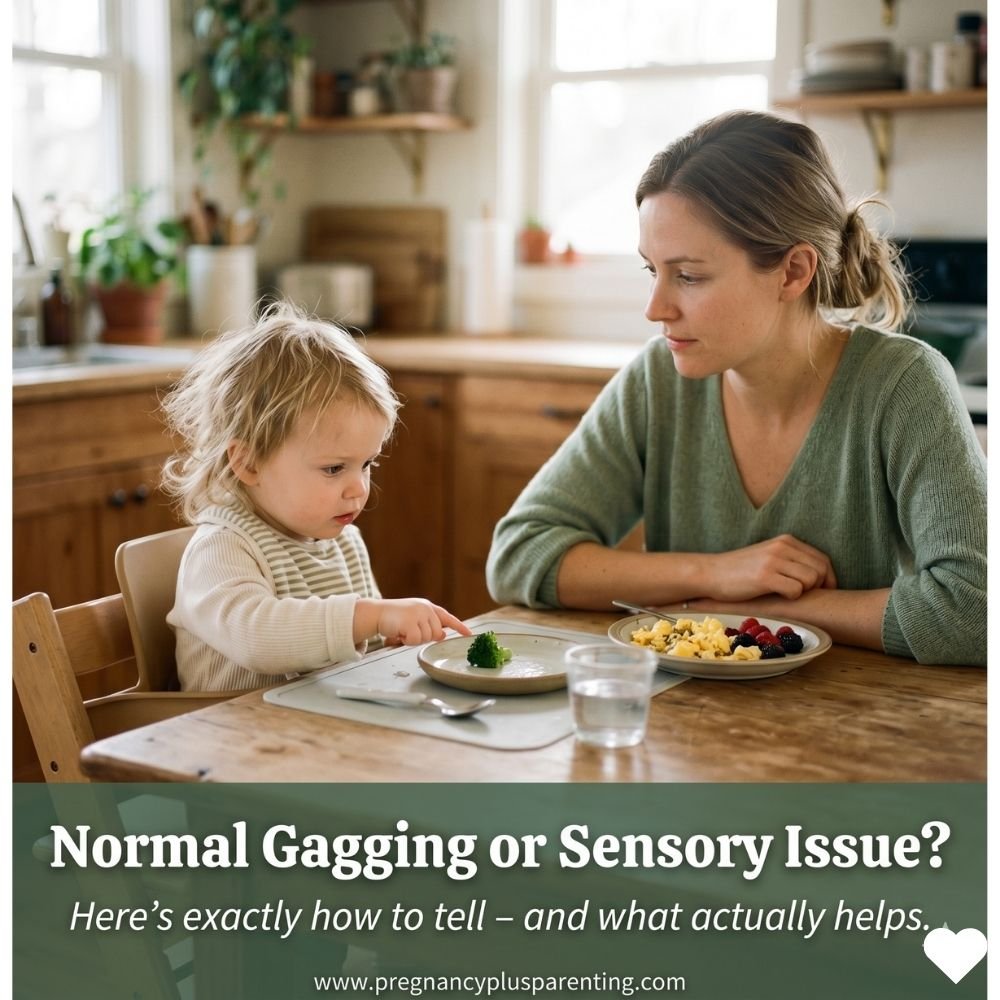
Some gagging at mealtimes is completely normal in toddlers — but there are clear signs that point toward a genuine sensory processing issue that benefits from professional support. This article tells you exactly how to tell the difference.
He picked up a piece of pasta, touched it to his lip — and gagged so violently that the entire table fell silent.
Not a small gag. A full-body, eyes-watering, hunched-forward retching that looked, to anyone who didn’t know us, like a medical emergency. My mother-in-law, who was visiting, made a sound of alarm. My husband reached out. And Eli — perfectly fine, completely unbothered — simply pushed the bowl away and said cheerfully: “No thank you, Mama. I don’t like red food.”
I excused myself to the kitchen and stood over the sink for a moment, feeling the very specific exhaustion of a mother who has been fighting this particular battle for eighteen months and still has no idea whether it is normal, whether it will end, whether she is doing something wrong, or whether her child needs help she hasn’t found yet.
If you are reading this, I think you know that feeling exactly. So let me share everything I eventually learned — from occupational therapists, from feeding specialists, from our pediatrician, and from research — laid out clearly for the parents who need real answers and not just reassurance.
See Also : The Truth About Picky Eaters That Pediatricians Don’t Tell You at the Well Visit
Understanding the Toddler Gag Reflex
Before we can answer the question of normal versus sensory issue, we need to understand what the gag reflex actually is and why toddlers have such a pronounced one.
The gag reflex is a protective neurological mechanism — it exists to prevent choking. When the back of the throat, or in some people the middle or front of the tongue, detects something unexpected — an unfamiliar texture, a food that’s too large, something that feels wrong — the body triggers a gagging response to push it forward or out.
Here is the crucial piece of information that changed how I thought about Eli’s gagging: in babies and young toddlers, the gag reflex is positioned much further forward in the mouth than it is in older children and adults. This is by design — it is an extra layer of protection for a child who is new to solid foods and doesn’t yet have the oral motor skills to safely process everything. As children grow and their oral motor skills develop, the gag reflex naturally migrates further back toward the throat — where adults experience it.
This means that some gagging in toddlers — especially when encountering new textures, temperatures, or food combinations — is a completely normal, developmentally expected response. It does not necessarily mean something is wrong. It does not mean your child is broken. And it does not mean every gag requires intervention.
This is important for safety. Gagging is loud — you can hear it, the child’s face is often red or watery-eyed, and they are working to expel something. Choking is silent — the airway is blocked, the child cannot make noise, their face may turn blue or they may be reaching for their throat. Gagging is the protective mechanism working. Choking is an emergency. If you ever observe true choking, act immediately with back blows and contact emergency services.

Normal Gagging vs. a Sensory Issue — How to Tell
This is the question at the heart of this article, and it deserves a real, clear answer rather than the vague “all children are different” response that leaves parents no more informed than when they started. Here is the framework I found most useful:
- Gagging on genuinely new or unfamiliar textures — especially mixed textures, lumpy foods, or strong flavors — in a toddler under 3 years old
- Gagging that is occasional and related to specific foods — they gag on mushrooms but eat dozens of other foods happily
- Gagging that decreases over time with repeated, low-pressure exposure to new foods
- Child who gags but recovers quickly and continues eating — the gag is a reaction, not a shutdown
- Gagging limited to mealtimes — no sensory issues with other textures in daily life (clothes, touching things, sounds)
- Child accepts 15–20+ foods across multiple food groups, even if their range feels narrow to parents
- Gagging is not accompanied by significant anxiety, distress, or complete refusal of mealtimes
- Gagging triggered by the sight or smell of food — before it even reaches the mouth — suggesting the nervous system is reacting at a sensory level, not a texture level
- A food repertoire of fewer than 15–20 foods that is shrinking rather than growing over time
- Gagging that frequently leads to vomiting — not just retching but actual vomiting — regularly at mealtimes
- Significant anxiety around mealtimes — distress, crying, tantrums, or avoidance behaviors that begin well before food is presented
- Texture aversions that extend beyond food into clothing, touching certain materials, or sensory reactions in other areas of daily life
- Gagging that has not reduced at all despite 6–12 months of consistent, positive food exposure
- Weight gain concerns or nutritional deficiency signs due to severely limited food intake
- The 20-food benchmark
Feeding therapists often use a benchmark of approximately 20 accepted foods as a rough threshold. A child who accepts 20 or more foods across different food groups — even if the range feels narrow to parents — is generally getting adequate nutritional variety. A child whose accepted food list falls below 15 foods, or whose list is shrinking, warrants a conversation with your pediatrician about a feeding evaluation.
Signs It May Be a Sensory Processing Issue
Sensory processing differences exist on a spectrum — from mild sensitivities that respond well to simple strategies at home, to more significant sensory processing disorders that benefit from occupational therapy. Here are the signs that point more specifically toward sensory processing involvement rather than typical toddler food selectivity:
Gagging to smell alone
If your toddler gags or retches when certain foods are cooked in the kitchen — before they have seen or touched the food — this suggests their olfactory and sensory system is hypersensitive in a way that goes beyond typical food preference.
Extreme texture specificity
Only accepts foods of one specific texture — only smooth and pureed, or only crunchy and dry — and has genuine physical distress responses to other textures. This is different from a child who prefers smooth foods.
Sensory issues beyond food
Significant sensitivity to clothing textures, labels, sock seams. Strong reactions to unexpected touch, loud sounds, bright lights, or crowded environments. Food sensitivities in a child with broader sensory sensitivities are often connected.
The food list is shrinking
A typical picky eater may not expand their food range quickly, but their accepted list stays relatively stable. A child with sensory food issues may progressively remove foods from their accepted list — a narrowing that warrants attention.
Mealtime anxiety is significant
Some resistance to new foods is normal. Genuine mealtime dread — anxiety that builds before mealtimes, tears at the sight of unfamiliar food, refusal to sit at the table — suggests the nervous system is in a state of threat around eating.
Regular vomiting at mealtimes
Gagging that regularly results in vomiting — not once in a while but frequently — is a significant sign that the oral sensory system is overwhelmed and that professional feeding support would likely help.
Food must be a specific brand
Accepting only one specific brand of chicken nuggets and gagging on any other brand — even visually identical versions — suggests the sensory processing is extremely precise in a way that differs from typical preference.
Cannot tolerate mixed textures
Many children with sensory food differences have strong reactions specifically to mixed textures — foods where a bite unexpectedly contains two different textures (chunky soup, casseroles, stews). This specific trigger is a common sensory processing pattern.
Sensory processing differences are neurological in nature — they are about how your child’s brain processes and interprets sensory information, not about how you have introduced foods or managed mealtimes. Many children with sensory food sensitivities have parents who did everything “right” from day one. This is not your fault. It is not your child’s fault either. It simply is — and it has real, effective solutions.
When Food Issues Go Beyond the Table
One of the most useful things I learned from Eli’s occupational therapist was to look at his food responses as part of his whole sensory picture — not as an isolated eating problem. She asked me questions I hadn’t expected:
Does he resist having his hair washed or cut? Does he notice and complain about clothing seams or tags? Does he cover his ears in loud environments? Does he seek out intense physical input — crashing into things, wanting to be squeezed, jumping from heights? Is he underreactive to some sensory input and overreactive to others?
The answers told a story. Eli was not “just” a picky eater. He was a child with a sensory system that was processing the world differently — and food, with its complex textures, temperatures, smells, and unpredictability, was simply the place where his sensory differences were most visibly on display.
Our occupational therapist explained that the mouth is actually one of the most sensory-rich parts of the human body — it contains an extraordinary concentration of sensory receptors. For a child whose nervous system is hypersensitive, eating is not just a physical act. It is a sensory experience of considerable intensity. Understanding this reframed everything about how I approached Eli’s mealtimes.
See Also : How I Got My Picky 6-Year-Old to Try New Foods Without Bribing or Battles
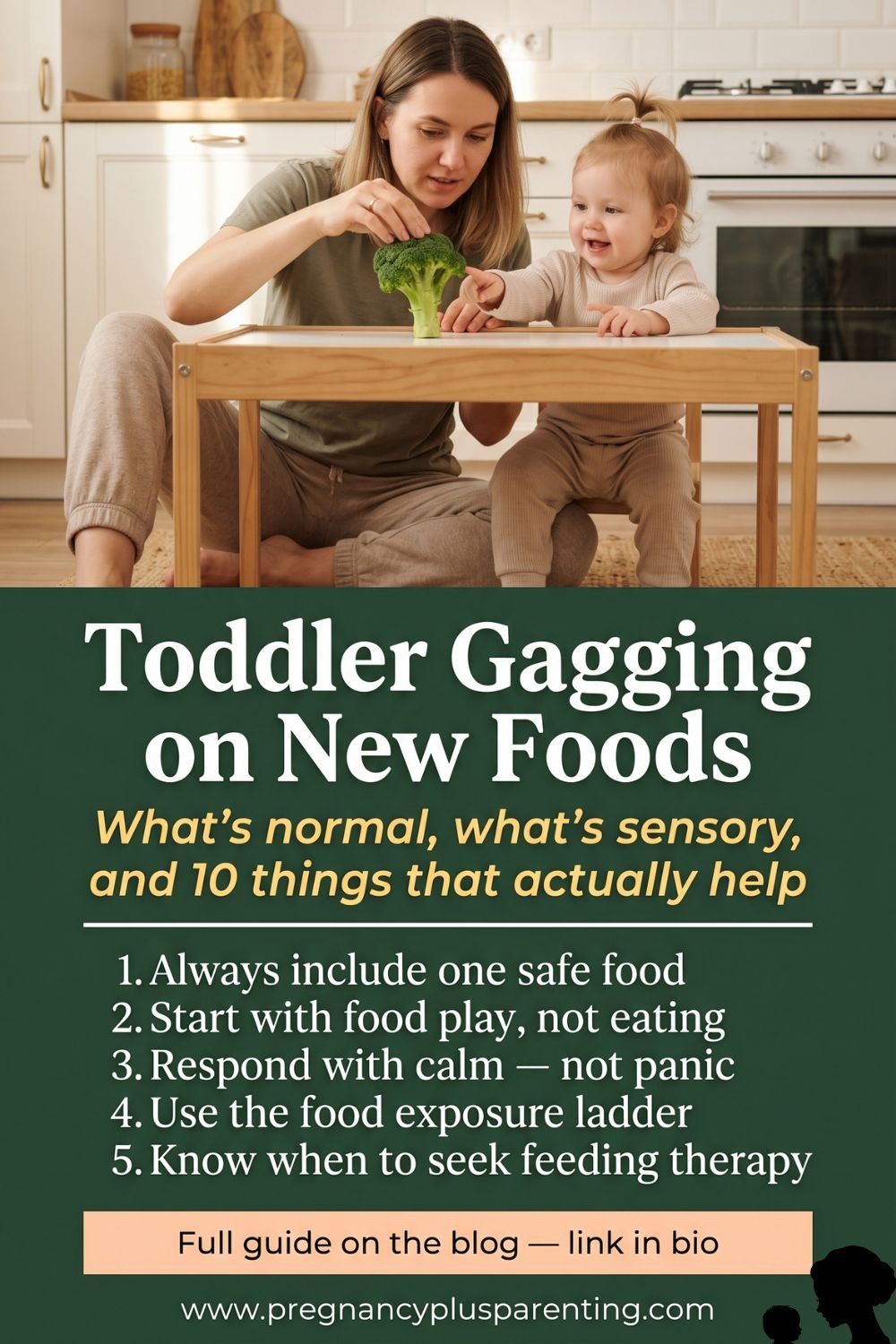
10 Strategies That Actually Reduce Gagging at Mealtimes
These are the approaches that made a genuine difference in our household and in the families I’ve spoken with who are navigating toddler food gagging. They draw on feeding therapy principles, sensory processing research, and the kind of practical, imperfect wisdom that only comes from real mealtimes with real toddlers.
Eliminate the pressure completely
The single most evidence-backed thing you can do for a child who gags at mealtimes is to remove all pressure to eat. “Division of responsibility” — a framework developed by feeding therapist Ellyn Satter — establishes that your job is to decide what, when, and where food is offered. Your child’s job is to decide whether and how much to eat. When the pressure is gone, the nervous system calms, and food exploration becomes possible.
Always include at least one “safe” food
At every single meal, make sure there is at least one food on the plate that your child reliably accepts and enjoys. This is not giving in or enabling picky eating — it is strategic. A child who knows their safe food is present is neurologically less threatened by the unfamiliar foods beside it. The safe food lowers the anxiety level of the entire meal۔
Start with food play — not food eating
For children who gag or show significant anxiety around new foods, the journey to eating something begins far before it goes in the mouth. Start with tolerance at a distance: a new food on the table. Then on their plate. Then touching it with a utensil. Then touching it with a finger. Each step is a genuine win. Do not rush to “just try a bite” — the ladder of exposure needs to be taken one rung at a time.
Keep portions tiny — one bite size
When you introduce a new food, make the portion laughably small. A single pea. One piece of pasta with sauce. A thumbnail-sized piece of new protein. A large portion of an unfamiliar food is visually and sensory overwhelming. A tiny amount makes the risk feel manageable. This is not a trick — it is genuinely how food exposure therapy works.
Try “food bridges” — same but different
A food bridge takes a food your child already accepts and uses it as a bridge to something similar. If they eat plain pasta, add butter. If they accept buttered pasta, try it with a tiny amount of mild cheese melted in. If they eat chicken nuggets, try homemade chicken strips in the same coating. Each bridge is small enough that the sensory difference is minimal and the risk feels lower to their nervous system.
Never hide vegetables or deceive
The “sneak the vegetables into the muffins” approach is popular and I completely understand the desperation behind it. But for sensory-sensitive children, it often backfires — when they discover the deception (and they often do, or they notice the taste is different), it damages trust around food and makes them even more vigilant and anxious at mealtimes. Long-term, honest exposure is more effective than short-term sneaking.
Make mealtimes sensory-calm
For a child whose nervous system is already working hard to process food, additional sensory load at mealtimes — loud TV, bright lights, overlapping conversations, strong-smelling foods nearby — makes things significantly harder. Try dimmer lighting, lower noise, and a calm mealtime environment. This is not coddling — it is managing the sensory load strategically.
Let them serve themselves
Children who have control over what goes on their plate — even from a family-style serving dish in the center of the table — tend to be more willing to engage with new foods than children who have food placed in front of them. The act of choosing and serving themselves provides an additional moment of sensory preparation and a sense of agency that reduces the threat response.
Cook together — even toddlers
A toddler who has touched, smelled, stirred, and had a role in preparing a food has already had multiple sensory exposures to it before it reaches the plate. Cooking together builds familiarity with ingredients in a low-stakes, playful context. You do not need them to taste anything during cooking — the exposure itself does the work over time.
Respond to gagging with calm neutrality
Your reaction to the gag shapes everything that comes after it. A panicked or disgusted parental reaction teaches a child that gagging is an alarming event — which increases their anxiety and makes future gagging more likely. A calm, matter-of-fact “your body didn’t like that one — let’s try your pasta” response teaches them that gagging is manageable and that mealtimes are safe. Fake the calm if you have to. It works.
The Food Exposure Ladder — A Gentle Framework
One of the most useful concepts I encountered in feeding therapy is the idea of a food exposure ladder — a framework that breaks down food acceptance into small, manageable steps rather than the binary of “eating it” vs. “refusing it.” Every rung of the ladder is a genuine win worth celebrating:
The key insight is that most parents focus entirely on rung 5 — did they eat it? — and feel defeated by every meal that doesn’t reach that level. But a child moving from rung 1 to rung 2 has made real neurological progress. Celebrate every rung, and resist the urge to push more than one rung at a time.
See Also : Why Won’t My 2 Year Old Eat Anything But Crackers? (And How to Gently Expand Their Diet)
What to Say at Mealtimes — and What Never to Say
The language around food shapes a child’s relationship with eating — and for a sensory-sensitive child, it can make the difference between a mealtime that stays manageable and one that spirals into full distress. Here is what I learned from our feeding therapist:
Try to avoid
“Just try one bite. Just ONE.”
“You won’t get dessert unless you eat this.”
“Don’t be so dramatic — it’s just food.”
“Your brother eats everything. Why can’t you?”
“You haven’t even tried it! You don’t know you don’t like it.”
“Fine, starve then.”
“Stop gagging, you’re going to make yourself sick.”
Try instead
“You don’t have to eat it. It’s just visiting your plate today.”
“Can you tell me what that food looks like? What color is it?”
“You can touch it or not — your choice. No pressure.”
“Your body said no to that one. That’s okay. Here’s your pasta.”
“Wow, you touched it with your finger! That was brave.”
“You’re learning about new foods. That takes time. You’re doing great.”
“I wonder what this smells like — should we smell it together?”
When to Seek Professional Support
Here is the guidance I wish someone had given me clearly in the beginning — because I waited longer than I should have before seeking a feeding evaluation, and earlier support would have helped us move faster.
| What you are observing | What it may indicate | Action |
|---|---|---|
| Gagging that frequently leads to vomiting at meals | Hypersensitive gag reflex; possible oral sensory processing issue | Seek evaluation soon |
| Accepted food list under 15 foods and shrinking | Avoidant/Restrictive Food Intake Disorder (ARFID) pattern | Seek evaluation soon |
| Weight gain concerns or nutritional deficiency | Intake too limited for adequate nutrition | Contact pediatrician now |
| Significant mealtime anxiety, distress, or avoidance | Negative food relationship forming; sensory or anxiety component | Seek evaluation soon |
| Gagging on sight or smell of food (not texture) | Sensory processing difference; hypersensitive olfactory system | Request OT evaluation |
| Food sensitivities plus broader sensory differences | Sensory processing disorder; SPD assessment recommended | Request OT evaluation |
| Occasional gagging on new textures, wide food variety | Developmental — likely typical toddler behavior | Monitor at home |
| Gagging decreasing over time with exposure | Normal gag reflex maturing as expected | Continue home strategies |
Start with your pediatrician for a referral and to rule out medical causes (reflux, anatomical issues, allergies). Ask for a referral to a pediatric occupational therapist who specializes in feeding, or a speech-language pathologist with feeding expertise — both can evaluate and treat oral sensory and feeding difficulties. A feeding therapist or a program using the SOS (Sequential Oral Sensory) Approach to Feeding is particularly well-regarded for children with sensory food issues.
Mistakes That Make Food Gagging Worse
I made most of these. I share them with the deepest solidarity:
Showing your own distress in response to the gag. I know how hard this is — watching your child gag is viscerally upsetting. But a parent who gasps, rushes forward, looks panicked, or shows visible disgust teaches a child that gagging is alarming and that mealtimes are a high-stakes event. Practice your poker face. Practice the calm “oh, your body didn’t want that one — no worries” voice in the mirror if you need to. It is genuinely one of the most effective things you can do.
Forcing bites or insisting “just one taste.” Forced feeding — even one reluctant bite — is associated in research with increased food refusal, increased mealtime anxiety, and in sensitive children, a deepened negative association with the forced food. It may feel like you are making progress when your child reluctantly takes a bite. But the data shows it typically moves in the wrong direction long-term.
Using food as reward or punishment. “Eat your broccoli and you can have dessert” sounds reasonable and is deeply ingrained in many of our parenting cultures. The research on this is clear: it increases the child’s dislike of the required food (broccoli) and inflates their desire for the reward food (dessert). For sensory-sensitive eaters, it adds pressure that compounds the existing anxiety.
Making separate “safe” meals for every dinner. This one is complicated. Consistently making separate meals gives your child no exposure to the family’s food and removes any opportunity for the gradual familiarity that builds acceptance. However, always forcing them to eat the family’s food with no safe option creates anxiety and distress. The middle path — always include one safe food alongside the family’s meal — is where most feeding therapists land.
Waiting too long to seek professional support. I waited 18 months before asking for a feeding evaluation for Eli. I kept hoping he would “grow out of it.” When we finally saw the OT, she identified specific sensory differences that we had been inadvertently making more entrenched by some of our responses at mealtimes. Earlier support would have helped us intervene before certain patterns were deeply established. If your instincts are telling you something needs attention — trust them. It is always easier to ask and be reassured than to wait and wish you had asked sooner.
Commenting on what other children eat. “Look how well Mia is eating!” or “Your cousin eats everything, maybe you can try it like her” adds social pressure and shame to an already anxious mealtime experience. It never, in the history of toddlers, has made a child more willing to eat. It only makes them feel inadequate in a space where they are already struggling.
See Also : Easy High-Protein Meals for Toddlers Who Refuse to Eat Anything Green
FAQ from Worried Parents
Avoidant/Restrictive Food Intake Disorder (ARFID) is a recognized feeding disorder characterized by an extremely limited food repertoire that impacts nutrition or daily functioning and is not explained by cultural practices or another medical condition. Only a qualified professional can diagnose ARFID — it is not something to self-diagnose from an article. What I can tell you is that a repertoire of five foods warrants a conversation with your pediatrician and likely a feeding evaluation, regardless of whether the diagnosis ends up being ARFID or something else. The sooner you seek support, the better the outcomes tend to be.
For many children with typical developmental gagging — a child who gags on some new textures but has a wide food repertoire and no significant food anxiety — yes, the gag reflex does mature and gagging decreases significantly by ages 3 to 4 as oral motor skills develop. For children whose gagging is connected to sensory processing differences, waiting without support tends to result in patterns becoming more entrenched rather than resolving on their own. The distinction between these two groups is exactly why knowing the signs matters.
You know your child better than anyone, including your pediatrician. If your gut is telling you this is more than typical picky eating — if the food list is extremely narrow, if there is significant distress at mealtimes, if the gagging is frequent and severe — you are allowed to advocate for a referral. Ask specifically for a pediatric occupational therapy evaluation for feeding or a speech-language pathology feeding assessment. If your pediatrician doesn’t refer and you remain concerned, seek a second opinion or self-refer to a feeding therapist if that’s available in your area. Trust your instincts.
Absolutely — and this is an important question to ask your pediatrician. Gastroesophageal reflux (GERD) or silent reflux can cause significant discomfort during eating and can result in gagging, arching, refusal, and food selectivity. A child who gags and also shows signs of discomfort during or after eating, waking at night with pain, arching their back, or chronic irritability around feeding may have an underlying reflux issue that needs medical treatment. Reflux and sensory processing issues can also co-exist — they are not mutually exclusive.
This varies significantly depending on the child’s age when they start, the severity of their sensory or feeding difficulty, and the approach used. Many families begin to see positive shifts — reduced mealtime anxiety, more willingness to interact with new foods, new foods being added to the accepted list — within two to four months of consistent feeding therapy. Significant expansion of the food repertoire often takes six to twelve months. It is not a fast process. But for children who genuinely need it, the results are real and meaningful, and early intervention produces better outcomes than delayed support.
This is one of the most honest questions a parent can ask and it deserves an honest answer: you lower the stakes as much as you possibly can. Make sure there is always something safe on the plate. Remove all pressure to eat new foods. Turn off screens if they’re causing stimulation issues but keep the atmosphere light. Talk about anything except what anyone is eating. Let mealtimes be about connection and time together, with food as a side note. This is genuinely the approach that feeding therapists recommend — and it often results, paradoxically, in children becoming more willing to engage with food, not less. Pressure is the enemy of progress. Connection is the vehicle.
A Note to the Mama Eating Cold Dinners Alone
I want to say something to the mother who has spent the last six months cooking meals that get pushed away, watching her child gag at the dinner table, quietly eating her own cold food after everyone else has given up and left. The mother who is simultaneously worried something is truly wrong and terrified she might be imagining it. The mother who Googles this at midnight wondering if it is her fault.
It is not your fault. You did not cause this. You are not failing your child.
Toddler feeding difficulties — whether typical developmental gagging or genuine sensory processing differences — are among the most emotionally wearing experiences of early parenting because they happen at least three times a day, every day, at the table where your family is supposed to connect and nourish each other. The weight of that is real.
What I want you to take from this article is this: you are not powerless. There are strategies that genuinely help. There is professional support that genuinely works. And your child’s relationship with food is not fixed by what is happening at your table right now.
This is a chapter, not the whole story. And you are going to write a better one.
Resources That Helped Our Family
Helping Your Child With Extreme Picky Eating by Katja Rowell and Jenny McGlothlin — the most practical, compassionate book I found for parents navigating significant food selectivity and sensory feeding issues.
Child of Mine: Feeding With Love and Good Sense by Ellyn Satter — the foundational text on Division of Responsibility in feeding, and the framework that most feeding therapists use as their base.
ARFID Awareness UK and ARFID Awareness International — informational resources for families whose children may have more significant food restriction patterns.
The SOS Approach to Feeding (sosapproachtofeeding.com) — information on the Sequential Oral Sensory approach, and a directory for finding trained therapists in your area.
Your child eating is not a measure of your worth as a parent. A warm, low-pressure, connected mealtime — even one where very little new food is eaten — is doing more good than a high-pressure meal that ends in tears and everyone leaves the table feeling defeated. You are building the relationship. The food comes later, and it does come.