
2-Year-Old Development Milestones: What Most Toddlers Can Do
If you have a 2-year-old, you probably already know that development does not happen in a neat, predictable order.
One child may be talking all day but still struggle to use a spoon without making a mess. Another may be climbing everything in sight but only have a handful of words. One toddler may love playing with other children, while another is perfectly happy playing beside them.
So when you look up 2 year old development milestones, it can be easy to turn a helpful checklist into a comparison exercise.
Try not to.
Milestones are meant to give parents and healthcare professionals a general picture of how children are developing. They are not a test that your child has to pass on their second birthday. The CDC describes developmental milestones as skills that most children — 75% or more — can do by a certain age. Children can still develop at different rates and have areas where they are stronger or less confident.
At age two, there is a lot going on. Your toddler is learning new words, testing their independence, figuring out how things work, becoming more aware of other people and emotions, and getting better at controlling their growing body.
Here are some of the 2 year old milestones you may start noticing.
Language and Communication
Language development can be one of the biggest things parents notice around age two.
Some toddlers suddenly seem to learn new words every day. Others are quieter and communicate with a mixture of words, sounds, pointing and gestures.
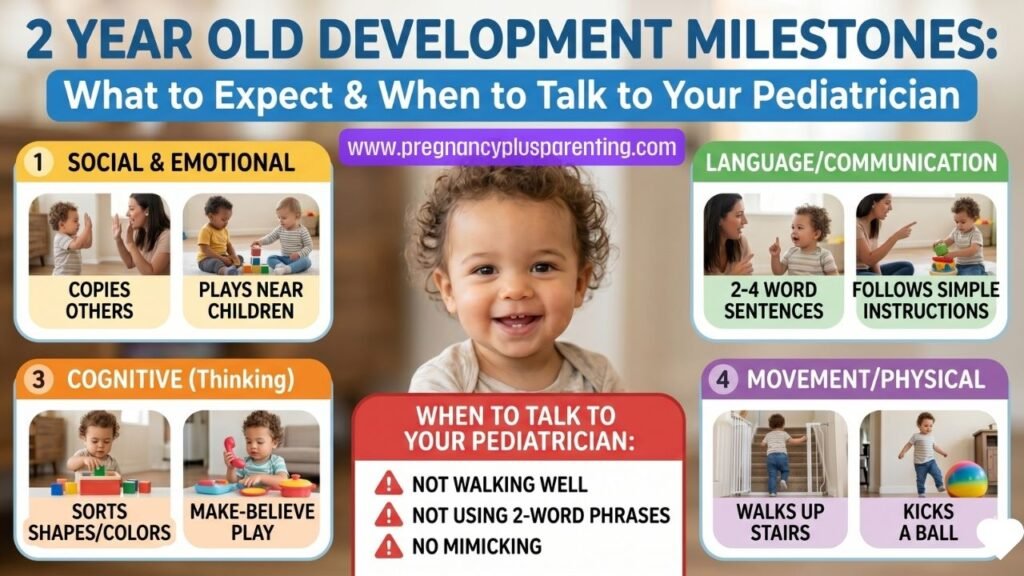
Around this age, many children are beginning to:
- Put two or more words together, such as “more milk,” “mommy come,” or “big truck”
- Use words to ask for something they want
- Point to things they recognize in a book when you ask
- Follow simple instructions
- Name familiar people, animals or objects
- Try to get your attention by talking or calling you
- Use more words to describe what they want, see or are doing
- Understand more words than they can say
- Start using words such as “me,” “mine” or their own name
ASHA’s communication guidance for children around 2 to 3 years includes frequent word combinations, getting an adult’s attention through language, answering simple questions and gradually becoming clearer in speech.
What does 2-year-old language development look like at home?
It might look very ordinary.
Your toddler points at the kitchen counter and says, “Cookie please.”
They see a dog outside and say, “Doggy!”
You ask, “Where are your shoes?” and they go looking for them.
You say, “Let’s get your cup and sit at the table,” and they understand what you mean.
Their pronunciation may still be far from perfect. “Nana” might mean banana. “Wawa” might mean water. That is okay. You are looking at whether your child is communicating and gradually adding to what they can understand and say.
There is also no need to expect a two-year-old to sound like a preschooler. Speech is still developing, and unfamiliar people may not understand everything they say. ASHA notes that speech becomes clearer during the 2-to-3-year period but may still be difficult for unfamiliar listeners to understand.
Social and Emotional Development
Two-year-olds are becoming much more aware of people around them, but they are still very young when it comes to handling emotions.
This is the age of big reactions.
Your toddler may be laughing one minute and crying because you gave them the “wrong” cup the next.
That does not mean something is wrong. They are still learning how to deal with frustration, disappointment, excitement and all the other feelings that come with becoming more independent.
Many 2-year-olds:
- Show affection toward parents and familiar caregivers
- Look to you for comfort when upset
- Show interest in other children
- Copy what adults or older children are doing
- Play beside other children, even if they are not really playing with them yet
- Have strong likes and dislikes
- Want to do things themselves
- Become upset when routines change
- Show happiness, anger, fear, excitement and affection quite openly
- Begin to notice when someone else is upset
Parallel play is normal
You may take your toddler to the park expecting them to make a little friend.
Instead, they sit next to another child and play with their own toy without interacting much.
That is called parallel play, and it is common at this age.
Your child does not need to share, cooperate and play a complicated game with another toddler yet. Those social skills develop gradually.
What matters more is that your child shows some interest in people, responds to familiar caregivers and is developing ways to connect with others.
Thinking and Learning
A two-year-old’s brain is busy making connections all day long.
You may notice that your toddler is suddenly very interested in how things work.
They push a button to see what happens. They put a toy inside a box and then take it out again. They try the same action repeatedly because they want to see whether the result will be the same.
This is learning.
At around two years, many toddlers are beginning to:
- Engage in simple pretend play
- Use objects in familiar ways, such as pretending to feed a doll
- Find familiar things when you ask
- Recognize some colors, shapes or objects
- Begin sorting similar objects
- Complete very simple puzzles
- Understand simple concepts such as in, on and under
- Follow simple instructions
- Remember familiar routines
- Begin understanding simple cause and effect
- Point to familiar body parts
- Explore objects to find out what they do
You do not need to sit your toddler down for formal “learning time” for these skills to develop.
When your child puts the teddy in a toy bed and covers it with a blanket, that is learning.
When they put all the cars in a box and then take them out again, that is learning too.
Physical Development
Two-year-olds usually want to move.
A lot.
Running across the room, climbing onto the sofa, kicking a ball and trying to jump are all ways your toddler is learning what their body can do.
Many toddlers around age two can:
- Walk and run with increasing confidence
- Kick a ball
- Throw a ball
- Climb onto low furniture or playground equipment
- Walk up stairs with help or by holding a railing
- Carry toys while walking
- Bend down to pick something up and stand again
- Start trying to jump with both feet
- Move around obstacles with better coordination
They will still fall.
They may trip over their own feet, bump into furniture or misjudge a step. Toddlers are still developing balance, coordination and awareness of their bodies.
So don’t worry if your 2-year-old’s running does not look particularly graceful yet.
Fine Motor Skills
Fine motor skills involve the smaller movements of the hands and fingers.
You may see these skills during meals, drawing, playing with blocks or helping around the house.
A 2-year-old may be able to:
- Turn the pages of a book
- Scribble with a crayon
- Stack blocks
- Put simple objects into containers
- Try to use a spoon independently
- Drink from a cup
- Pick up small objects using their fingers
- Build simple towers
- Try to open containers or lids
- Help with simple dressing tasks
And yes, they will probably spill things.
Letting your toddler try to feed themselves may mean more cleaning up, but those messy attempts are also practice. You don’t have to make every meal a lesson. Simply giving them opportunities to try is enough.
Everyday and Self-Help Skills
This is an area that often gets overlooked when parents search for developmental milestones.
Your toddler is not only learning words and physical skills. They are also slowly learning how to take part in everyday life.
At two, you may see your child starting to:
- Help put toys away
- Carry something light for you
- Take off simple clothing items
- Try putting on shoes
- Wash or dry their hands with help
- Brush their teeth with your help
- Use a spoon and cup
- Help put laundry into a basket
- Choose between two simple options
- Follow familiar routines
- Help with simple household tasks
These skills do not have to be perfect.
If your toddler puts their shoes on the wrong feet but proudly comes running to show you, that still counts as practice.
What about potty training?
There is no need to use potty training as a test of whether your child is developing “on time.”
Some toddlers show interest around two. Others are nowhere near ready.
Readiness can include noticing when they are wet or soiled, showing interest in the toilet, being able to communicate that they need to go and being able to follow simple instructions.
Being in diapers at two does not automatically mean your child is behind.
What If My 2-Year-Old Isn’t Doing These Things Yet?
This is probably the part you were looking for when you searched for 2 year old milestones.
First, take a breath.
Not checking every box on a milestone list does not automatically mean there is a problem.
Development is not perfectly even. Your child may be ahead in one area and still developing another. A toddler might have lots of words but be cautious with climbing. Another may be physically confident but use fewer words.
Look at the overall picture rather than one isolated skill.
Ask yourself:
- Is my child learning new things over time?
- Are they communicating with me in some way?
- Do they understand what I say?
- Do they show interest in people around them?
- Do they play and explore?
- Are they gaining new physical or self-help skills?
- Have they lost a skill they previously had?
If you have concerns, you do not have to wait until they become severe before mentioning them.
A pediatrician can look at your child’s development more broadly and decide whether further screening or an assessment would be useful.
When should I talk to a pediatrician?
Consider bringing up your concerns if your 2-year-old:
- Is not using words to communicate
- Is not putting words together
- Does not seem to understand simple language or instructions
- Rarely responds to their name or to people trying to get their attention
- Does not use gestures such as pointing, showing or waving
- Shows very little interest in interacting with other people
- Does not appear to be developing new skills over time
- Has lost words, social skills or other abilities they previously had
- Has significant concerns with hearing
- Has ongoing difficulties with movement or coordination that concern you
These signs do not tell you what diagnosis a child has. They simply mean that a conversation with a qualified professional may be worthwhile.
For example, a child who is not talking much may have many possible reasons for slower language development. A hearing problem can sometimes affect speech and language, which is one reason hearing may be checked when there are communication concerns. ASHA specifically recommends seeking professional guidance when a child is not meeting many communication milestones in their age range.
Don’t wait if your child loses a skill
A child forgetting something temporarily is not the same as losing a skill they had clearly developed.
If your toddler was regularly using words, interacting in a certain way or doing a physical skill and then loses that ability, tell their healthcare provider.
You do not need to figure out why it happened yourself.
Just describe what you noticed and when it started.
What About Autism Screening at Age Two?
Developmental concerns can sometimes make parents immediately worry about autism.
Try not to diagnose your child from an online checklist.
Autism screening is part of routine pediatric care in the United States. The American Academy of Pediatrics recommends autism screening at 18 and 24 months, and screening is different from diagnosis. A screening result does not by itself mean that a child is autistic.
If you have concerns about your child’s communication, social interaction or behavior, bring them up with your child’s doctor rather than trying to work out the answer yourself.
And if you are outside the United States, the exact screening process may be different. Your child’s pediatrician or local child-development service can guide you.
Simple Ways to Support Your 2-Year-Old’s Development
You don’t need expensive toys or a complicated toddler curriculum.
A lot of development happens during ordinary family life.
Talk about what you are doing
You can talk while making breakfast, getting dressed or walking to the shop.
“I’m cutting the banana.”
“Your red shirt is here.”
“Let’s put your shoes by the door.”
You are giving your toddler words they can hear again and again in meaningful situations.
ASHA recommends talking about what you and your child are doing, using a variety of words, listening and responding, reading together and speaking in the languages you are most comfortable using.
Read the same books again and again
Toddlers often have one book they want every night.
Let them.
Repetition helps them become familiar with words, pictures, characters and the order of a story.
You don’t have to finish every page. Point at a picture and say, “Look, the cat is sleeping.” Let your child point, make sounds or tell you what they see.
Let your toddler help
Give them small jobs that are safe and manageable.
They can put socks in the laundry basket, carry a napkin to the table, put toys into a box or help stir something while you are cooking.
These little jobs give them practice with movement, language, following instructions and independence.
Play without taking over
Give your toddler blocks, toy animals, dolls, cars, cups, boxes or crayons and let them decide what to do.
If they make a tower, you can say, “That’s a tall tower.”
If they put a toy inside a box, you can say, “The car is in the box.”
You are adding language without turning play into a lesson.
Get outside
A walk to the park, playing with a ball, climbing safely or simply exploring the garden gives your toddler opportunities to move and explore.
It doesn’t have to be an organized activity.
Give simple choices
Instead of asking an open question such as “What do you want to wear?” try:
“Do you want the blue shirt or the yellow shirt?”
This gives your toddler a chance to communicate while keeping the choice manageable.
Talk about feelings
When your toddler is frustrated, you can put simple words to what is happening.
“You wanted the toy.”
“You’re angry because we have to leave.”
“You’re sad that Daddy went to work.”
You are not expected to stop every tantrum with the perfect sentence. Sometimes your toddler will still cry.
The goal is simply to help them gradually connect feelings with words.
A Note About Screen Time
Screens are part of many families’ lives, so there is no need to feel guilty about every minute your toddler spends watching something.
The more useful question is what that screen time is replacing.
At two, children learn a lot through talking, moving, playing and interacting with people. When your child does watch something, watching together and talking about what you see can make the experience more interactive.
If you are concerned about your child’s screen use, talk with your pediatrician about what is appropriate for your family and your child’s needs.
2-Year-Old Development Milestones: Questions Parents Often Ask
Should my 2-year-old be talking in full sentences?
Not necessarily.
At this age, many toddlers are using short phrases and combining words. Their language will become longer and more complex over the coming year. ASHA’s 2-to-3-year communication milestones include frequent word combinations, but children are still developing grammar and clarity during this period.
If your toddler is using very few words or is not combining words, it is reasonable to mention this to their pediatrician or a speech-language professional rather than simply waiting.
My 2-year-old understands everything but doesn’t say much. Is that normal?
Good understanding of language is useful information, but it does not mean communication concerns should automatically be ignored.
If your toddler understands what you say but uses very few words, talk to their pediatrician. They may recommend monitoring, a hearing check or a speech-language evaluation depending on the situation.
Is it normal for a 2-year-old to have tantrums every day?
Tantrums are very common at this age.
A two-year-old is still learning to handle frustration, wait, communicate wants and manage strong emotions. Daily tantrums can happen, especially around things like hunger, tiredness, transitions and being told “no.”
What matters is the bigger picture. If tantrums are extremely difficult to manage, involve frequent serious injury, or are happening alongside other developmental concerns, bring them up with your child’s healthcare provider.
Should my 2-year-old play with other children?
They may show interest in other children without actually playing cooperatively with them.
Playing alongside another child is common at this age. Your toddler might watch, copy or occasionally interact with another child, then return to their own activity.
Social skills develop gradually, so don’t expect a two-year-old to behave like a much older preschooler.
What if my child is ahead in some areas and behind in others?
That can happen.
Development is not always balanced across every area. Your toddler may be physically confident but quieter with language, or very verbal while still developing coordination.
Instead of comparing one skill with another child, look at whether your own child’s skills are gradually developing and whether there are any concerns worth discussing with a professional.
The Big Picture
Looking at 2 year old development milestones can be helpful, especially when you use them as a way to understand your child rather than as a scorecard.
At two, your toddler is learning to communicate, move, play, think, manage feelings and do more things independently.
Some days you may feel like they are growing by the hour.
Other days it may seem like you are repeating the same instruction twenty times.
Both are part of having a two-year-old.
Keep talking to them. Read together. Let them play. Give them chances to try things for themselves. Notice what they are learning, not just what they haven’t mastered yet.
And if something genuinely concerns you, ask.
You do not need to wait until you are completely certain that something is wrong. A conversation with your child’s pediatrician is simply a way to get another pair of experienced eyes on your child’s development.
Milestones are there to help you notice your child’s progress — not to make you worry about every little thing.
When in doubt, write it down
If you are worried about your child’s development, make a few simple notes before the appointment.
Instead of writing:
“I’m worried that my child is behind.”
Try:
“She uses about 15 words.”
“She understands simple instructions but does not combine words.”
“He points to things he wants but rarely points to show me something interesting.”
“She stopped using a word she used every day.”
Specific examples give your child’s healthcare provider something useful to work with.
And remember, you know your child well. Your observations matter.
If a concern stays on your mind, it is okay to ask about it.
Helpful Resources
For a more detailed checklist, the CDC’s Learn the Signs. Act Early. program has a milestone checklist for children around age two. The CDC explains that its milestone lists describe things most children — 75% or more — can do by that age, and the checklist is intended to support conversations with healthcare providers rather than replace formal developmental screening.
For speech and language development, ASHA provides communication milestone information for children from birth through age five and guidance on when to consider speaking with an audiologist or speech-language pathologist.
The American Academy of Pediatrics also recommends developmental surveillance and autism screening at the 18- and 24-month visits.
A final note: This article is for general information and is not a substitute for medical advice. If you have concerns about your child’s development, hearing, speech, movement, behavior or loss of skills, speak with your child’s pediatrician or another qualified healthcare professional.