
The discipline tool that teaches real lessons without punishments, threats, or anyone losing their mind
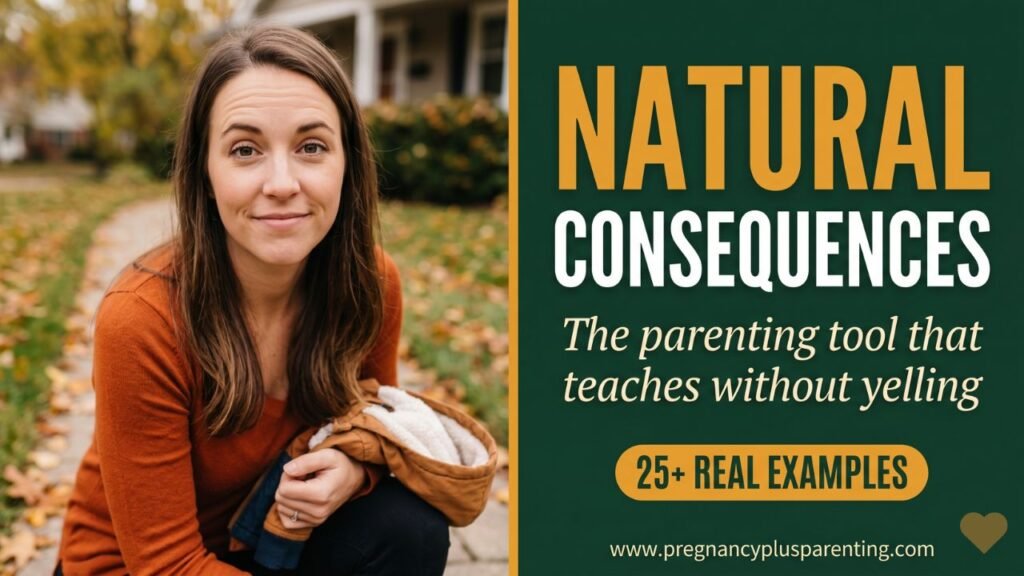
I had asked three times. I had explained three times. I had tried bribery. I had tried reasoning. I had tried the cheerful “let’s put on your cozy jacket!” voice that I read about in a parenting book and which, in practice, sounds exactly as hollow as it feels. She crossed her little arms and said no with the conviction of someone who had made a decision and would not be revisited on the matter.
And then I remembered something I had read about natural consequences. I took a breath, handed her the jacket to carry, and said — in the most genuinely calm voice I have ever produced — “Okay. Bring it with you in case you change your mind.” And I let her walk to the car without it.
She lasted approximately ninety seconds before she tugged on my sleeve and said, “Mama. Jacket please.”
That was the whole lesson. No lecture. No “I told you so.” No battle. Just ninety seconds of cold air and one small, meaningful, entirely self-generated piece of learning. That is what natural consequences look like when they work — and understanding when and how to use them is genuinely one of the most liberating things I have learned as a parent.
🌿What Natural Consequences Actually Are
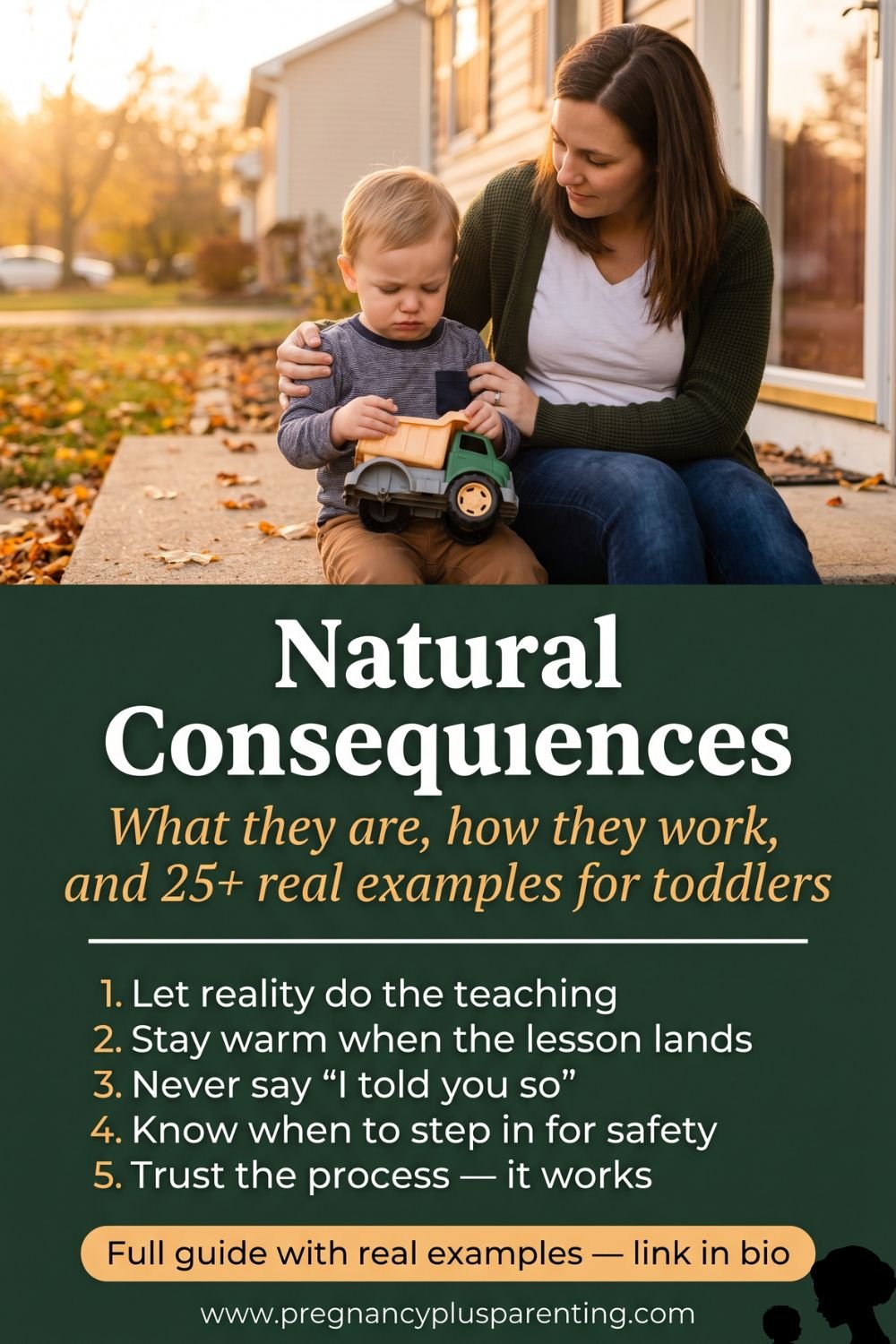
Natural consequences are the outcomes that occur as a direct, logical result of a child’s behavior — without any parental imposition, threat, punishment, or manipulation. They are simply what reality delivers when a choice is made.
The concept was developed most extensively by Rudolf Dreikurs, building on Alfred Adler’s work in individual psychology, and has been refined by generations of child development researchers since. The core premise is elegant: children learn most effectively from experience, not from being told what experience will teach them.
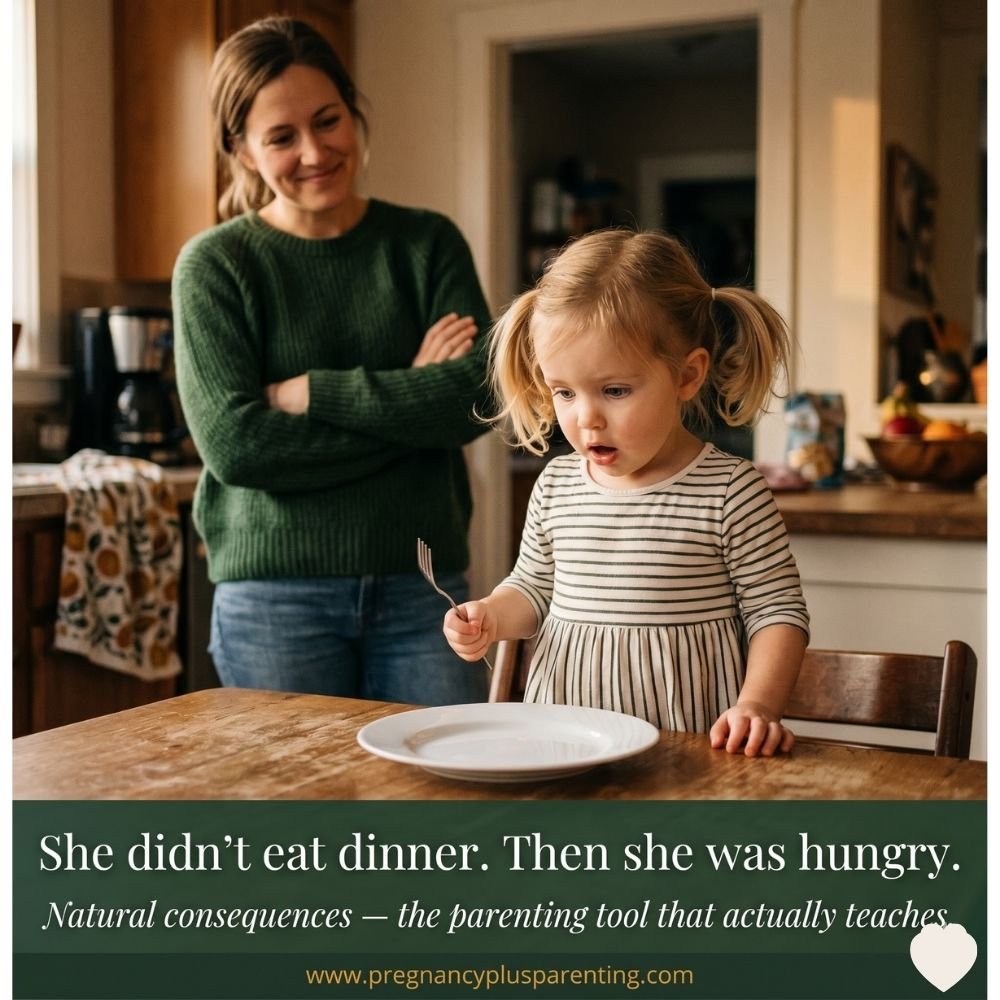
When your toddler refuses to eat dinner and then feels hungry an hour later — that is a natural consequence. When they throw their toy and it breaks — natural consequence. When they won’t put their shoes on and the grass is wet — natural consequence. Reality is already doing the teaching. Natural consequences are simply about getting out of the way and letting it.
Natural consequences work because they are honest. They are not arbitrary adult decisions about what should happen — they are what actually happens. A toddler’s brain, with its limited capacity for abstract reasoning, responds much more powerfully to the concrete reality of being cold than to a parent’s explanation of why cold happens. Experience teaches in a way that explanation simply cannot.
🍂Natural vs. Logical Consequences — The Important Difference
These two terms are often used interchangeably, but they are meaningfully different — and understanding the difference helps you choose the right tool for each situation.
Occur without any parental intervention. They are the direct result of the behavior — what the world delivers on its own. The parent simply steps back and allows it to happen rather than rescuing the child from it.
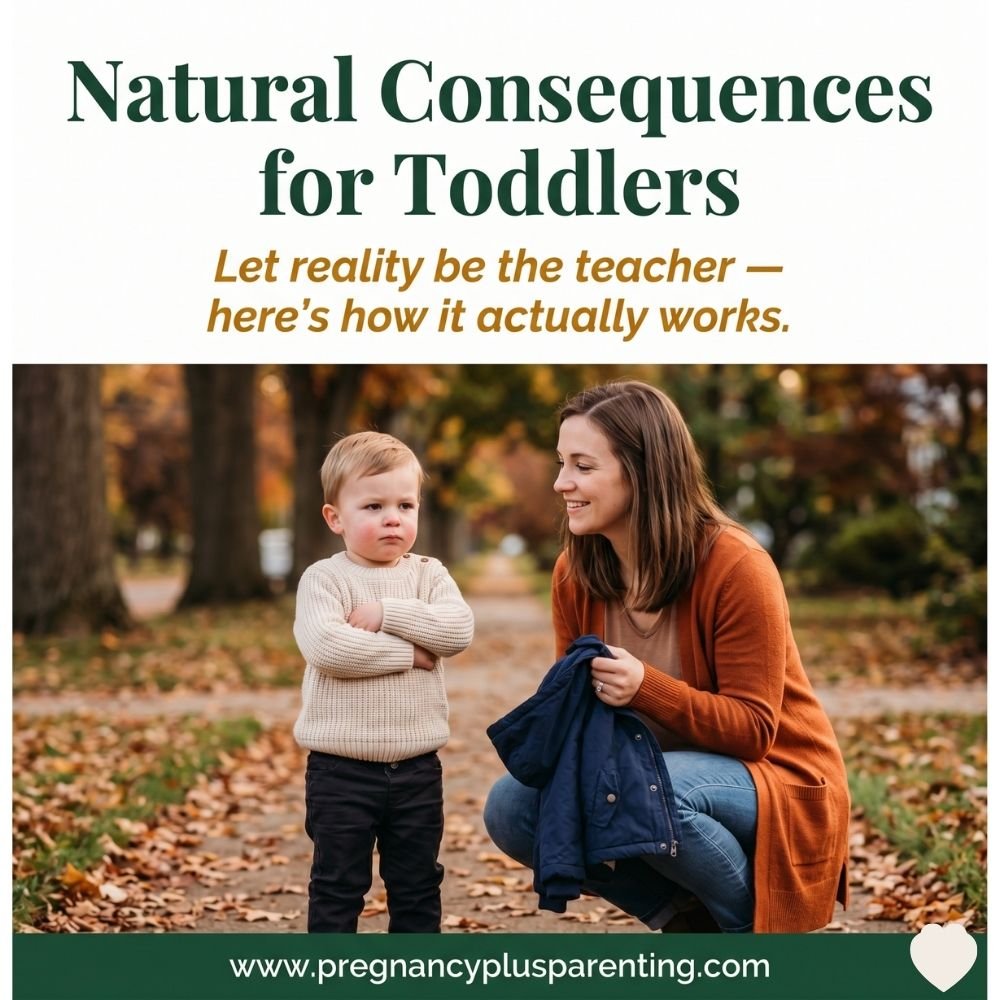
Example: Toddler refuses to wear mittens → hands get cold → they ask for mittens. You did nothing except not rescue them from the cold.
Introduced by the parent but directly related and proportionate to the behavior. They make intuitive sense — the consequence logically follows from the choice. They require parental action but should feel fair, not punitive.
Example: Toddler throws food → meal ends immediately. The parent ends the meal — this doesn’t happen automatically — but the consequence directly relates to the behavior.
Both are powerful. Natural consequences are generally preferable when they exist and are safe, because they remove the parent from the equation entirely — there is no one to be angry at, no authority to resist. Logical consequences are necessary when there is no natural consequence, or when the natural consequence would be unsafe or too far in the future to be meaningful to a toddler.
One important limitation of natural consequences with very young toddlers: their sense of time is extremely compressed. A consequence that happens tomorrow or next week is too far removed from the behavior to create the connection your toddler needs. Natural consequences work best when they happen quickly — ideally within minutes or hours of the behavior. If the consequence would take days or weeks to materialize, a logical consequence that happens immediately is more educationally effective.
🌿Why Natural Consequences Work So Well for Toddlers
There are several reasons why natural consequences are particularly well-suited to toddler discipline — reasons rooted in developmental psychology and neuroscience:
They eliminate the power struggle entirely
A natural consequence doesn’t come from you — it comes from reality. There is no authority to resist, no parent to argue with, no battle to win or lose. The toddler’s need to assert independence and test limits hits a wall made of actual physics and natural law rather than parental will. Cold hands don’t care about your toddler’s opinions about mittens. This removes the relational conflict from the equation and lets the learning happen cleanly.
They are concrete and immediate
Toddlers’ brains are not yet wired for abstract reasoning — they learn through direct experience far more effectively than through explanation. “You’ll be cold without your jacket” is abstract. Actually being cold is concrete, immediate, and completely impossible to argue with. The felt experience bypasses the cognitive limitations of the toddler brain and creates a direct learning connection between choice and outcome.
They build intrinsic motivation rather than compliance
Children who learn through experience develop internal reasons to make good choices — “I put on my jacket because I don’t want to be cold” rather than “I put on my jacket because Mama said so.” This internal motivation is far more durable and transferable than compliance-based behavior, which evaporates the moment the authority figure is absent. Natural consequences are literally building your child’s future judgment.
They preserve the relationship
Punishments, lectures, and imposed consequences can damage the parent-child relationship over time — they position you as an adversary, as the source of the child’s suffering. Natural consequences position you as an ally: you are not the one causing the problem, you are the warm presence they come to when the problem has occurred. “Oh, you’re cold! Let’s get your jacket” is a moment of connection rather than conflict.
They respect the child’s autonomy and intelligence
Natural consequences communicate something profound to your toddler: “I trust you to learn from your own experience.” They treat the child as a capable person who can gather information from the world and adjust their behavior accordingly. This respect for autonomy — so critical during the toddler years when everything is about independence — often results in surprisingly rapid learning. Children who are treated as capable of learning tend to learn.
⚠️When NOT to Use Natural Consequences — This Matters
Natural consequences are powerful, but they are not appropriate in every situation. Understanding when not to use them is just as important as understanding when to use them. Here are the clear situations where you step in rather than step back:
When safety is at risk
You do not allow a toddler to run into traffic to learn about cars. You do not let them touch a hot stove to learn about burns. When the natural consequence of a behavior is serious physical harm, you intervene — always, immediately, without hesitation. Safety is never a teaching moment via natural consequence.
When the consequence affects someone else
If your toddler’s behavior causes harm or significant inconvenience to another person — hitting a friend, breaking someone else’s toy, disturbing others — you don’t step back and let the natural consequence play out. You intervene to protect the other person and address the behavior directly.
When the consequence is too distant in time
If the natural consequence won’t occur for days, weeks, or longer, it will not connect meaningfully to the behavior in your toddler’s mind. A toddler who doesn’t brush their teeth won’t experience cavities for months — a logical consequence that happens immediately is more educationally appropriate here.
When health or nutrition is affected
Allowing a toddler to consistently skip meals because they refuse to eat is not appropriate — adequate nutrition is a developmental need, not a negotiable preference. There is a difference between “they didn’t eat much dinner and they’ll be hungry” (acceptable) and “they went to bed without eating for the third day” (not a natural consequence situation — get pediatric guidance).
When the child is already too dysregulated
A toddler mid-meltdown cannot process or learn from a natural consequence. Their brain is flooded, their learning centers are offline. Wait for regulation first. The lesson — and the consequence — lands only when the child is calm enough to actually receive it.
When it would humiliate or shame
A natural consequence that would publicly humiliate a toddler — in front of peers, extended family, or strangers — is not an appropriate teaching moment. Shame is not a learning tool. It is a relationship damager. If the natural consequence involves public embarrassment, find a gentler approach.
Your role is not passive indifference — it is thoughtful restraint. You are actively choosing not to rescue your child from a manageable, safe, educational experience. You stay warm and present. You are available when they need you after the consequence lands. You don’t say “I told you so.” You are the safe harbor they return to, not the judge waiting for them to fail.
🌱25+ Real Natural Consequence Examples by Category
Here are real, practical natural and logical consequence examples organized by the most common toddler behavior situations. Each includes the situation, the consequence, and the exact script to use when delivering it:
Refuses to eat dinner
Your toddler pushes their plate away and says they don’t want to eat.
Throws or spills their drink deliberately
Cup goes onto the floor — with eye contact.
Eats all their snack immediately and wants more
Devours the snack in thirty seconds and immediately asks for another.
Refuses jacket, hat, or mittens
Classic battle — child insists they don’t need a coat on a cold day.
Refuses to put shoes on before going outside
You need to leave. Shoes are being refused with great theatrical commitment.
Won’t pack their bag or get ready to leave
You’re leaving for somewhere fun — but only if they’re ready.
Throws or breaks a toy
Toy is thrown in frustration and breaks — or nearly does.
Leaves toys outside and they get rained on or lost
Toys left outside despite being asked to bring them in.
Won’t tidy up toys before getting new ones out
Every toy in the house is now on the floor and they want more.
Fights bedtime and stays up late
Bedtime is resisted and they eventually fall asleep an hour late.
Messes around instead of getting ready for bed and misses a story
Bedtime routine is being prolonged with stalling and playing.
Won’t leave the park when asked
Time to leave — toddler refuses to come.
Refuses to turn off screen when asked
Screen time is up but toddler refuses to stop.
Runs away in a parking lot or public place
Toddler bolts in an unsafe environment.
📋Quick Reference Table — Common Situations at a Glance
Here is a condensed reference you can screenshot and keep handy for the moments when you need a quick answer:
| Situation | Consequence type | What to do | Label |
|---|---|---|---|
| Refuses jacket in cold | They feel cold | Bring it, let them ask for it | Natural |
| Won’t eat dinner | Feels hungry later | Close the kitchen after dinner | Natural |
| Throws toy, it breaks | Toy is gone | Don’t replace immediately | Natural |
| Spills drink deliberately | No more drink | Don’t replace the drink | Logical |
| Won’t pack up toys | No new toys out | Hold the limit calmly | Logical |
| Stalls at bedtime | Fewer stories | Time runs out — one story only | Logical |
| Fights bedtime, stays up late | Tired next day | Keep wake time consistent | Natural |
| Leaves toys outside | Toys get wet/lost | Don’t rescue the toys | Natural |
| Won’t leave the park | You leave without them | Start walking (if safe) | Logical |
| Runs away in parking lot | Stroller / hand-holding | Intervene immediately — safety first | Safety — step in |
| Touching hot surfaces | N/A | Always intervene — no natural consequences for danger | Safety — step in |
🌿How to Deliver a Natural Consequence Without Lecturing
The delivery is everything. A natural consequence delivered with a lecture, a “I told you so,” or obvious satisfaction on the parent’s face stops being a learning tool and starts being a punishment. Here is how to do it well:
State it once, clearly, before it happens
Before allowing the natural consequence to unfold, give your child one clear, calm statement of what will happen: “If you throw the toy it might break.” “If you don’t eat now, the kitchen closes after dinner.” One statement. Not three. Not five. Not a lecture. Just information, offered once, so the choice is genuinely informed. Then step back.
Stay warm when the consequence lands
When the consequence arrives — when they are cold, when the toy is broken, when they are hungry — your job is to be warm and present, not distant or satisfied. “Oh, you’re cold! Let’s get your jacket.” “The toy broke — that’s sad, isn’t it.” You are the safe harbor. The consequence was the teacher. You are the comfort they come to afterward, which is exactly the relational dynamic you want to build.
Never say “I told you so”
Ever. Not once. Not even gently. Not even with your face. The moment you communicate any version of “see, I was right” — even nonverbally — you turn the learning moment into a power dynamic about you being right and them being wrong. That destroys the lesson and damages the relationship. Let reality be right. You just be present.
Keep post-consequence comments minimal
When the consequence has landed and your toddler comes to you, resist the urge to process it extensively. A brief, connected comment is enough: “Hands got cold without mittens — there they are.” Then move on. The experience itself was the learning. You do not need to add a verbal lesson on top of it. In fact, doing so often diminishes the impact of the natural consequence by shifting the child’s attention from the experience to defending themselves against a lecture.
Trust the process — even when it’s hard to watch
The hardest part of natural consequences is tolerating your own discomfort as a parent. Watching your child be cold, or disappointed, or hungry, or sad about a broken toy triggers every protective instinct you have. But a small, safe, manageable experience of consequence is genuinely one of the greatest gifts you can give your child’s developing judgment. The child who learns that choices have outcomes becomes the adult who thinks before acting. Trust the process.
💬Exact Scripts — What to Say and What to Avoid
The language around natural consequences matters more than most parents realize. Here is what tends to undermine the learning versus what tends to reinforce it:
Undermines the learning
“See? I TOLD you it would be cold.”
“Maybe next time you’ll listen to me.”
“That’s what happens when you don’t do what I say.”
“Are you going to listen next time?”
“You should have thought about that before.”
“This is your fault for not listening.”
“I’m not going to rescue you every time.”
Reinforces the learning
“Oh, hands are cold! Here are your mittens.”
“The toy broke when it was thrown. That’s so sad.”
“You’re hungry — that happens when dinner doesn’t get eaten.”
“We only have time for one story tonight.”
“Teddy got wet from the rain. Next time we can bring him in.”
“That’s what happened. What do you want to do now?”
“I’ve got your jacket right here.”
🍂Mistakes That Undermine Natural Consequences
Rescuing too quickly. You set up the natural consequence beautifully — and then, the moment your toddler shows any discomfort, you swoop in and remove it. A consequence that lasts thirty seconds teaches very little. Give it time to land. The discomfort needs to be felt, even briefly, for the learning to occur. Trust your child to handle manageable discomfort — they are more resilient than our protective instincts believe.
Adding a lecture on top. The natural consequence is the lesson. A lecture on top of it is a second, inferior lesson that actually competes with the first. “You’re cold because you didn’t wear your jacket, which I told you three times, and now do you understand why I tell you to wear it?” — this replaces the clean learning of “cold means jacket” with defensive attention to your frustration. Less is so much more.
Using “consequence” as a disguised punishment. There is a meaningful difference between a logical consequence and a punishment wearing a consequence’s clothing. “Because you didn’t eat your dinner, you don’t get to watch a show tomorrow” is a punishment — the show has nothing to do with dinner. True logical consequences are directly related to the behavior. If you find yourself stretching to connect the consequence to the behavior, it is probably a punishment.
Expecting instant change. Natural consequences build learning over time through repeated experience — not through a single occurrence. Your toddler may leave their jacket behind twice, three times, five times before the lesson is fully integrated. This is not failure. This is how learning works at two years old. Consistency and patience are the long game.
Applying natural consequences during a meltdown. A child who is already dysregulated cannot learn from a consequence in that moment. Their brain is flooded. Wait for the storm to pass, for regulation to return, and then — gently, briefly — connect the consequence to the behavior. Timing is everything.
Being inconsistent. If the jacket battle sometimes results in natural consequences and sometimes results in you forcing the jacket on in exasperation, your toddler learns that the outcome is unpredictable — which teaches them to push harder to see which version of the situation they’re in today. Consistency is the thing that makes natural consequences educationally powerful. Decide your approach and hold it.
🌿FAQ from Parents Trying This Approach
First, check the timing: is the consequence happening quickly enough after the behavior? A consequence that arrives an hour later may not connect to the behavior in a toddler’s mind. Second, check whether you’re rescuing before the consequence has time to land. Third, understand that toddlers genuinely may need to repeat the experience many times before the neural pathway between “choice” and “outcome” is solidly wired. Repeat exposures over weeks are normal and expected — this is not failure, it is how learning works at this age. If a behavior has persisted for months despite consistent consequences, that’s worth discussing with your pediatrician.
The discomfort of a natural consequence — being briefly cold, briefly hungry, disappointed about a broken toy — is qualitatively different from suffering. It is the small, safe, manageable discomfort of reality, which is one of the most important teachers in a child’s life. What would be genuinely unkind is shielding your child so completely from all consequence that they reach adulthood without the experience of connecting choices to outcomes. Small doses of manageable disappointment, delivered with warmth and support, build resilience, judgment, and genuine learning. That is not cruel. That is deeply caring parenting.
Very different things. Ignoring behavior means taking no action and allowing it to continue without consequence. Natural consequences mean deliberately stepping back from rescuing your child from the real-world result of their choice — which is the opposite of ignoring. You are very much present and engaged: you set up the situation, you stay warm and available, you allow the consequence to land, and you support your child afterward. You are actively choosing not to intervene — which requires more intentionality than intervening, not less.
Lead with outcomes, not philosophy: natural consequences are not about being permissive — they include clear limits and real follow-through. Share the research and reframe the conversation: the goal you both share is a child who behaves well and makes good choices. Natural and logical consequences are among the best-evidenced tools for building exactly that. And note what natural consequences are not: they are not passive, they are not letting everything slide, and they are not “soft.” They are strategic and intentional — which is a form of discipline that is difficult to implement well.
Simpler natural consequences — a dropped object falls, a spilled drink is wet — are understood from very early toddlerhood as children develop object permanence and cause-and-effect understanding. More complex natural consequences that require connecting a behavior to a consequence that happens minutes or hours later work better from around 18–24 months onward, as working memory and cause-and-effect reasoning develop. The key at any age is immediacy: the closer the consequence is to the behavior in time, the more effective it is for young toddlers.
Some children are genuinely less bothered by certain consequences than others — a particularly sunny-natured child might be cold and simply unbothered, or lose a toy and shrug it off. In these cases, the natural consequence for that particular situation may not be the right teaching tool for that particular child, and a different approach — logical consequence, teaching replacement behavior, adjusting the environment — may be more effective. Children are individuals. Not every tool works for every child in every situation. Observe your child’s responses and adjust accordingly.
Letting the World Be the Teacher — A Final Thought
There is something genuinely humbling about stepping back and letting reality do what no amount of lecturing, threatening, or punishing can do as effectively: teach your child through experience what the world is actually like.
The ninety seconds Mira spent without her jacket on that cold October morning taught her something that no number of “you need your jacket” conversations had managed to convey — because she felt it rather than heard it. That is not a small thing. That is how human beings have always learned the most important lessons about how the world works.
Your job is not to protect your child from every consequence of every choice. It is to make sure the consequences they experience are safe, proportionate, and delivered with warmth — so they can do the extraordinary thing that children do when given the space: learn.
You don’t have to be the heavy all the time. Sometimes you can just let the world be the teacher — and be the person they come home to afterward.
That is enough. That is, actually, everything.
📚Resources Worth Reading
Positive Discipline by Jane Nelsen — the foundational text on natural and logical consequences in parenting, and the book that most clearly articulates the difference between the two and how to use each effectively.
How to Talk So Little Kids Will Listen by Joanna Faber and Julie King — endlessly practical on the language and approach around toddler discipline, including consequences.
Raising Self-Reliant Children in a Self-Indulgent World by H. Stephen Glenn and Jane Nelsen — specifically about building the judgment and resilience that natural consequences, applied consistently, develop over time.
Natural consequences work best in a relationship where your child fundamentally trusts you and feels safe with you. All of the strategies in this article — and in every parenting approach worth reading — rest on that foundation. Connection first. Everything else follows from there. If the tools aren’t working, the first question is always: how is our connection right now? Often, the answer to that question is where the real solution lives.