


A real mom shares what actually worked after years of trying everything else
Not hard enough to hurt. But hard enough to sting my heart completely.
I’d read all the books. I’d done the calm voice, the firm “no hitting,” the time outs, the redirecting. And yet here we were again, every single day, sometimes multiple times a day, with me either in tears or hanging on by a thread.
If you’re reading this, I’m guessing you know exactly what I’m talking about. And I want you to know, mama to mama: this does not make you a bad parent. Your child is not broken. And there is a way through this that actually works.
In this article, I’m going to share everything I learned — from child development research, from occupational therapists, from pediatric behavior specialists, and most importantly, from my own exhausted trial-and-error in the trenches of toddlerhood. Let’s get into it.
The Moment I Knew Time Out Wasn’t Working
For the first several months after Mia started hitting, my go-to response was the classic time out. I’d seen it on every parenting show. My own mother swore by it. And in the beginning, it seemed to work — she’d sit on the step, I’d get 2 minutes of peace, and then we’d hug it out.
But here’s what I noticed over time: the hitting wasn’t decreasing. If anything, it was escalating. And something else was happening too — she’d sit in that time out corner and work herself into an absolute state. By the time the two minutes were up, she was so dysregulated that we couldn’t even have a conversation about what happened. She couldn’t absorb anything I was trying to teach her. She just wanted to be held and cry, and honestly, so did I.
My neighbor, a former early childhood educator with 20 years of experience, sat me down over coffee one afternoon and said something I’ll never forget: “Sara, a child who is hitting you during a tantrum is not a child making a choice. She’s a child whose brain is on fire. You can’t punish a fire out.” That sentence changed everything for me.
I started researching in earnest. I talked to Mia’s pediatrician. I joined online parenting groups. I read Dr. Daniel Siegel’s work on the “upstairs brain” and “downstairs brain.” And slowly, a completely different picture of what was happening — and what I could actually do about it — started to take shape.
Why Your Toddler Hits — It’s Not What You Think
Here’s the first thing I wish someone had told me earlier: your toddler is not hitting you to be manipulative, mean, or defiant. I know it feels that way in the moment — I know! — but developmentally, something completely different is going on.
The brain science (in plain-mom language)
Children between the ages of 18 months and 4 years old have an incredibly immature prefrontal cortex — that’s the part of the brain responsible for impulse control, emotional regulation, and logical thinking. It literally won’t be fully developed until their mid-twenties (yes, I know, fun times ahead).
When your toddler is overwhelmed — whether it’s because they’re hungry, tired, overstimulated, frustrated, or just feel like the goldfish crackers came in the wrong bowl — they flood with cortisol and adrenaline. Their emotional brain (the amygdala) essentially hijacks the whole operation. They cannot think. They cannot reason. They cannot access language. Their body just reacts.
Hitting, biting, throwing, kicking — these are all forms of what experts call big body responses. They’re your child’s immature nervous system trying to discharge an overwhelming surge of emotion it literally has no other tools to handle yet.
Common reasons toddlers hit during tantrums
They can’t find their words
Toddlers’ verbal abilities lag far behind their emotional experiences. Hitting fills the gap when they can’t express what they feel.
Sensory overwhelm
Too much noise, stimulation, transitions, or changes to routine can push a toddler’s nervous system past its capacity to cope.
They need connection
Counterintuitively, some toddlers escalate physical behavior when they’re craving closeness and attention from their caregiver.
Cause and effect exploration
Younger toddlers (18–24 months) are genuinely testing: “What happens when I do this?” It’s cognitive development, not malice.
They’re physically uncomfortable
Hunger, tiredness, teething, illness, and constipation all lower a toddler’s emotional threshold significantly.
Imitation
They may have seen hitting in a show, at daycare, or among older siblings and are simply copying what they observed without understanding the impact.
Understanding why your toddler hits doesn’t mean you accept or ignore the behavior. It means you now have the information you need to respond in a way that actually teaches, rather than just reacts.
See Also That Will Help You : Why My Toddler Has a Tantrum at Bedtime Every Night (And What Finally Stopped It)
Why Time Out Often Backfires for Hitting
Time out can absolutely work for some behaviors in some children. I’m not here to throw the whole concept out the window. But for hitting during a full tantrum state — when your child is already dysregulated — here’s why it frequently makes things worse:
When your child is mid-meltdown, their cortisol levels are so high that the rational, learning part of their brain is essentially offline. Any lesson you’re trying to teach — including the consequence of hitting — simply cannot be absorbed right now. The learning can only happen after the brain calms down.
For many children, especially those who are more sensitive or anxious by temperament, being separated from their attachment figure during an emotional storm doesn’t regulate them — it amplifies the fear and distress, making the tantrum bigger and longer.
Time out deals with the behavior (the hitting) without ever helping your child build the actual skill they’re missing: emotional regulation. Without that skill-building, the behavior keeps coming back — which is exactly what I was experiencing with Mia.
Children under three especially have limited ability to understand the conceptual message of “you’re in time out because you hit.” What they often experience is simply: “I’m distressed, and the person I love most is walking away from me.” This can erode the safe attachment that’s crucial for regulation.
“You can’t punish a skill into a child. You can only teach one.”
What to Do in the Exact Moment Your Toddler Hits
Okay, this is the section I want you to screenshot and stick on your refrigerator, because this is where the rubber meets the road. Your toddler just hit you. What do you do — right now, in the next five seconds?
Step 1: Protect yourself and stay calm (yes, you matter too)
First things first — calmly and physically block the hit if you can, or step back slightly. You are allowed to protect your body. Say clearly, in a low, steady voice: “I won’t let you hit me.” Not angry. Not panicked. Just matter-of-fact. Your nervous system being calm is genuinely the most powerful tool you have in this moment, because toddlers co-regulate with the adults around them. If you escalate, they escalate. If you stay steady, you give their brain a scaffold to come down from.
I know how hard this is. There have been so many times I’ve had to take a silent breath and remind myself: She needs me to be her anchor right now, not another storm.
Step 2: Don’t launch into explanations
Resist the powerful urge to explain why hitting is wrong in this moment. I know it feels important. It is important — but not right now. A child whose amygdala has taken the wheel cannot process your reasoning. Save the teaching for after the storm passes. Right now, your only job is to help them come back down.
Step 3: Get close (rather than sending away)
This was the most counterintuitive thing I learned, and the one that changed everything. Instead of walking away or enforcing a consequence in that exact moment, I started getting closer. I’d lower myself to her level, keep my voice calm, and often say something like: “You’re so upset. I’m right here.”
I am not saying to let the hitting continue — absolutely not. But you can physically position yourself to prevent another hit (hold their hands gently, create a little space, or if they’re safe to move, simply get out of arm’s reach while staying present and calm) while still staying connected rather than withdrawing completely.
When Mia was mid-meltdown, instead of reasoning or scolding, I’d narrate what I saw: “You are so angry right now. Your body needs to let it out. I’m here.” This simple act of being witnessed — without judgment — would often take the wind out of the tantrum within minutes. She didn’t need fixing. She needed seeing.
Step 4: Wait for the window
There’s a moment in every tantrum — you’ll learn to feel it — when the storm starts to break. The sobs slow down. The rigidity in their little body softens. They start looking for you. This is your window. This is when you move in for the hug, the quiet connection, and eventually the gentle conversation about what happened and what they can do differently next time.

9 Powerful Alternatives to Time Out for Hitting
These are the strategies that have actually worked for us and for many of the mothers I’ve spoken with in parenting communities over the years. Not all of them will suit every child or every family — you know your kid best. Take what works and leave what doesn’t.
1. The “Time In” — Stay Together Through the Storm
The time in is exactly what it sounds like: instead of removing your child from you, you stay together. You sit nearby or hold them (if they want to be held), and you co-regulate through the meltdown rather than apart from it. Research strongly supports this approach for building long-term emotional resilience in children.
What this looks like practically: when Mia would hit, I’d block the hit gently and say, “I’m staying right here with you while you feel all these big feelings. When your body is calm, we can talk.” Then I’d sit near her — not engaging in dialogue, not lecturing — just being a calm, steady presence.
2. Emotion Coaching — Name It to Tame It
Dr. John Gottman’s research on “emotion coaching” shows that children who have their emotions named and validated by parents develop significantly better emotional regulation skills over time. When toddlers hear their feelings reflected back in words — “You’re so frustrated because you wanted the orange bowl” — something in their brain actually settles.
This doesn’t mean you agree with the behavior. “You’re really angry” is not the same as “it’s okay to hit.” You’re just acknowledging the emotion, which helps the child feel heard — and a child who feels heard has less need to escalate.
3. Give Their Body Something to Do — The “Safe Hitting” Redirect
Toddlers hit partly because their bodies need somewhere for that energy to go. You can honor that physical need while redirecting it away from people. In our house, we have a “hitting pillow” — a specific cushion that Mia knows she can hit, throw, or stomp on when her body feels explosive.
Other options: stomping feet on the floor, tearing up old paper, squeezing playdough, hitting a drum, doing jumping jacks together, running to the end of the hall and back. You’re channeling the energy, not suppressing it.
4. The Empathy Bridge — Connect Before You Correct
This is a phrase I first heard from Janet Lansbury, and it’s become my parenting north star. Before you redirect, teach, or address the behavior — connect. A simple “I see you, I’m here, I love you even when you’re angry” creates the emotional safety that makes children receptive to guidance.
It sounds soft, but it’s actually deeply strategic. A child who feels connected is neurologically more open to learning. A child who feels shamed or rejected is more likely to dig in defensively.
5. Offer Choices — Return the Feeling of Control
Many tantrums — and the hitting that accompanies them — are fundamentally about a child’s desperate need to feel some control over their world. Toddlerhood is a constant stream of being told no, wait, not now, come here, eat this, put that down. It’s no wonder they explode.
When you can sense a tantrum brewing, offering simple binary choices can defuse it before it ignites: “Do you want to put your shoes on by yourself, or do you want my help?” “We’re leaving the park — do you want to walk or should I carry you?” It’s not about giving them complete power. It’s about giving them a sliver of agency, which is often all they need.
See Also That Will Help You : Why My Toddler Has a Tantrum at Bedtime Every Night (And What Finally Stopped It)
6. The Sensory Reset — Engage the Five Senses
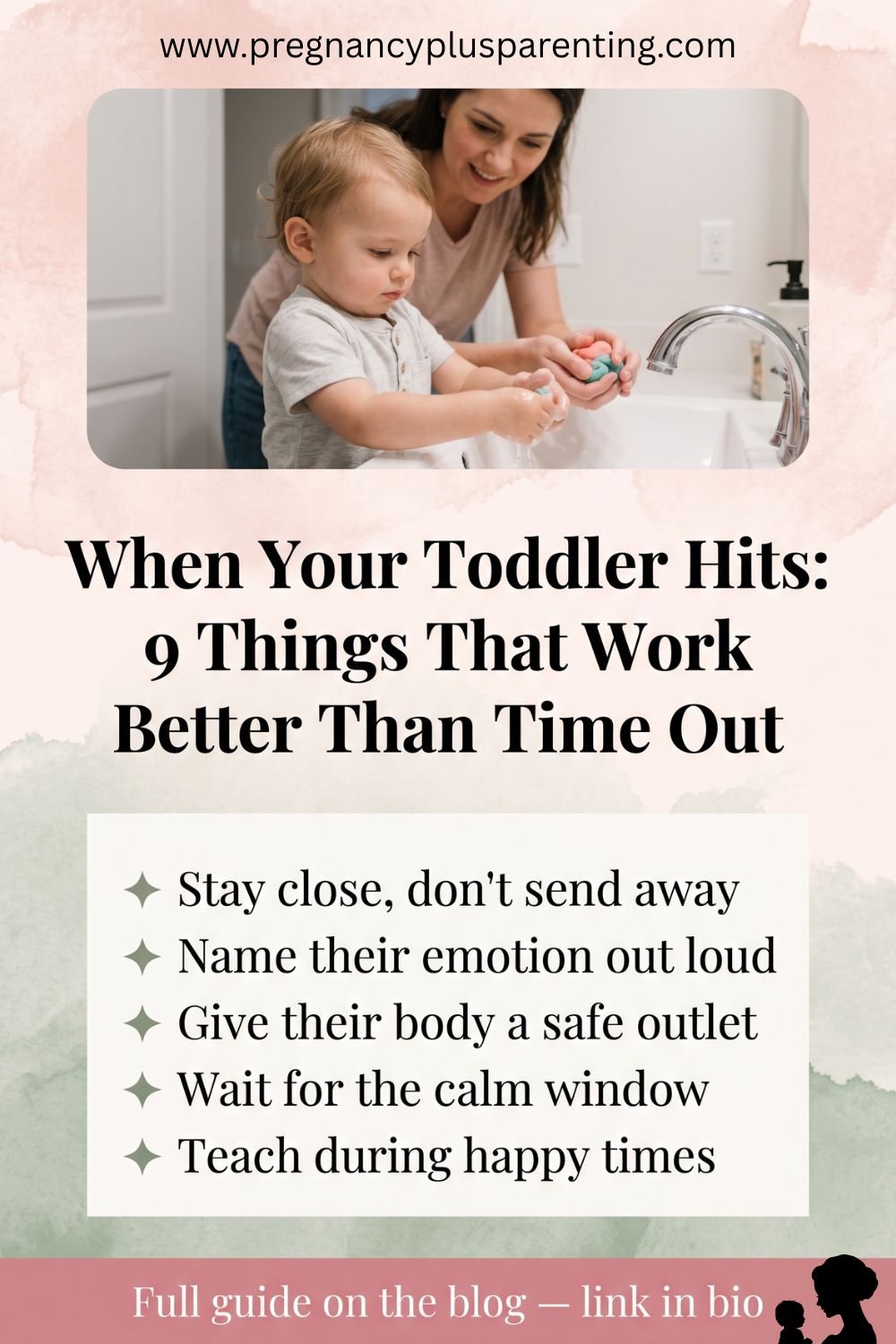
For children who are sensory-sensitive (and many are, even without a formal diagnosis), engaging a different sense during a meltdown can interrupt the spiral. Water is a particularly powerful regulator — hand washing, a drink of cold water, playing at the sink. Other options include something crunchy to eat, a heavy blanket, or deep pressure — a firm hug if they want it, or pressing their hands flat on the floor.
Our occupational therapist explained that these sensory inputs work because they engage the proprioceptive and vestibular systems, which have a direct calming effect on the nervous system. “Heavy work” — carrying, pushing, climbing — is especially effective for dysregulated kids. I’ve started keeping a small sensory basket downstairs for exactly these moments.
7. The “Feelings Check-In” — Build Emotional Vocabulary During Calm Times
This one is preventative as much as responsive. The more you talk about emotions during calm times — reading picture books about feelings, doing feelings check-ins at dinner, labeling your own emotions out loud (“Mama is feeling a little frustrated right now because I spilled my coffee”) — the more vocabulary and awareness your child builds over time.
Children who can say “I’m so angry!” are less likely to demonstrate it with their fists. The words become the outlet. But this capacity takes time and consistent practice to build — it’s a long game, not a quick fix.
8. Natural Consequences — When the Moment Has Passed
Once your child is calm, regulated, and connected with you again — and this is key, only then — you can gently address what happened and introduce a natural or logical consequence. “You hit me when you were upset. That hurt. Hitting hurts people. Next time your body wants to hit, let’s try hitting the pillow instead.”
You can also introduce a logical consequence: “Because you hit me and it scared me, I’m going to need some space for a few minutes now.” This is different from a time out in the heat of the moment — it’s a calm, matter-of-fact, non-punitive consequence that makes relational sense.
9. Role Play “What to Do Instead” — During Happy Times
One of the most powerful things I started doing with Mia was practicing alternatives when she was happy and regulated — not as punishment or lecture, but as play. We’d use stuffed animals to act out scenarios: “Oh no, teddy bear is really angry! What can teddy do instead of hitting?” She loved it. And I started noticing the language coming back to us during real moments: “I need to hit the pillow, Mama.”
You are literally wiring new neural pathways through play. It sounds dramatic but it’s true.
The Exact Words to Say (and What to Avoid)
I know that in the heat of the moment, your brain goes completely blank. So here are some actual phrases, organized into what tends to escalate versus what tends to help:
Try to avoid
“Stop it right now!”
“That was very naughty.”
“Why did you do that?!”
“If you do that again, you’re going to your room.”
“You’re being so bad.”
“Big kids don’t hit.”
Try instead
“I won’t let you hit me. I’m right here.”
“You’re so upset. I see that.”
“Your body needs to move — let’s stomp our feet.”
“I’m staying with you while you feel this.”
“Hands are not for hitting. Here’s the pillow.”
“When you’re ready, I’m here for a hug.”
The language you use shapes not just the moment, but your child’s long-term inner narrative about themselves and their emotions. “You’re being bad” teaches a child they are bad. “You’re having big feelings and your body doesn’t know what to do with them yet” teaches a child that emotions are manageable and they have the capacity to learn.
Prevention: How to Reduce Hitting Before It Starts
Responding well in the moment is crucial. But reducing how often we get there in the first place is just as important — for your child and for your sanity. Here are the preventative practices that made the biggest difference for us:
Protect sleep above almost everything else. A well-rested toddler has a dramatically higher emotional threshold than a tired one. We guarded Mia’s nap schedule like it was sacred, because when that nap went, so did her ability to cope with literally anything.
Feed before you go. Never leave the house before naptime, after too much activity, or when your toddler is hungry. Hunger plus transition plus stimulation is a recipe for meltdowns. I started keeping snacks in every bag, coat pocket, and car door pocket.
Give transition warnings. “In five minutes we’re going to leave the park” — said genuinely, not as an empty threat — gives toddlers time to mentally prepare for a change. Abrupt transitions are one of the biggest tantrum triggers I know of.
Schedule one-on-one connection time daily. Even just 15–20 minutes of undivided, child-led play per day reduces attention-seeking behavior (including hitting for reaction) significantly. I started calling it “Mia’s special time” and protecting it fiercely.
Notice and name your child’s emotions proactively. Throughout the day, not just during meltdowns, practice saying “You seem really excited right now!” or “That looks frustrating.” You’re building the emotional literacy muscle that makes regulation easier over time.
Look after your own nervous system. I know — easier said than done. But I cannot overstate how much my own stress level affects Mia’s behavior. When I’m regulated, she’s easier to regulate. When I’m depleted and triggered, everything escalates faster. Protecting your own wellbeing is not selfish — it is parenting strategy.
Reduce screen time, especially before transitions. This was a hard one for me. But I noticed a clear pattern: heavy screen time followed by abrupt screen removal was one of our most reliable tantrum triggers. We shifted to screens only at the most protected, low-stakes times of day.
See Also That Will Help You : My Toddler Cries Over Everything Is This Normal or Should I Be Worried?
When Hitting May Need Professional Support
I want to speak to this directly, because I think it gets glossed over in most articles and it shouldn’t. The vast majority of toddler hitting is developmental and will improve significantly with consistent, connected approaches like the ones I’ve described. But there are situations where hitting is more intense, more frequent, or accompanied by other behaviors that warrant a conversation with your pediatrician or a child development specialist.
Please consider reaching out for professional support if:
→ The hitting is injuring people or themselves
Occasional hitting with a toddler’s little fist is one thing. If your child is causing real physical injury to you, siblings, peers, or to themselves — head-banging, self-hitting — that warrants professional evaluation.
→ Tantrums are very long and very intense, consistently
Tantrums that regularly last more than 30–40 minutes, happen multiple times per day every day, and don’t respond to any of the above strategies may indicate sensory processing differences, anxiety, or other needs that benefit from evaluation.
→ Your child seems unable to connect or make eye contact
If hitting is accompanied by significant social or communication differences — limited eye contact, language delays, difficulty with joint attention — discuss this with your pediatrician promptly. Early intervention makes a real difference.
→ You are struggling significantly
This one is for you, not just your child. If you find yourself feeling out of control in your responses to your toddler — if you’re yelling more than you want to, if you’re feeling depressed or overwhelmed — please reach out to your own doctor or a counselor. Parenting is hard. Getting support is wise, not weak.
FAQ from Real Moms
These are the questions I see asked most often in the parenting groups I’m part of, and I want to answer them honestly.
No — and this is the fear that keeps a lot of parents stuck. You’re not ignoring the behavior or “letting them get away with it.” You’re addressing it at the moment when their brain can actually receive the lesson: after they’re regulated. Consistently responding with calm, firm boundaries (“I won’t let you hit me”) while also supporting regulation and following up with teaching afterward is actually far more effective at reducing hitting long-term than in-the-moment punishment.
Honestly? It varies. Some families see shifts within a few weeks of consistent implementation. For others it takes two to three months, especially with children who are more sensitive by temperament or who have been in a pattern of escalating responses for a while. Consistency is absolutely key — the approaches above only work if they’re practiced over and over, because you’re literally building new brain pathways. Trust the process, even when it’s slow.
This is so common and it genuinely matters. Share some of the research with your partner — not as a lecture, but as a “I found this really interesting, can we talk about it?” conversation. Focus on what you both want: less hitting, a calmer household, a child who can handle emotions. And remember that no child needs their parents to be identical. Some inconsistency between adults is manageable. What matters most is that each adult is responding with calm and connection rather than escalation and shame.
You are not ruining anything. This is so important: the goal is not perfection. The goal is repair. When you lose your cool — and you will, we all do — what matters enormously is what comes after. Going back to your child, naming what happened (“Mama lost her temper and I yelled. That wasn’t okay. I’m sorry.”), and reconnecting models something incredibly valuable: that relationships can be repaired, that mistakes can be owned, and that everyone has big feelings sometimes — even grown-ups.
You are the parent. You get to make the choices. That said, I’ve found it helps to lead with outcomes rather than philosophy: “I’ve been trying this approach for the past month and the hitting is actually decreasing” is harder to argue with than “well, the research says…” You don’t owe anyone a debate about your parenting. And honestly? Most grandparents just want peace and a happy grandchild. Show them the results.
See Also That Will Help You : Why Won’t My 2 Year Old Eat Anything But Crackers? (And How to Gently Expand Their Diet)
You Are Not Failing — A Final Word
Mama, if you are deep in it right now — if today had hitting and tears and a moment where you locked yourself in the bathroom for three minutes just to breathe — I want you to hear this:
The fact that you are reading this, searching for better answers, trying to understand your child rather than just control them — that is extraordinary parenting. That is love in action.
Toddlerhood is genuinely hard. It is neurologically intense, emotionally demanding, and often deeply lonely. Your child hitting you is not a report card on your worth as a mother. It is a developmental stage that will pass — and with your calm, connected presence, it will pass more quickly and leave your child with stronger emotional tools than they’d have had otherwise.
I’m rooting for you. I really am.
A Few Resources That Helped Me
If you want to go deeper on any of this, here are the books and people that shaped my thinking most:
The Whole-Brain Child by Dr. Daniel Siegel & Dr. Tina Payne Bryson — accessible, practical, and genuinely life-changing for understanding toddler brains.
No Drama Discipline, also by Siegel & Bryson — specifically addresses behavioral challenges like hitting with practical, connected strategies.
Raising Good Humans by Hunter Clarke-Fields — brilliant on managing your own nervous system so you can show up for your child’s.
Janet Lansbury’s Unruffled podcast — free, practical, and deeply calming to listen to, especially when you’re in the thick of a difficult phase.
And most of all: find your village. Whether it’s an online parenting community, a local mom group, or even one friend who gets it — this is not meant to be done alone.
You cannot pour from an empty cup. Asking for help, finding support, and taking care of your own mental health is not a luxury — it is the foundation of everything else. You matter too.